
















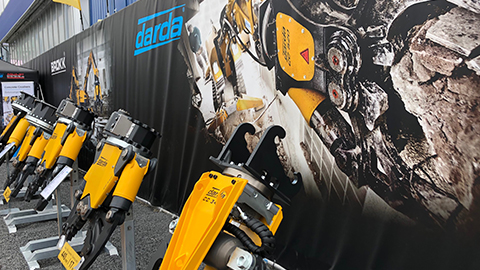





Deep foundation transfers structures into great soil depths when near-surface ground does not provide sufficient load-bearing capacity or deformation resistance. It is used for bridges, high-rise buildings, wind turbines, port facilities, as well as in refurbishment and in special foundation engineering within existing structures. Precise workflows and suitable tools are crucial for planning, construction, repair, and deconstruction. Especially in selective removal and work in existing structures, Darda GmbH concrete crushers and rock and concrete splitters play an important role because they can operate in a low-vibration, material-selective, and controlled manner.
Definition: What is meant by deep foundation
A deep foundation (also deep founding) refers to foundation types that transfer structural loads into greater soil depths via piles, diaphragm walls, caissons, or similar load-bearing elements. Unlike shallow foundation, which transfers loads close to the surface, deep foundation mobilizes tip resistance (end bearing in a competent horizon) and/or shaft friction (shear resistance along the shaft). It is used when soft soil layers, high settlement sensitivity, groundwater conditions, frost and erosion risks, or dynamic actions preclude a shallow foundation.
Types and systems of deep foundation
Deep foundation is differentiated by construction method, material, and load transfer. Common systems are:
- Bored piles (cast-in-place piles with or without casing, optionally with reinforcement cage)
- Driven piles (displacement or precast piles)
- Micropiles (small diameter, high capacity, injected; suitable in existing structures)
- Diaphragm walls (load-bearing, sealing walls; as wall foundation or excavation support)
- Caissons and well foundations (lowered under self-weight or compressed air)
- Special hybrid solutions (e.g., piled-raft foundations, piles combined with ground improvement)
Pile action: shaft friction and end bearing
Load transfer occurs as a friction pile via shaft resistance, as an end-bearing pile in competent layers (rock, densely packed sands), or in combination. The subsoil governs sizing, pile length and diameter, reinforcement, and the execution of the pile head.
Materials
Common materials are reinforced concrete, steel (e.g., steel pipe piles), and more rarely timber (for temporary foundations). For cast-in-place piles, concreting quality and the formation of the pile head are particularly decisive for ultimate and serviceability performance.
Planning, design, and subsoil
Design is based on geotechnical investigations, soil-mechanical parameters, and limit states (ultimate, serviceability). System selection follows the interplay of structural loads, ground profile, groundwater, construction logistics, and environmental influences. Standards and regulatory requirements must be observed; the design is performed by qualified specialist engineers and does not replace case-by-case verification.
Verification and reserves
Design reserves arise from partial safety concepts, trial load tests, and execution tolerances. Load redistribution among piles in a group is considered in group design. Negative shaft friction due to settlements of soft layers must be accounted for separately.
Construction and site workflow
Execution requires a coordinated method considering groundwater, adjacent development, vibration, and noise. Typical steps for bored piles:
- Site setup, surveying, and axis staking
- Drilling with or without casing, if necessary with supporting fluid
- Cleaning the borehole (base protection, sediment control)
- Installing the reinforcement cage
- Concreting (continuous, low segregation)
- Pile-head formation and exposure
Micropiles in existing structures
Micropiles are constructed with smaller equipment and are suitable for tight access, underpinning, and supplementary foundations. Injection improves bond performance. During subsequent selective deconstruction, concrete crushers and Multi Cutters are helpful to open head areas in a controlled manner and to separate reinforcement.
Diaphragm walls and caissons
Diaphragm walls serve as foundations or as excavation support. Caissons are sunk under self-weight. Interfaces with demolition and deconstruction arise when trimming capping beams, connecting to slabs, and decoupling temporary construction stages.
Interfaces to concrete demolition and specialized deconstruction
Deep foundation work often entails tasks requiring precise cutting, exposure, or removal. These include pile-head removal, trimming diaphragm-wall heads, removal of defective concrete, selective deconstruction of foundation elements in existing structures, and rehabilitation of corroded head zones.
Selective pile-head removal
The pile head connects the pile and the bearing element (e.g., pile cap). During removal, the load-bearing zone should be opened in a controlled manner without unnecessarily damaging reinforcement. Darda GmbH concrete crushers enable precise breakout of concrete with good visibility of cracks and reinforcement. Stone and concrete splitters and stone splitting cylinders are used to induce targeted tensile cracks and to release components with low vibration—a benefit in sensitive environments, such as near existing foundations or during ongoing operations.
Cutting and sorting embedded components
Steel, reinforcement, anchors, ducts, or sheet-pile elements are present in head zones and connection parts. Darda GmbH steel shears and Multi Cutters cut reinforcement cages, strand anchors, and steel sections. Combination shears help at transitions from concrete with embedded steel. Where thick-walled pipes or casing pipes must be cut, tank cutters can be used for defined cuts. Darda GmbH hydraulic power units supply the tools; their compact design favors use in tight excavations.
Particularities in rock excavation and tunneling
For pile foundations with rock bearing or for rock anchors in portal zones, hard and brittle rocks occur. For base adjustments, enlargements, releasing rock noses, and exposing rock sockets, stone and concrete splitters and stone splitting cylinders from Darda GmbH are suitable. The controlled, low-frequency splitting action limits vibration and protects neighboring structures and geotechnical instruments. Experience from natural stone extraction can be transferred to selective rock release in tunneling and special foundation engineering.
Strip-out and cutting in existing structures
In vertical extensions, underpinning, or replacement of foundations, existing components must be opened. Concrete crushers allow freehand removal of foundation corbels, creation of predetermined breaking sections, or shaping visible edges. In confined basements and shafts, lightweight attachments with power units are advantageous. Multi Cutters and steel shears support cutting steel sections, anchor plates, or temporary bracing.
Avoiding secondary damage
Selective work minimizes damage transmitted to adjacent components. This is particularly important in strip-out and when connecting new elements to existing deep foundation, for example with subsequent pile groups or underpinning.
Occupational safety, environment, and emissions
Work on deep foundation is subject to increased requirements concerning safety, emissions, and water protection. Processes should be selected to limit noise, dust, and vibration. Splitting methods and the pincer principle support this goal because they avoid extensive impact tools. Legal requirements and official stipulations must be checked project-specifically; these notes are general and non-binding.
- Plan dust and dirty-water handling (collecting, filtering, proper disposal)
- Vibration monitoring in sensitive environments
- Safe access into shafts and excavations; rescue routes and communication
- Provide lifting gear and attachment points for equipment
- Locate hazards from embedded prestressing steel, utilities, and services
Quality assurance and testing
To ensure execution quality, pile load tests, integrity tests, drilling logs, concreting reports, and injection records are used. During deconstruction, component documentation and joint-planning are important to place cuts and split points deliberately. Clear separation of material fractions facilitates disposal and recycling.
Pile-head construction and rehabilitation
After concreting, pile heads are usually reduced and checked for cleanliness and freedom from cracks. For rehabilitation of corroded head zones, concrete crushers are helpful to remove concrete in a defined way, expose reinforcement, clean it, and subsequently reprofile with suitable systems.
Typical damage patterns and repair
Frequent findings include insufficient concrete quality in the head area, honeycombing, corrosion of exposed reinforcement, negative shaft friction due to settlements, or uneven load distribution in pile groups. Rehabilitation strategies range from partial replacement of the head zone through supplementary piles to strengthening by cap beams. Darda GmbH concrete crushers, stone and concrete splitters, and steel shears support gentle removal, exposure, and trimming of embedded parts.
Practical tips for construction logistics
Work on deep foundation often takes place in shafts, excavations, and under restricted access. Short setup times, modular power units, and hand-held or compact attachments ease the workflow. A coordinated disposal concept for concrete debris, reinforcing steel, and any legacy materials encountered prevents delays. For rock contact, timely provision of stone splitting cylinders and matching wedges is recommended.
Application areas at a glance
The connection of deep foundation with demolition and cutting tasks is broad:
- Concrete demolition and specialized deconstruction: pile-head removal, trimming diaphragm-wall heads, selective deconstruction of foundation bodies
- Strip-out and cutting: openings, underpinning, connecting new components to existing foundations
- Rock excavation and tunneling: rock release at foundation bases, rock sockets, portal zones
- Natural stone extraction: transferred splitting techniques for controlled rock release in the foundation area
- Special operations: work under ongoing operations, in sensitive areas, and with limited accessibility