












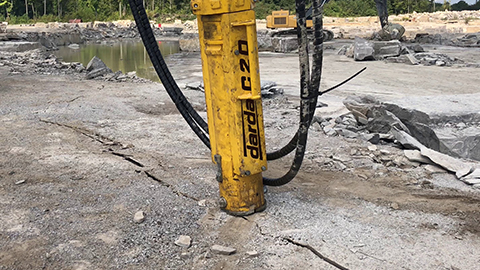



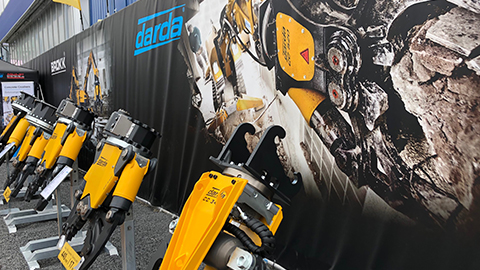





Safety measures are the foundation for a controlled, low-disruption, and safe process in demolition works, deconstruction, natural stone extraction, and in rock excavation as well as tunnel construction. Wherever components are separated, concrete is crushed, or rock is split, load paths change, new edges arise, and energy can be released suddenly. This applies in particular to work with concrete pulverizers as well as with hydraulic rock and concrete splitters from Darda GmbH. The aim of every safety measure is to protect people, infrastructure, and the environment, to detach components in a defined sequence, and to keep the process predictable.
Definition: What is meant by a safety measure
A safety measure comprises all technical, organizational, and personal precautions that avoid or minimize hazards in demolition works, in cutting and splitting operations, and in extraction and tunnel construction. These include, among other things, static pre-holds and shoring, the set-up of exclusion and hazard zones, load pick-up with suitable lifting clamp/tongs, pressure relief of hydraulic systems, dust protection and noise control, the control of vibrations, and the instruction of the parties involved. In connection with hydraulic separation/cutting technology — such as concrete pulverizers, combination shears, Multi Cutters, steel shears, or rock wedge splitters and concrete splitters from Darda GmbH — safety measures are designed to enable controlled breakage and cutting operations and to prevent uncontrolled movements.
Fundamentals of effective safety measures on the construction site
Effective safeguarding follows a clear hierarchy: first technical solutions (e.g., shoring, catch devices, protective screens), then organizational measures (e.g., exclusion zones, procedures, communication routes), and additionally personal protective equipment. Key principles include early identification of changing load paths, reducing stored energies before releasing components, guiding material removal in a defined manner, and consistent monitoring. Depending on the working method — such as selective deconstruction with concrete pulverizers or controlled splitting with rock wedge splitters and concrete splitters — the focus and sequence of measures will differ.
Planning and hazard analysis before demolition and splitting operations
Every safety measure begins with careful planning. Before starting deconstruction, gutting works, rock breakout, or tunnel heading, building data, material composition, and surroundings are analyzed. Relevant points include component dimensions, reinforcement, any prestressing, bond to adjacent structural elements, utilities and installations, as well as access for lifting equipment.
- Check structural stability: load paths, intermediate states, permissible removal steps.
- Set up the work area: define exclusion and fall zones, establish safe routes and lines of sight.
- Select the method: concrete pulverizer, splitter, tank cutter, or steel shear depending on objective, constraints, and environmental sensitivity.
- Communication and authorizations: clear responsibilities, release/authorization before each separation cut or splitting operation.
Component securing when working with concrete pulverizers
With concrete pulverizers from Darda GmbH, material removal occurs through crushing and fracture. Safeguarding focuses on the controlled release of component edges, holding sections, and avoiding uncontrolled falling movements. Slabs, beams, or wall panels are gripped, shored, or picked up with lifting gear before biting.
Load pick-up and lifting points
For detaching larger elements, suitable lifting points are created. The crane, spreader beams, and textile- or chain-based lifting clamp/tongs take up the self-weight and dynamic additional loads that occur through the action of the pulverizer. Edges must receive edge protection, slinging angles are to be kept shallow, and the load-bearing capacity of the lifting means must be matched to intermediate states. Lifting takes place only when the separation progress permits it safely.
Shoring, underpinning, and segmentation
Walls, slab edges, and columns are underpinned with steel shoring posts, wood or steel yoke beam girder and wedges. Segmental material removal limits component lengths and weights. This keeps load paths traceable, and neighboring components retain temporary stability. Bearings and the load-bearing capacity of the subsoil beneath the posts must be checked in advance.
Safety measures when using rock wedge splitters and concrete splitters
Rock and concrete splitters as well as rock splitting cylinders from Darda GmbH produce targeted crack formation with very low vibration levels. Safeguarding focuses on the control of crack propagation, fragment protection, and holding detached blocks or component segments. Drilling pattern, splitting direction, and the sequence of wedge settings are selected so that the desired separation joint is created and no unintended spalling occurs.
- Crack monitoring: visual inspection of progress, markings at critical edges.
- Fragment protection: shielding with panels, tarps, or timber planks in adjacent areas.
- Component retention: timely installation of auxiliary anchor(s), support trestles, or lifting clamp/tongs before separation progress leads to release.
- Avoid drift: always align wedges in the planned direction, execute boreholes perpendicular and at consistent depth.
Hydraulic safety: power packs, hose lines, and cylinders
Hydraulic power units from Darda GmbH supply pulverizers, shears, split cylinders, and tank cutters with pressure. High pressure involves risks. Hydraulic hose lines must be protected against constriction, kinking, abrasion, and crushing; quick couplings are connected cleanly and positively. Work areas are arranged so that no one is endangered in the event of a hose failure.
Energy management and pressure relief
Before maintenance, changeover, or transport, systems are depressurized. Residual energy in cylinders can move components; therefore, pressure relief is carried out in a defined sequence. Leaks must be eliminated immediately, spilled oil is absorbed and disposed of. Emergency stop and operator stations remain accessible at all times and free of tripping hazards.
Dust, noise, vibrations, and media
In concrete demolition, gutting works, and rock excavation, emissions must be limited. Hydraulic methods from Darda GmbH support low-vibration work; nevertheless, accompanying measures are required.
- Dust suppression: targeted water spray at the pulverizer or at the split joint, mist nozzles in the hazard area (water spray system).
- Noise reduction measures: plan work windows, use sound-damping screens, increase distance to sensitive areas.
- Vibration control: ground vibration monitoring on sensitive structural elements, adjust the sequence of steps.
- Media management: safe drainage of water, provide drip trays and absorbents for hydraulic oil.
Safe cutting of steel and tanks
Steel shears, combination shears, Multi Cutters, and tank cutters from Darda GmbH are used in the deconstruction of steel structures and in special operations on tanks. Steel sections often store energy (bending, torsion). For the final cut, parts must be secured against spring-back, for example by temporary connections, lifting clamp/tongs, or props. When working on tanks and pipelines, emptying, cleaning, gas-free measurements, and avoidance of ignition sources are paramount. The work area is secured over a wide area, the surroundings are checked for vapors and media, and cutting only takes place after release.
Safety measures in rock breakout and tunnel construction
In rock breakout and tunnel construction, the use of rock wedge splitters and concrete splitters from Darda GmbH leads to controlled crack formation with low environmental impact. Central safeguards include removing loose blocks, setting up protective canopies or safety net(s), and consistent zoning of work and waiting areas. In tunnels, ventilation, water management (tunnel drainage), and a clear escape route organization are added.
Hazard zone management
Visible markings, barriers, spotters with radios, and defined hand signals improve oversight. Machine routes are planned without crossings, and personnel maintain a minimum safety distance from pulverizers, splitting wedges, and shears. Work is carried out only within released areas.
Work organization, instruction, and personal protective equipment
Safe workflows stand and fall with qualification and communication. Roles are clearly assigned (operating the equipment, slinging, supervising, releasing). Instructions cover in particular the specifics of concrete pulverizers, splitters, hydraulic power packs, and shears.
- Pre-job check: equipment inspection, function test, visual inspection of hydraulic hose lines, PPE, rescue equipment.
- Execution: follow work instructions, maintain the sequence of steps, keep escape routes clear, use signals.
- Completion: pressure relief, securing of released parts, clean-up, documentation, and handover.
Documentation, monitoring, and release
Checklists, photo documentation, measurements (e.g., vibration, dust), and acceptances ensure traceability. Changes in the process are documented and released before work continues. Only after checking the condition — posts, lifting gear, hose routing, closures — is the area released again.
Typical sources of error and their avoidance
- Insufficient pre-support: missing shoring before biting with the concrete pulverizer or before the final splitting stroke.
- Faulty load pick-up: incorrect slinging angles, unprotected edges, undersized lifting clamp/tongs.
- Unplanned crack paths: unsuitable drilling pattern during splitting, missing fragment protection at exposed edges.
- Hydraulic risks: pressure not released, damaged hydraulic hose lines, unsecured quick couplings.
- Insufficient communication: missing release, people in the hazard area, unclear signals.
Practical example: ceiling demolition in an existing building
For a reinforced concrete slab, the area beneath the slab is first cleared and cordoned off. Shoring posts secure adjacent structural elements. Lifting clamp/tongs are set, and the slab is divided into transportable segments. With the concrete pulverizer from Darda GmbH, the edge area is removed in a controlled manner, and reinforcement is gradually exposed. Before each separation cut, the load is taken up, then the reinforcement is separated with a steel shear. In areas of sensitive use, a splitter is additionally employed to minimize vibrations and to create defined crack joints. Dust is bound with water, and the hydraulic power pack is positioned outside the exclusion zone. After releasing a segment, it is set down on a prepared laydown area, followed by pressure relief of the hydraulic system and documentation of construction progress.