





















The post-and-beam system describes a facade construction method in which vertical posts and horizontal beams form a load-bearing grid for glazing or panels. This type of construction is common in new builds as well as refurbishment and allows large-area, transparent building envelopes. In the context of deconstruction, strip-out, and special demolition, the post-and-beam system facade plays an important role, because fixings are often anchored to concrete components such as parapets, edge beams, or floor slabs. This creates interfaces with concrete demolition methods and with tools such as concrete pulverizers or hydraulic rock and concrete splitters that enable low-vibration separation in existing structures.
Definition: What is meant by post-and-beam system
The term post-and-beam system refers to the post-and-beam construction of a facade, in which a slender bar framework takes up loads from self-weight, wind, and, where applicable, service loads, and transfers them into the primary structure. The posts (vertical members) are the primary load-bearing elements; the beams (horizontal members) connect the posts and support glazing or opaque panels. Typical materials are aluminum, steel, or timber, often with thermally broken profiles and integrated sealing and drainage layers. Unlike unitized facades, post-and-beam system facades are usually assembled piece by piece on site. Fastening is generally via brackets to concrete or steel components, which makes the interface to the shell structure particularly relevant.
Configuration, fastening, and structural action
The post-and-beam system facade is designed as a curtain wall: it does not carry floor loads but does transfer wind and self-weight loads into the building. The build-up follows a clear layered concept of load-bearing structure, seals, thermal break, and cladding.
Posts, beams, and connections
Posts are anchored to the edge of the structural shell at regular spacing. Beams are connected via positive-locking nodes or plug-in systems. Connections account for length changes, tolerances, and building movements. Loads are usually transferred floor by floor via brackets into concrete parapets or perimeter edge beams.
Glazing and panels
Glazing (e.g., insulating or triple glazing) and opaque fields are supported linearly. Pressure plates, cover caps, and sealing profiles secure the components. Depending on joint design, structurally bonded solutions are also possible, but they remain true to the post-and-beam system principle in terms of construction.
Sealing and drainage
Multi-stage sealing layers and drainage channels carry moisture to the outside. The thermal break minimizes thermal bridges at posts and beams. Interface details to the structural shell must be airtight, watertight against driving rain, and designed to reduce thermal bridging.
Typical applications and boundary conditions
Post-and-beam system facades are found in office and administrative buildings, educational and cultural buildings, high-rises, and hall and industrial construction. Requirements arise from wind loads, fire protection, sound insulation, and energy efficiency. In refurbishment, modular or partial replacement solutions are common, in which individual beams or fields are replaced without renewing the entire facade.
Interfaces with concrete, masonry, and steel structures
The posts are often fastened to concrete parapets, steel beams, or masonry bands. Brackets, anchor plates, and anchors are the functional interfaces between the facade and the structural shell. When changing the facade grid, during deconstruction, or during strip-out, these connections must be released and the bearing areas adjusted or removed entirely. On concrete components, a low-vibration and controlled material removal is often the best approach to avoid damage to the remaining structure.
Deconstruction and strip-out of post-and-beam system facades
The deconstruction of post-and-beam system facades requires a clear sequence of work, coordinated safety measures, and suitable cutting and demolition techniques. The goal is a safe, low-noise, and low-vibration approach that protects adjacent components, enables reuse, and cleanly separates material streams.
Sequence in deconstruction
- Set up safeguards and workplaces: fall protection, glass catch systems, paths of travel, laydown areas.
- Unload and release: remove pressure plates, cover caps, and sealing profiles; remove glazing and panels in a controlled manner.
- Dismantle the beams: release connectors, remove beams sequentially and secure them.
- Dismantle the posts: check suspension and temporary shoring, lift posts off the brackets.
- Release the brackets and anchors: undo bolted connections, remove or cut fixings flush at the structural shell.
- Treat the shell edge: make breakouts, remaining anchors, and anchor zones flush; perform controlled concrete removal if required.
Tools and methods in the context of Darda GmbH
Depending on the material and boundary conditions, different methods can be used for dismantling. In the area of concrete demolition and special demolition, hydraulic, low-vibration techniques have proven effective:
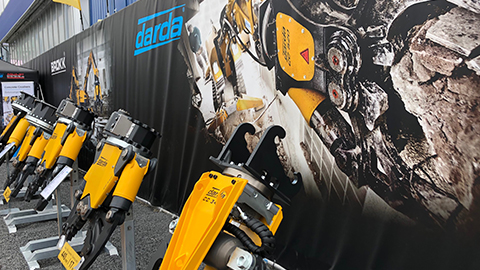
- Concrete pulverizers: Local breaking out of concrete edges at parapets or slab edges, exposing brackets and anchor plates, reducing cross-sections prior to cutting. Suitable for selective removal in existing structures.
- Stone and concrete splitters as well as rock wedge splitters: Create controlled split joints in concrete, e.g., to release anchor zones or edge strips with low vibration. Particularly useful in sensitive areas and in special demolition.
- Combination shears, steel shears, and Multi Cutters: Cut aluminum and steel profiles of the posts and beams, cut off anchors, tie members, and bracket components.
- hydraulic power units: Power supply for hydraulic tools with high power-to-weight ratio, including in confined strip-out situations and during facade deconstruction.
The choice of method depends on the type of facade, material thicknesses, accessibility, requirements for noise and vibration, and the desired degree of reuse of the components removed.
Special challenges in special demolition
In inner-city projects, on high-rise facades, or while the building remains in use, emissions, work windows, and logistics are decisive. Post-and-beam system fields are often large-format, so the load-bearing capacity of temporary suspensions and transport routes must be carefully planned. For historic facades or sensitive connections, a step-by-step approach with small-scale separation work is advantageous.
Low-vibration working
Heightened requirements for limiting vibrations favor splitting methods and targeted size reduction. Stone and concrete splitters minimize vibration input into adjacent components. In combination with concrete pulverizers, edge areas can be reworked precisely without overloading the structure.
Cutting anchors and dowels
Depending on the anchorage, anchors are cut flush or removed completely from the concrete. Steel shears and combination shears enable cutting of the metallic connections; for deeper anchor zones, localized splitting of the concrete can support non-destructive removal.
Installation, repair, and replacement of individual beams
In existing buildings, individual beams, sealing profiles, or glazing are frequently replaced. Tolerances, settlements, and movement joints must be taken into account. Before a partial opening, it must be checked whether beams perform functions as horizontal bracing. Temporary safeguards prevent load redistribution.
Quality assurance and documentation
Dimensional checks, functional tests of fittings, visual inspections of sealing layers, and documented drainage tests ensure serviceability. For deconstruction work, evidence of material streams, sorting concepts, and proof of proper disposal or recycling of glass, aluminum, steel, and sealing compounds are advisable.
Occupational safety, logistics, and environmental protection
Work on post-and-beam system facades requires consistent fall protection, glass breakage protection, and clear separation of work areas. When using hydraulic tools, hose routing, pressure testing, and a stable setup of the hydraulic power packs are essential. Noise and dust reduction as well as the use of low-vibration methods protect building users and the surroundings. Legal requirements on occupational safety, waste management, and hazardous substances must be observed; project-specific requirements should be coordinated in advance with the responsible authorities.
Planning and costing: method selection for deconstruction and strip-out
Method selection is based on component thicknesses, anchorage type, accessibility, schedule requirements, and emission limits. A combined approach of selective cutting of the profiles and localized concrete removal at anchor zones has proven effective. Concrete pulverizers and stone and concrete splitters help produce flush shell edges and form the basis for subsequent interior or facade works.
Terminology and practice
In practice, post-and-beam system facades are also referred to as stick facades. They differ from prefabricated unitized facades by the on-site installation of the individual members and fields. For planning, installation, repair, and deconstruction alike, the interfaces to the structural shell and the choice of suitable cutting and demolition tools determine construction time, quality, and emissions. The product solutions of Darda GmbH cover, in particular, tasks in concrete demolition and special demolition, strip-out and cutting, and special applications, without changing the constructive character of the post-and-beam system.