
















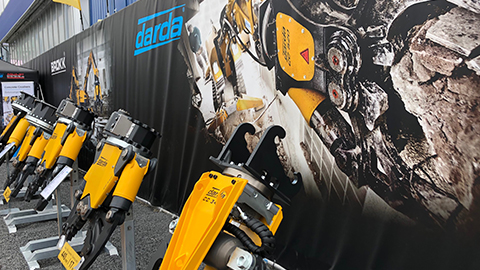





Cast-in-place concrete is the widely used construction method in which concrete is placed directly on the construction site into formwork and cured there to the desired shape. The method enables monolithic, joint-minimized load-bearing structures with high adaptability to geometry, subsoil, and construction sequence. Throughout the life cycle—from planning and execution to later deconstruction—there are close interactions with work processes of concrete demolition. Particularly in selective deconstruction, strip-out, or subsequent openings, hydraulic tools such as concrete demolition shears as well as hydraulic rock and concrete splitters play a central role, because they can intervene with low vibration, in a controlled way, and with minimal structural damage.
Definition: What is meant by cast-in-place concrete
Cast-in-place concrete (also in-situ concrete) is concrete that is produced at the place of installation, placed into formwork, compacted, and then hardened there to its final strength. In contrast to precast elements, load-bearing members—such as foundations, walls, columns, slabs, or tunnel linings—are created directly on the construction site. The material develops its properties through the hydration of cement depending on water content, temperature, and curing. The resulting performance values (e.g., compressive strength, modulus of elasticity, durability) are shaped by the composition, execution, and the actions during hardening.
Producing cast-in-place concrete: formwork, reinforcement, placing, and curing
Execution begins with the formwork as a shape-giving, sealing support structure. After placing the reinforcement, fresh concrete is delivered or mixed on site, placed, and compacted with internal or external vibrators to minimize entrapped air. Consistent curing (e.g., keeping moist, covering, temperature control) steers setting behavior, limits early shrinkage cracking, and ensures uniform strength development. Decisive factors include careful work preparation, defined placement rates, controlled concrete temperatures, and compaction matched to the member.
Material properties and mix design
The performance of cast-in-place concrete is controlled via the mix design and the fresh and hardened concrete properties. The goal is a balanced relationship of workability, strength, and durability—adapted to member thickness, reinforcement ratio, and environmental conditions.
Water–cement ratio and consistency
An appropriate water–cement ratio governs tightness and strength. Consistency (e.g., plastic to soft) is matched to placement method, pump distances, and reinforcement density to avoid voids.
Admixtures and additions
Plasticizers, retarders, or accelerators support placement and hydration; additions such as fly ash or stone powder can influence pore structure and workability. Compatibility, dosage, and the documented effect in interaction with cement and aggregates are critical.
Formwork, surfaces, and exposed concrete
Formwork systems determine geometry, dimensional accuracy, and surface appearance. Tightness and uniform absorbency of the form-facing are essential to limit bleeding and color variations. For exposed concrete, increased demands apply to joint patterns, tie arrangement, concrete mix, and uniform compaction.
Reusability and sequencing
Repeated formwork use requires careful cleaning and application of release agents. Pours, concreting sections, and construction joints are planned to minimize restraint stresses and cracking risk.
Execution under weather conditions
Temperature, wind, and solar radiation affect setting and hardening. During hot periods, pre-wetting, reduced pour lengths, and swift curing are advisable; in cold weather, preheating constituents and protection against undercooling are considered. The aim is controlled hydration without shrinkage cracks or frost damage.
Quality assurance on the construction site
Quality results from planning, documented execution, and testing. Typical measures include:
- Fresh concrete tests (consistency, temperature, density)
- Sampling and testing of specimens for strength development
- Visual and dimensional checks on members, including degree of compaction
- Documentation of pour times, delivery batches, and curing
Structural design and detailing in cast-in-place concrete construction
Structural concept and design consider load transfer, crack width limitation, serviceability, and durability. Reinforcement layout, cover, and joint planning must be aligned with exposure conditions and construction stages. Applicable technical rules and recognized standards are to be observed; concrete provisions are made project-specifically within the scope of the responsible design.
Typical applications of cast-in-place concrete
Cast-in-place concrete proves its worth on large areas and complex geometries and wherever monolithic connections and high stiffness are required. Examples:
- Foundations, slab-on-grade foundations, walls, and slabs in building construction
- Bridge components, retaining walls, and abutments
- Water-impermeable members (e.g., basins, basement tanks)
- Tunnel linings and massive infrastructure elements
Deconstruction of cast-in-place concrete: methods, tools, and applications
In concrete demolition and special deconstruction, controlled, low-vibration procedures are required to protect extensions, neighboring buildings, and plant. Depending on the boundary conditions, mechanical, hydraulic, and thermal methods are used. Relevant tools and equipment—often hydraulically driven—include:
- concrete demolition shears for biting and downsizing members in selective deconstruction
- rock wedge splitters and concrete splitters for controlled, crack-guided splitting of members without explosives
- Hydraulic power packs as the energy source for shears, splitters, and cylinders
- Combination shears and Multi Cutters for mixed tasks with concrete and steel
- Steel shears for reinforcing steel, sections, and steel components in composites
- Tank cutters for special operations on steel tanks in the vicinity of concrete structures
Within strip-out and cutting, openings are made, members are removed, and load paths are shifted step by step. Concrete demolition shears enable sectional dismantling with good control over fracture lines and piece sizes. Rock wedge splitters and concrete splitters are suitable when vibration or noise must be minimized, for example in inner-city areas, hospitals, or during ongoing operations.
Interfaces with rock breakout, tunnel construction, and natural stone extraction
Cast-in-place concrete and rock engineering meet in tunnel and support construction, where cast-in-place concrete linings meet rock or shotcrete. For local adjustments, penetrations, or the deconstruction of temporary concrete members, quiet, precise interventions are needed. Rock wedge splitters and concrete splitters as well as stone splitting cylinders can introduce loads with low vibration and predetermine fracture lines. In mixed-material zones—such as reinforcing steel in cast-in-place concrete or embedded items—shear tools support a swift material separation process.
Selective openings, repair, and repurposing of cast-in-place concrete
In existing structures, subsequent breakthroughs, strengthening, or replacement of damaged zones are common. Typical procedures include:
- Structural analysis and securing of temporary load paths
- Marking of intended fracture lines or borehole grids for splitting methods
- Use of concrete demolition shears for controlled, piece-by-piece dismantling
- Targeted splitting with rock wedge splitters and concrete splitters to guide cracks
- Separation of steel components with shear tools
- Source-separated material sorting for recycling
These steps reduce structural vibration and protect adjacent members—especially important for sensitive uses or listed structures.
Occupational safety and environmental aspects
Dust, noise, vibration, and falling components are safety-relevant issues. Measures include dust suppression, shielding, coordinated lifting and load securing, and compliance with applicable regulations. Hydraulically driven tools, supplied by suitable hydraulic power packs, allow work at a distance from the hazard zone. Environmentally, source-separated sorting, the reuse of aggregates, and an efficient construction logistics concept are beneficial.
Sustainability and circularity in cast-in-place concrete construction
Well-considered mixes, adapted member thicknesses, and controlled crack widths promote durability. For deconstruction, the more precisely components are selectively released and separated, the higher the quality of recycled construction materials. Low-vibration methods such as splitting and shear-based demolition support these goals, as they convert members predictably into transportable pieces and allow reinforcement to be separated from concrete.
Practice details: common defects and countermeasures
Typical issues include honeycombs, clouding in exposed concrete, spalling at edges, or restraint-induced cracking. Countermeasures include:
- adjusted consistency and compaction intensity
- uniform sequencing and temperature control
- clean formwork, defined joint and tie layout
- consistent curing, edge protection, and early defect inspection
During deconstruction, vibration and noise emissions can be reduced by rock wedge splitters and concrete splitters; concrete demolition shears limit flying debris by controlled biting instead of percussive methods.
Role of Darda GmbH in the context of cast-in-place concrete
Tools from Darda GmbH are used in numerous phases around cast-in-place concrete—from strip-out and low-vibration deconstruction to special operations in existing structures. The focus is on hydraulic applications that allow precise, controlled, and reproducible work steps. These include concrete demolition shears, rock wedge splitters and concrete splitters, hydraulic power packs, combination shears, multi cutters, steel shears, and tank cutters—each selected according to member thickness, reinforcement ratio, accessibility, and the requirements of the application areas concrete demolition and special demolition, strip-out and cutting, rock breakout and tunnel construction, natural stone extraction, and special operations.