












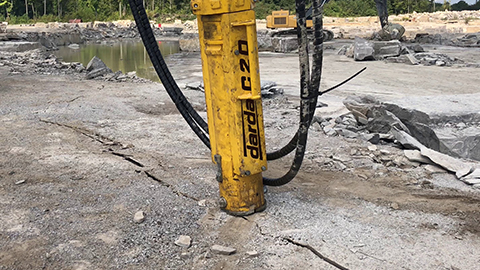



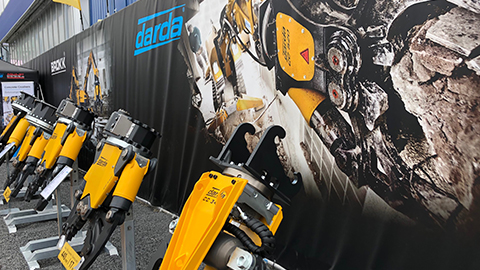





Quantity takeoff is a central tool for implementing construction, deconstruction and special demolition in a plannable, calculable and safe manner. It creates the basis for section planning, equipment deployment, scheduling, construction logistics and billing. In the application areas of concrete demolition and special deconstruction, interior demolition and cutting, rock excavation and tunnel construction, natural stone extraction, as well as special operations, it determines whether the appropriate hydraulic tools—such as concrete pulverizer or rock wedge splitter and concrete splitter—are available at the right time with the right performance. Those who accurately capture volumes, counts, lengths and tonnages can steer cutting and splitting sequences, define component sizes for low-damage separation, and simultaneously reduce noise emission, dust exposure and vibrations.
Definition: What is meant by quantity takeoff
Quantity takeoff is the systematic recording, calculation and documentation of all quantities relevant to planning, execution and billing. This includes cubatures (volumes), areas, lengths, counts and masses (tonnages) of materials, components and construction debris. Quantity takeoff forms the starting point for bills of quantities, schedules and capacity plans, disposal and recycling concepts, and the selection of suitable hydraulic attachment and handheld tool. In the context of demolition works, deconstruction, rock cutting/processing and natural stone processing, it also includes deriving separation and splitting strategies, drilling and cutting patterns, as well as equipment parameters such as splitting force, shear force, hydraulic pressure and hydraulic fluid flow.
Procedure and calculation steps in practice
Practical quantity takeoff follows a clear sequence: first, components, materials and construction states are identified, then described geometrically and converted into measurable units. This is followed by deriving the demolition or separation method, assigning suitable equipment (for example concrete pulverizer for reinforced components or rock wedge splitter and concrete splitter for low-vibration deconstruction), and consolidating everything into a quantity documentation with tolerances and assumptions. Core steps include geometry determination (wall: length × height × thickness; slab: area × thickness; foundation: base area × thickness), consideration of openings and embedded items, determination of masses from volumes and material densities, as well as estimating reinforcement content, fasteners and built-in parts. In addition, cutting and drilling lengths, grid or spacing, and the expected piece sizes for handling are defined so that the performance of the hydraulic power packs and attachments matches the planned takt.
Geometric fundamentals and typical formulas
Robust quantity takeoff relies on simple but consistently applied geometry. For rectangular components: volume V = length × width × height. For walls, thickness replaces width; for slabs, thickness replaces height. Cylindrical elements: V = π × r² × height. Openings are to be subtracted as negative volumes. For irregular components, reasonable approximate geometries are chosen and documented in the as-built measurement. Mass M results from volume V multiplied by the material’s density. For reinforced concrete, 2.3 to 2.5 t/m³ are commonly used; for plain concrete approx. 2.2 to 2.4 t/m³. Stones and rocks vary by rock type, but are likewise determined via V × density. For reinforcement, a reinforcement allowance in kg/m³ serves as a practical indicator; realistic reference values vary widely depending on usage and component. Concrete values are derived from existing documents, exploratory openings or low-destructive testing.
Quantity takeoff in concrete demolition and special demolition
In reinforced concrete deconstruction, the total cubature per component is first determined, then the reinforcement quantity is estimated or measured. From this, separation and processing strategies follow: With concrete pulverizer, components can be released in sections in a controlled manner, reinforcement exposed, and concrete pieces converted into manageable sizes. The quantity takeoff defines target dimensions for pieces, the number of pulverizer cycles, and the anticipated cut or crush lines. For low-vibration deconstruction in sensitive environments, rock wedge splitter and concrete splitter are considered. This yields a drilling pattern with the number and depth of boreholes and a splitting cycle per takt. Assigning masses to fractions (concrete, reinforcement, embedded items, hazardous substances recorded separately) and deriving transport and disposal quantities complete this step, including haulage logistics.
Interior demolition and cutting: lengths, counts and cutting patterns
In interior demolition, lengths (for example service and cable routes), areas (suspended ceilings, floor build-ups), counts (doors, built-ins, fasteners) and masses are recorded. When separating components—e.g., with combination shears, multi cutters or steel shear—cutting lengths and material grades are decisive. Quantity takeoff defines cutting patterns, prioritizes separation sequences, and determines handling sizes so that performance and jaw opening of the equipment match the material thickness. For concrete cutouts, it defines the contour, the core drilling meters or saw cuts, as well as the subsequent breakdown with concrete pulverizer to ensure transport and lifting capacities are observed.
Rock excavation, tunnel construction and natural stone extraction
For rock mechanics tasks, the in-situ volume is divided into blocks or takts. For work with rock wedge splitter cylinders, borehole drilling lengths, counts and grid are crucial. Quantity takeoff accounts for geological discontinuities, desired block sizes and permissible vibrations. In tunnel heading and special operations, the advance length per heading, the tunnel cross-section, overbreak/underbreak and the secondary breakage are additionally quantified. In natural stone extraction, quantity takeoff targets usable block cubatures, yield rates and residual masses. The resulting data determine the number of splitting cycles per block, the capacity of the hydraulic power packs and the sensible sequence of splitting operations.
From quantity to equipment: deriving technical parameters
There is a close relationship between quantity takeoff and equipment selection. From volume, material quality and target piece sizes arise splitting or shear forces, cycle counts and takt times. For hydraulic systems, hydraulic pressure and hydraulic fluid flow requirements are derived from the planned parallel operation (number of active cylinders or tools) and the targeted takt frequency. From this follows the need for appropriate Hydraulic Power Units, hose lengths and connection points. With concrete pulverizers, the combination of component thickness, reinforcement ratio and target breakdown determines a sensible component sequence; with rock wedge splitter and concrete splitter, the drilling pattern determines the number of necessary splitting cycles and thus the daily output. Quantity takeoff ensures that these quantities fit together and that reserves exist for uncertainties.
Quality, tolerances and documentation
A reliable quantity takeoff states assumptions and tolerances. Plans are reconciled with as-built measurements, exploratory openings and visually accessible component sections. Deviations—such as varying component thicknesses, inhomogeneous concrete, or irregular reinforcement—are allowed for with ranges and safety add-ons that are documented transparently. Measurements, photos, sketches and sampling support traceability. This diligence makes it possible to schedule equipment such as concrete pulverizer or rock wedge splitter and concrete splitter in a targeted manner and to adjust cutting or splitting sequences in good time.
Legal and organizational classification
Quantity takeoff forms the basis for tendering, award and billing. It should be aligned with recognized rules of technology and take into account project-specific contractual requirements. Depending on the project phase, it serves as a forecast, a calculation basis or a proof for billing. Information on masses and fractions is also relevant for disposal and recycling concepts. Legal frameworks can vary by project and country and must always be examined carefully; quantity takeoff does not replace binding case-by-case assessments.
Practical example: quantity takeoff for a reinforced concrete wall
Given is a reinforced concrete wall with 10.0 m length, 3.2 m height and 0.25 m thickness, as well as two openings of 1.0 m × 2.1 m each. The gross volume is 10.0 × 3.2 × 0.25 = 8.0 m³. The openings add up to 2 × (1.0 × 2.1 × 0.25) = 1.05 m³. Net volume: 6.95 m³. With a density of 2.4 t/m³, this results in a concrete mass of around 16.7 t. A project-specific plausible reinforcement allowance—based on documents or exploratory openings—leads, for example, to 110 kg/m³. This results in a reinforcement mass of about 765 kg. For deconstruction, target pieces of approx. 0.6 m × 0.6 m × 0.25 m are planned to facilitate handling and transport. This yields about 31 pieces per m³ and thus approx. 215 pieces in total. The separation strategy initially foresees cuts along opening edges, followed by a breakdown with concrete pulverizer to expose reinforcement in a targeted manner. Alternatively—in vibration-sensitive surroundings—a splitting strategy is defined: drilling pattern and splitting cycles are dimensioned so that the targeted piece sizes are achieved. The resulting cut or core drilling meters, cycle counts and takt times feed into the allocation of hydraulic power packs and workforce.
Common error sources and how to avoid them
Incomplete geometry, unconsidered openings and embedded items, underestimated reinforcement, target pieces that are too large for handling, missing reserves in hydraulic performance, and unclear tolerances are typical causes of deviations. Remedies include a structured as-built survey, comparison with existing documents, cautious assumptions with documented ranges, and early derivation of the equipment concept. Particularly effective is interlocking quantity takeoff with execution planning: If target pieces, splitting grids or cutting patterns are already defined in the quantity takeoff, the risk of downtime and replanning decreases.
Digital tools and continuous updates
Model-based workflows, 3D as-built measurements and continuously updated quantity frameworks increase reliability. During execution, the actuals are compared to the planned quantities. Insights from the construction site—such as changed reinforcement densities, unexpected embedded items or geological peculiarities—flow directly into the quantity updates. In this way, equipment deployment, such as the takt of concrete pulverizers or rock wedge splitter and concrete splitter, and the capacity of the hydraulic power packs remain consistent at all times.
Keeping an eye on safety, environmental impacts and logistics
Quantity takeoff supports careful planning of occupational safety, noise reduction measures, dust suppression, ground vibration monitoring and traffic management. It highlights container and transport needs, lifting device and intermediate transports. Where low vibration levels are required, a splitting strategy with rock wedge splitter and concrete splitter can be represented early; where reinforcement is the focus, cutting patterns and cycles for concrete pulverizers are sized to the reinforcement density. This creates a coherent interplay of quantity, method and equipment.
Key takeaway
Quantity takeoff links geometry, material and method into a reliable planning framework. It enables concrete pulverizers, rock wedge splitter and concrete splitter, hydraulic power packs and other tools to be deployed precisely, to calculate performance realistically, and to execute tasks in concrete demolition, interior demolition, rock excavation, natural stone extraction and special operations safely and efficiently.