












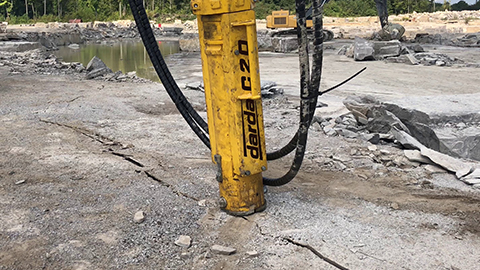



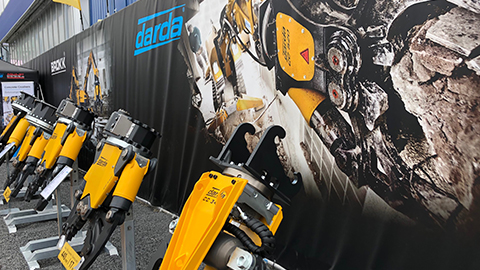





Chisel paste is a specialized lubricant for tools and tool holders operating under extreme pressure and impact loads. In the context of Darda GmbH, it is frequently encountered wherever hydraulic hammers are used to break up concrete or rock alongside stone and concrete splitters and concrete demolition shears. When correctly selected and applied, chisel paste reduces wear on tool shanks and bushings, mitigates fretting corrosion, and stabilizes work quality—whether in concrete demolition and special deconstruction, in strip-out and cutting, in rock demolition and tunnel construction, in natural stone extraction, or in special applications.
Definition: What is meant by chisel paste
Chisel paste is a high-pressure-resistant lubricating paste for tools subjected to percussive or vibratory loads, typically for the shank of chisels in hydraulic and demolition hammers. It consists of a load-bearing base oil–soap structure and a high proportion of solid lubricants. These solid lubricants form an adhesive protective film on the tool shank and in the tool holder. This prevents cold welding, galling, fretting corrosion, and excessive bushing wear. Unlike conventional multi-purpose grease, chisel paste is designed for extreme contact pressures, high temperatures, and abrasive environments.
Composition, operating principle, and properties
The effect of chisel paste is based on a combination of base lubricant and solid lubricants that remain on the surface even if relubrication is intermittent. Typical characteristics:
- Extreme-pressure resistance (EP): The solid-lubricant film bridges load spikes, reduces friction, and counters galling wear.
- High temperature stability: The lubricating film remains functional at the temperatures occurring around the shank.
- Adhesion and washout resistance: Good adhesion prevents rapid sling-off due to vibrations and protects against moisture.
- Corrosion protection: Additives and solid lubricants inhibit rust formation in the tool holder.
- Compatibility: Formulations can be metal-containing (e.g., with copper) or metal-free (e.g., with graphite, MoS2). Metal-free variants are often preferred where spark formation, material compatibility, or environmental requirements suggest it.
Application relevance to products and use cases of Darda GmbH
Chisel paste has an influence on processes in which breakers are used alongside Darda GmbH tools. In practice, the following links are relevant:
- Stone and concrete splitters: A defined line of weakness is often created before splitting with cylinders. If this is done with a hydraulic hammer, chisel paste protects the tool holder and stabilizes the fit. This facilitates controlled scoring on which precise splitting can build.
- Concrete demolition shears: For selective removal, the hammer can be used to open cracks or pry off concrete shells. A well-lubricated chisel shank prevents fretting corrosion at the fit and helps ensure that the shear can subsequently work with a clean gripping line.
- Combination shears, multi cutters, steel shears, tank cutters: These tools are less often supplied with chisel paste, as their bearing points are typically lubricated with high-pressure greases. Touchpoints arise when hammers and cutting tools alternate in sequence: Reliable hammer performance reduces follow-on damage to the carrier and ensures predictable transitions to the cutting process.
- Application areas: In concrete demolition and special deconstruction, in rock demolition and tunnel construction, and in natural stone extraction, breakers often work in parallel with splitting cylinders and shears. Chisel paste helps reduce downtime and maintain the dimensional accuracy of tool holders—an advantage for precision work in sensitive environments.
Proper application: coating, interval, and dosing
Optimal lubrication focuses on the tool’s shank area and the contact zones in the holder. General, manufacturer-independent guidance:
- Preparation: Remove dust and old residues from shank and holder. Clean surfaces improve adhesion.
- Application: Apply a thin, even layer of chisel paste to the shank. The striking face area is usually omitted.
- Relubrication: In dusty environments, relubricate more frequently. For automatic centralized lubrication, ensure paste-capable products and correct dosing.
- Alternating operation: When changing tools, check the paste on the removed tool, inspect wear marks, and renew if necessary.
Avoid common sources of error
- Wrong lubricant: Universal greases are not designed for impact and vibratory loads.
- Over-application: Too much paste binds dust, can increase abrasion, and stress seals.
- Mixing: Do not mix different pastes; chemical incompatibilities impair protection.
- Contamination: Dirt particles in the lubricating film act like abrasives.
Impact on productivity, wear, and cost
An intact lubricating film lowers friction and fit wear on the tool and the bushing. This reduces play, lowers vibration, and can significantly extend the service life of tools and holders. As a result, maintenance windows can be scheduled more predictably, downtime reduced, and processing steps—such as precise splitting with stone and concrete splitters or defined gripping with concrete demolition shears—carried out more reliably. Ultimately, the site cadence benefits, especially in projects with tight schedules.
Selection criteria for the appropriate chisel paste
Selection is based on the tool, environment, and lubrication method:
- Temperature range: The paste must withstand the thermal loads at the tool holder.
- Solid-lubricant system: Metal-containing or metal-free—depending on environmental requirements, spark formation, and material requirements.
- Lubrication method: Manual application or centralized lubrication; consider viscosity and pumpability.
- Environment: High dust load, moisture, salt, or dirt ingress require robust corrosion and wear protection.
- Tool size and load profile: Larger breakers and higher impact energies generally require higher solid-lubricant content and strong EP performance.
Practical relevance in the application areas
Concrete demolition and special deconstruction
When opening slabs, walls, or foundations, a hydraulic hammer can initiate cracks before concrete demolition shears remove components in a controlled manner. Chisel paste stabilizes the holder, reduces vibrations, and promotes repeatable tool guidance.
Strip-out and cutting
In strip-out work, operators frequently switch between impact, gripping, and cutting tools. Cleanly lubricated chisels make precise positioning easier, which in turn supports the transition to combined cutting and gripping processes.
Rock demolition and tunnel construction
During impact work in abrasive rock, tool shanks are subjected to intense micro-movements. A robust chisel paste keeps the contact surfaces functional so that splitting cylinders can subsequently work in a controlled manner.
Natural stone extraction
Where blows are used for preliminary separation, the paste helps avoid cold welding on tool and bushing. This improves the repeatability of scoring lines before splitting.
Special applications
In noise-sensitive or low-emission zones, measured lubrication is helpful, as unnecessary friction noise can be avoided. Metal-free pastes are sometimes preferred where spark-free operation is required.
Distinction from other lubricants on Darda GmbH equipment
Chisel paste should not be confused with standard high-pressure greases used at bearing points of shears, crushers, or splitting cylinders. For pin bearings, sliding, and rolling points, suitable greases are typically used according to manufacturer specifications. Chisel paste belongs primarily on the chisel shank and in the tool holder of hammers that often operate in the same workflow as stone and concrete splitters or concrete demolition shears. Darda GmbH hydraulic power packs (Power Units) operate with hydraulic oil—chisel paste is strictly separate from this and must not enter hydraulic systems.
Material compatibility and environmental aspects
Selection involves compatibility with contact materials, possible interactions with seals, and local environmental requirements. Metal-free pastes can offer advantages where copper or nickel is undesirable. In water-sensitive areas, careful handling, proper application, and good cleaning practice are important. Avoid leaks; dispose of expelled residues properly.
Occupational safety and handling
Handling chisel paste should always be clean and controlled. Avoid skin contact; wear protective gloves and suitable clothing. Tools may be hot; beware of burn hazards. Do not use highly volatile solvents for cleaning without adequate ventilation. Follow the instructions of equipment and lubricant manufacturers; the information here is general in nature.
Checklist for daily practice
- Clean the tool holder and shank before starting work.
- Apply suitable chisel paste thinly and evenly.
- Adjust relubrication intervals to dust, moisture, and impact intensity.
- Watch for play, noise, and heating in the holder area.
- Do not mix different pastes; keep containers clean.
- Do not use chisel paste as a substitute for bearing greases on shears, crushers, or splitting cylinders.