












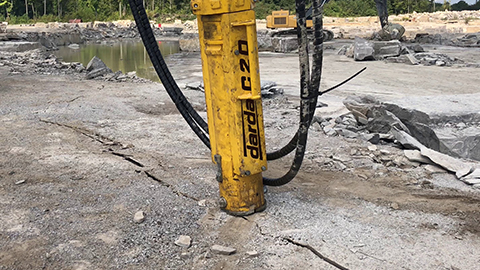









Fibre addition describes the targeted mixing of short, discontinuous fibres into mortar and concrete mix designs. The aim is to limit crack formation, increase toughness and residual load-bearing capacity, and improve element behaviour under tension and flexural tension. In planning and execution, but also in deconstruction, fibre addition plays an important role: fibre-reinforced concrete behaves differently from conventional concrete during demolition and thus influences the selection and use of concrete pulverizers or hydraulic splitters (wedge) from Darda GmbH in areas such as concrete demolition and special deconstruction, interior demolition, rock excavation and tunnel construction, or special operations.
Definition: What is meant by fibre addition
Fibre addition means mixing metallic or non-metallic fibres into cementitious construction materials. The fibres act as micromechanical crack bridges: they limit crack openings, increase energy absorption capacity, and can improve the ductility of the composite. Depending on fibre material, geometry and dosage, different effects are achieved, such as early-stage crack width limitation (microfibres) or residual load-bearing capacity after cracking (macrofibres). These properties are important for the serviceability of industrial floors, shotcrete in tunnel construction, or components with increased robustness—and they shape fracture and size-reduction behaviour in deconstruction using equipment from Darda GmbH.
Mechanism of action, fibre types and application limits
In cementitious matrices, fibres do not provide a classic reinforcement function like bars; instead, they act in a distributed manner. Decisive is the pull-out or rupture behaviour of the fibre in the cracked composite. This results in increased toughness, post-cracking load contribution, and a limitation of crack widths.
Steel fibres
Steel fibres (with hooks, anchorage or deformed surface) provide high residual tensile and flexural tensile load contributions. They improve impact toughness and reduce brittleness. Typical applications include industrial floors, precast elements or shotcrete for tunnel construction. In deconstruction, steel fibres often keep fragments connected for longer; concrete pulverizers must cut or tear fibres as well. Protruding fibre bundles may require rework with steel shear or hydraulic demolition shear.
Synthetic fibres
Polypropylene (PP) and polyethylene (PE) fibres are used as micro- or macrofibres. Microfibres address early shrinkage cracking and reduce the risk of explosive spalling under fire exposure. Macrofibres provide—within limits—crack-bridging functions. During demolition, synthetic fibres can generally be torn effectively with concrete pulverizers; the splitting behaviour approaches that of conventional concrete, yet remains tougher.
Glass, basalt and carbon fibres
Alkali-resistant glass fibres (AR glass) and basalt fibres improve surface and edge stability, while carbon fibres increase strength in thin-walled elements. They are more common in special components. In selective deconstruction, finer fracture surfaces and increased edge integrity can be expected; adjusting jaw forces and cutting geometries can improve process stability.
Application limits
Very high fibre contents increase mixing and pumping demands, can reduce workability, and raise tool wear during deconstruction. The suitability of the fibre type depends on the exposure and application area; adherence to recognized rules of practice is essential.
Dosage, distribution and mix design
The effect of fibre addition depends on dosage (by volume or mass fraction), fibre length and diameter (slenderness ratio), surface characteristics, and uniformity of distribution. A balanced mix design ensures workability and performance.
- Dosage: Microfibres are usually in the range of a few kilograms per cubic metre; macro- and steel fibres higher—always sized project-specifically.
- Workability: Adjusted aggregate grading and concrete admixture reduce balling and maintain pumpability.
- Fibre distribution: Even, clump-free mixing prevents local weaknesses and ensures reproducible properties.
- Water content: The effective water–cement ratio must not be inadmissibly altered by fibre addition; fresh concrete tests help with control.
Recommended mixing sequence
- Homogenize dry components.
- Add part of the mixing water and admixtures, set the workability level.
- Slowly and evenly sprinkle in fibres, increase mixing time, add remaining water.
- Test fresh concrete (consistency, homogeneity) and fine-tune as needed.
Placement and processing: Cast-in-place concrete, shotcrete, precast elements
The placement of fibre-containing concretes follows the same basic principles as conventional concrete, but requires more careful control of homogeneity and deaeration.
Cast-in-place concrete
During placement, sufficient compaction and controlled curing are important, as fibres can influence early-age shrinkage cracking. Edges and anchorage zones benefit from uniform fibre distribution.
Shotcrete (tunnel construction)
Fibre-reinforced shotcrete is widespread in tunnel face support. Macrofibres or steel fibres provide residual load contribution between anchor points. During later deconstruction, for example in cross-section enlargement, fibre addition changes removal behaviour: concrete pulverizers work efficiently when size reduction is performed in layers and fibre bridges are deliberately torn.
Precast elements and industrial floors
In slabs, chambers, edge beams or industrial floors, fibre addition increases robustness against impact and fatigue loading. In selective deconstruction, the combination of pre-splitting and subsequent trimming supports a clean separation.
Effect of fibre addition on demolition, deconstruction and size reduction
Fibre-reinforced concrete exhibits tougher behaviour in fracture. Crack faces remain interconnected for longer; fragments are held together by fibre bridges. This results in practical consequences for equipment selection and operation.
Concrete pulverizers
Concrete pulverizers by Darda GmbH are designed for controlled size reduction. For fibre-containing elements, a sequential approach is recommended: pre-crack along planes of weakness, then follow up to separate remaining fibre bridges. Steel fibres may protrude along the cut edge; a short trimming pass or snipping with steel shear or hydraulic demolition shear prevents hook formation. An adjusted stroke and closing speed supports material-appropriate crack propagation.
Hydraulic splitters (wedge)
Splitters, such as hydraulic rock and concrete splitters, develop high wedge forces for brittle separation. Fibre addition reduces the tendency to pure brittle fracture; borehole spacing, splitting direction and number of setting points must be planned accordingly. In elements with steel fibres, combining pre-splitting with subsequent processing using concrete pulverizers can increase efficiency. With low fibre content, the split pattern usually remains predictable; at high contents, tougher crack paths are to be expected.
Combination shears, multi cutters and steel shears
If fibre whiskers remain after crushing, they can be removed flush with steel shear or hydraulic demolition shear. Multi cutters support separating local inserts or trimming fibre-reinforced edges. This reduces trip edges and injury hazards.
Hydraulic power packs
Hydraulic power packs from Darda GmbH provide the working pressure for pulverizers, shears and splitters. In fibre-containing concrete structures, a slightly longer working cycle may be required; stable oil flow and precise controllability facilitate material-adapted processing.
Application areas relevant to fibre addition
Concrete demolition and special deconstruction
Fibre-reinforced concrete is common in deconstruction-friendly designs, industrial floors or machine foundation blocks. Concrete pulverizers enable controlled size reduction with low dust and low vibration levels; with steel fibres, increased fibre bridge formation is to be expected, which influences the cutting sequence.
Interior demolition and cutting
In interior demolition of fibre-reinforced walls and slabs, pre-cracking with concrete pulverizers is often combined with saw cuts. Fibre bundles along cut faces can be trimmed afterwards to achieve a clean joint.
Rock excavation and tunnel construction
In tunnel construction, fibre-reinforced shotcrete is used as temporary or permanent lining. When widening cross-sections or removing temporary shells, a layer-by-layer pulverizer method ensures controlled detachment without impairing the load-bearing action of adjacent areas.
Natural stone extraction
In natural stone extraction itself, fibre addition plays no role. It becomes relevant where fibre-reinforced shotcrete shells were used for stabilization and later need to be removed. Splitters and concrete pulverizers can be coordinated to release stabilization layers without unnecessarily damaging the natural stone.
Special operations
In areas with fire exposure, microfibres are used to limit spalling. During later deconstruction, edge zones often remain more intact and tougher; an adapted pulverizer guidance with short gripping strokes improves control. In safety-sensitive environments, combining splitting and pulverizing minimizes the introduction of vibrations.
Quality assurance, testing and documentation
To assess fibre-reinforced concrete, tests of fresh concrete (consistency, homogeneity) and hardened concrete (flexural tensile behaviour, residual load-bearing capacity, crack width limitation) are used, among others. Traceable documentation of fibre type, content and mixing procedure facilitates later deconstruction concepts. For demolition, as-built documents are helpful, since fibre content and type influence the equipment setup and work steps.
Occupational safety and environmental aspects
During processing, fibre dust and mechanical irritation can occur. Personal protective equipment, low-dust methods and orderly handling of fibres must be considered. In deconstruction of fibre-containing components, watch for protruding fibre ends; clean cutting with shears reduces injury risk. Metallic fibres can often be magnetically separated in the recycling process; source-separated sorting improves recovery routes. Legal requirements must be checked in a project-specific and general manner.
Planning and tendering in the context of deconstruction
Even at the planning stage, it is advisable to consider fibre addition in specifications and as-built documentation. For deconstruction, trial areas and test demolitions are useful to assess the composite’s toughness and optimally coordinate the interaction of concrete pulverizers, hydraulic splitters (wedge) and shears. A clear sequence—pre-splitting, layer-by-layer crushing, trimming of fibre whiskers—increases process reliability and reduces rework.
Typical practical mistakes and how to avoid them
- Fibre balling due to improper mixing—choose slow feeding and sufficient mixing time.
- Underestimated toughness in deconstruction—adapt pulverizer sequencing and gripping strokes, place splitting points closer.
- Loss of workability—match aggregate grading and concrete admixture to fibre content.
- Incomplete documentation—record fibre type and dosage to define equipment selection and work sequence in a targeted manner.
- Safety risks from fibre whiskers—consistently snip them flush with steel shear or hydraulic demolition shear.