
















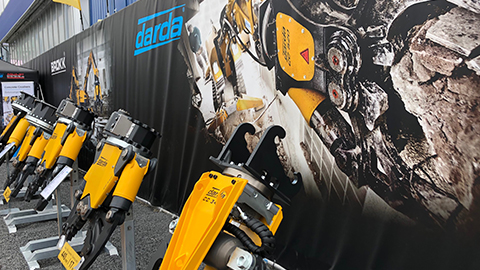





The deformation verification is a central element in the planning, execution, and supervision of structures and structural components—in both new construction and deconstruction. It ensures that deflections, rotations, settlements, and displacements remain within permissible limits in all construction stages. For Darda GmbH’s practice, the verification is particularly relevant when components are separated, weakened, or completely removed using concrete pulverizers, hydraulic splitters for stone and concrete, rock wedge splitters, hydraulic demolition shears, or steel shears. Whether in concrete demolition and special demolition, during strip-out and cutting, in rock excavation and tunnel construction, or in natural stone extraction: a sound deformation verification supports a safe work sequence, protects adjacent structures, and improves the quality of results.
Definition: What is meant by deformation verification
Deformation verification refers to the analytical and/or measurement-based verification that a structural component, a structure, or a rock mass, under the assumed actions (self-weight, live and construction-stage loads, load redistributions, temperature and shrinkage deformations), only experiences as much deformation as permitted by the accepted rules of practice. The verification belongs to the serviceability limit state and typically covers deflections, rotations, displacements, crack openings, and settlements. In deconstruction and splitting/cutting technology, deformation verification complements the verification of load-bearing capacity: it aims to ensure the serviceability and integrity of remaining structures, the functional safety of temporary shoring, and the dimensional accuracy of separation and splitting processes.
Fundamentals of the verification process
The verification is based on correct representation of the structural system, realistic stiffnesses and boundary conditions, as well as plausible load assumptions for the planned workflow. In practice, analytical methods, numerical models, and accompanying monitoring are combined. The particularity in deconstruction: the structure changes its system step by step through separation cuts and splitting operations. Therefore, deformation verification is not a one-off step but a continuous process across multiple construction stages.
Importance in concrete demolition and special demolition
In selective deconstruction, tools such as concrete pulverizers and hydraulic demolition shears act locally with high forces on components. These forces can trigger local crushing zones, crack propagation, and load redistributions. A well-conceived deformation verification ensures that adjacent members (e.g., floor fields, shear walls, columns), under the changed boundary conditions, do not experience impermissible deflections or displacements. This also protects finishes, installations, and neighboring areas of use from consequential damage.
Typical situations in deconstruction where deformation verification is critical
- Creating openings in slabs and walls before components are separated with concrete pulverizers
- Sequentially separating beams and slab panels with steel shears and Multi Cutters
- Core drilling and relieving prior to lifting component segments
- Temporary underpinning and shoring to limit deflections and the risk of tipping
- Deconstruction in partial construction states with changed support conditions
Procedure: Verification chain and key parameters
An effective deformation verification follows a structured sequence. For work with Darda GmbH tools, the following procedure has proven successful:
- Capture the system: Component geometry, structural system, supports, joints, existing crack patterns, detailing.
- Apply loads: Self-weight, construction-stage live loads, equipment and auxiliary equipment effects, load redistributions due to cuts or splitting operations.
- Determine stiffnesses: Elastic modulus and section properties, crack state, potential stiffness reductions due to damage or aging.
- Define boundary conditions: Temporary shoring, decoupling, intermediate supports, friction mobilization.
- Calculation and assessment: Hand calculations for quick checks, FEM for complex system changes; comparison with allowable deformations per the rules of practice.
- Plan monitoring: Measurement points, instruments, threshold and warning values, documentation.
- Control the work sequence: Stepwise separating/splitting, pressure stages, pre-cuts, adjustment of shoring.
Relevant material parameters
- Concrete: Elastic modulus, cracking, creep and shrinkage, temperature and moisture effects.
- Steel: Elasticity, buckling behavior of plates and sections (e.g., when cutting tanks).
- Rock: Anisotropy, jointing, shear strength, and exposure conditions (important with rock wedge splitters and hydraulic splitters).
Deformation verification in rock excavation, tunnel construction, and natural stone extraction
In rock excavation and tunnel construction, hydraulic splitters and rock wedge splitters generate directional splitting forces. Here, deformation verification evaluates displacements along joints, the stability of crown and bench areas, and the dimensional accuracy of the split surfaces. In natural stone extraction, the focus is on controlled separation joints and minimizing unintended cracks so that blocks are extracted to dimension with minimal edge damage. By applying splitting forces stepwise and guiding the splitting line appropriately, displacements remain controlled.
Influence of the splitting line and wedge insertion
The position of the splitting line determines the stiffness of the remaining cross-section. A split guided too close to edges can trigger rotational deformations; an unfavorable wedge insertion point can activate tension zones. Therefore, splitting lines are usually chosen to support the principal compression zones and keep limit deformations within bounds. Accompanying measurements of relative displacements at reference points increase process safety.
Correctly accounting for tool effects
The hydraulic power units of Darda GmbH provide the drive power for concrete pulverizers, hydraulic demolition shears, Multi Cutters, steel shears, and cutting torches. For deformation verification, it is important to represent the resulting tool forces realistically. Less decisive than the rated force is the force actually introduced into the component or rock, depending on application point, lever arm, contact geometry, and friction. A conservative assumption avoids unpleasant surprises during construction stages.
Load paths when using concrete pulverizers
Concrete pulverizers generate local compressive and splitting forces that trigger failure cones and cross-section weakening. In slabs, this can result in additional bending moments; in walls, in membrane stresses and local buckling risks. Deformation verification checks that these effects do not drive deflections and displacements beyond allowable values—especially when adjacent members must remain in service.
Purposefully limiting splitting forces
- Stepwise pressure increase and visual monitoring of crack formation
- Pre-cuts (e.g., saw cuts or core drilling) to reduce peak forces
- Shoring and relieving to shorten free spans
- A targeted sequence of separation and splitting to control load redistributions
Temporary states, shoring, and monitoring
Temporary states dominate in deconstruction. Shoring shortens spans, reduces deflections, and limits rotations. Deformation verification documents the effectiveness of these measures. Additionally, monitoring provides transparency: dial gauges, crack monitoring, optical methods, or laser distance measurements record deformations in real time. Warning and shutoff values are set so that sufficient reaction time remains for adjustments.
Monitoring concepts in practice
- Set reference points on invariant components and define measurement baselines
- Link measurement intervals to work progress (before/during/after a separation step)
- Document measured values with photos and sketches for traceability
- Adjust shoring or work parameters if trends exceed thresholds
Distinction from the verification of load-bearing capacity
The load-bearing capacity verification answers whether a component can carry the actions at all; deformation verification ensures that the associated deformations do not exceed the allowable level. The two verifications complement each other. In deconstruction, components can be load-bearing yet exhibit impermissibly large deflections—then shoring, a modified cut layout, or reduced tool forces are suitable measures.
Typical sources of error and how to avoid them
- Stiffness overestimated: Cracking, creep, and shrinkage are not considered.
- System changes neglected: Separation cuts alter supports and load paths.
- Unfavorable application points: Tools engage in regions with large lever arms.
- Insufficient monitoring: Deformations are detected too late.
- Lack of work sequencing: Simultaneous interventions lead to cumulative deformations.
Practical examples from the fields of application
Strip-out and cutting: When creating an opening in a floor slab, the remaining slab is propped in advance. After the saw cut, the segments are separated with concrete pulverizers. Deformation verification shows that the remaining slab carries the temporary loads with limited deflection; dial gauges monitor the edge area.
Concrete demolition and special demolition: A shear wall is separated segment by segment with hydraulic demolition shears. Due to stepwise relieving, loads shift onto adjacent columns. Deformation verification evaluates displacements at the column head and limits them by additional shoring.
Rock excavation and tunnel construction: Hydraulic splitters open a controlled separation joint. The planned splitting sequence and moderate pressure stages keep edge displacements at the crown low; measuring bolts document the deformations.
Natural stone extraction: When releasing a block with rock wedge splitters, the splitting line is chosen so that the remaining cross-section remains sufficiently stiff. Deformation verification shows that the block separates to dimension and the bench remains stable.
Special application: When opening thin-walled vessels with cutting torches, local bulging is avoided by defined cutting sequences and intermediate shoring, and deformations are continuously observed.
Terminology and calculation aids in daily work
In daily practice, clear terms and simple aids have proven valuable: deflection as the governing deformation measure for slabs and beams; displacement and rotation for walls and diaphragms; local buckling for thin-walled components; settlements at supports. Hand-calculation approximations provide quick plausibility checks, numerical models represent complex construction states. Together with traceable documentation of measured values, a robust, verifiable chain of proof emerges—an essential foundation for controlled cutting and splitting work with the tools of Darda GmbH.