
















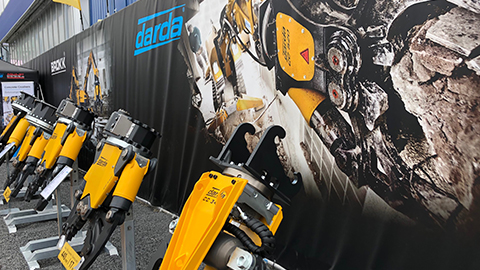





The reinforcement of components is a central topic in preserving existing structures and adapting load-bearing systems to new requirements. Whether in reinforced concrete, masonry, steel, or timber—the goal is always to specifically increase load-bearing capacity, stiffness, ductility, or durability. In practice, component reinforcement often goes hand in hand with selective deconstruction: before reinforcement is added, laminates are bonded, or jacketing is installed, areas must be exposed, openings created, or damaged zones precisely removed. This is exactly where hydraulic methods with concrete pulverizer or hydraulic wedge splitter are well established, as they work with low vibration levels, in a controlled manner, and gently on the structure—prerequisites for safe, high-quality strengthening in the fields of concrete demolition and special demolition, building gutting and concrete cutting, as well as special demolition.
Definition: What is meant by structural reinforcement of components
Structural reinforcement of a component refers to measures that improve the load-bearing and deformation behavior of an existing member. This includes increasing load-bearing capacity (ULS), limiting deflections and crack widths (SLS), and enhancing ductility, fire safety, or durability. Structural reinforcement differs from pure structural repair: while structural repair addresses damage and restores the original state, reinforcement targets an additional performance increase. Reasons include changes in use, higher loads, material aging, code changes, or new requirements from earthquake and safety engineering.
Fundamentals, structural behavior, and terminology
Structures must safely transfer loads and ensure serviceability. Reinforcement strategies therefore intervene in load paths, cross-section properties, and connections. Key parameters include cross-sectional area, reinforcement ratio, modulus of elasticity, bond conditions, and member depth. Depending on the goal, cross-sections are enlarged, additional reinforcement is installed, fiber-reinforced systems are bonded externally, loads are re-routed, or supports are redefined. It is crucial that the substrate is load-bearing, the bond is durable, and the construction process is compatible with the behavior of the existing structure. Preparatory works—from removing weakened zones to creating defined edges—require selective methods that protect adjacent areas. Here, concrete pulverizers and hydraulic wedge splitters are widespread in practice because they can open components in a targeted way without unnecessarily stressing the remaining structure.
Objectives and triggers for component reinforcement
Triggers for reinforcement are diverse:
- Changes in use, such as higher traffic loads, new machine foundations, or additional stories.
- Damage patterns such as cracking, concrete carbonation, chloride contamination, and consequences of rebar oxidation in reinforced concrete.
- Requirements from seismic retrofit, fire protection, or robustness.
- Conversions that require openings, support relocations, or load redistribution.
- Code updates and the desire for a longer service life of the structure.
Common to all triggers is that planning, design, and execution must be tightly integrated. This also concerns the choice of deconstruction and exposure techniques, so that the existing structure safely withstands construction stages and the substrate is prepared for bonding.
Methods of structural reinforcement
The choice of method depends on material, load case, boundary conditions, and construction sequence. Combinations are often useful, such as cross-section enlargement with local reinforcement retrofits or CFRP laminates combined with grouted anchors.
Cross-section enlargement and jacketing
In reinforced concrete, cross-sections are enlarged with additional cast-in-place concrete, shotcrete, or concrete jacketing. Steel jackets can improve shear and ductility properties in columns. Proper substrate preparation is essential: remove loose zones, define edges, and create a load-bearing, roughened bonding surface. Concrete pulverizers enable precise removal of weakened areas without overloading adjacent zones. For producing grooves and working joints, separation cuts and splitting sequences are often used; hydraulic wedge splitters open massive areas in a controlled, crack-guided manner—helpful in confined conditions.
Reinforcement with fiber-reinforced systems (CFRP/GFRP)
Externally bonded laminates or fabrics increase flexural and shear capacity without significantly enlarging the cross-section. Near-surface mounted (NSM) laminates lie in narrow slots near the surface. Dust-free, load-bearing substrates and defined edges are important. For NSM, precise slots are required; on site, these are often produced with separation cuts and milling sequences and complemented with controlled splitting to avoid spalling. End anchorage and U-shaped shear reinforcement must be carefully detailed so that the laminates develop their intended effect.
Additional reinforcement, anchors, and prestressing
Post-installed rebars, heavy-duty anchor, or external prestressing system introduce forces in a targeted manner. Recesses and exposure are required for anchor heads, rebar splices, and bearing areas. The concrete pulverizer creates clean edges and exposes existing reinforcement without damaging it. Hydraulic wedge splitters can open boreholes to defined enlargements to accommodate anchor heads, especially where vibrations and noise must be limited. High-performance hydraulic power units provide the necessary drive power for such work in environments with limited infrastructure.
Local repairs and concrete repair
If concrete cross-sections are weakened by rebar corrosion or freeze–thaw and de-icing salt attack, removal proceeds back to sound material, reinforcement is derusted and passivated, and concrete repair material is applied. For repair quality, selective removal is critical: concrete pulverizers allow defined depth and avoid uncontrolled crack propagation. With a rock wedge splitter, compact blocks can be separated with low vibration levels, which reduces dust exposure and noise emission and does not impair adjacent use.
Masonry, timber, and steel
In masonry, anchors, injection, reinforcement slots, and steel straps are used. Opening joints and producing pockets succeeds through controlled cutting and splitting. In timber members, bonded laminates, steel plate fishplates, or doublings are used; careful exposure of connection nodes is a prerequisite. In steel structures, plates are added, nodes are strengthened, or loads are re-routed—this requires precise cuts and removal of existing build-ups (e.g., fire protection, corrosion protection); Multi Cutters, steel shear, and hydraulic shear (demolition shear) are used for this in selective deconstruction.
Preparatory works: selective deconstruction and exposure
The quality of reinforcement depends directly on the preparatory works. In practice, a coordinated approach of surveying, marking, separation cut, controlled splitting, and clean removal has proven effective.
- Expose bearing and node areas with concrete pulverizer to make reinforcement visible and continue using it undisturbed.
- Create predetermined breaking lines via cuts and subsequent opening with a hydraulic wedge splitter; a rock wedge splitter acts in a targeted way in the core, keeping crack propagation controlled.
- Remove non-load-bearing components during building gutting, e.g., masonry infills, installation shafts, or secondary steelwork, with hydraulic shear (demolition shear), multi cutters, and steel shear.
- Deconstruction of installations and tanks in industrial facilities when they obstruct foundation or frame reinforcement; a cutting torch is used here.
The advantage of hydraulic methods is reduced vibrations and minimal spark generation. This protects sensitive existing structures and reduces disruptions in ongoing operations, for example in hospitals, laboratories, or listed buildings. Nevertheless, protection against dust, noise, and falling parts must be planned; load transfer and construction stages must be continuously verified.
Planning, design, and construction sequence
Robust reinforcement starts with investigating the existing structure. Material properties, reinforcement layout, damage, and loads must be determined. Based on this, the design and the choice of construction method are defined—including the deconstruction and exposure concept.
- Investigation: test borehole, concrete cores (specimens), rebound hammer, reinforcement locating, and pull-off tests provide reliable basics.
- Construction phase planning: define shoring, load redistribution, and the sequence of interventions to ensure stability and serviceability at every stage.
- Deconstruction planning: set separation cuts, splitting points, fall direction, equipment selection (e.g., concrete pulverizer, hydraulic wedge splitter), and logistics.
- Execution: substrate preparation, installation of the reinforcement, curing, and aftertreatment according to system specifications; continuously document quality assurance.
- Inspection and monitoring: visual inspections, measurements (cracks, deflection), and, if required, low-impact testing; maintain a maintenance plan.
Tool selection in the context of structural reinforcement
The choice of equipment depends on material, member thickness, accessibility, and environmental requirements. The hydraulic power pack supplies mobile, high-performance tools even under confined conditions.
- Concrete pulverizer: for precise removal, exposure of reinforcement, edge formation, and selective deconstruction of weakened concrete zones.
- Hydraulic wedge splitter as well as rock wedge splitter and hydraulic rock and concrete splitters: for controlled opening of massive components, creating predetermined fracture planes, extracting compact blocks—advantageous with limited vibrations.
- Hydraulic shear (demolition shear), multi cutters, and steel shear: for safe cutting of steel sections, protruding reinforcement, and secondary components during building gutting.
- Cutting torch: during deconstruction of tanks and apparatus when their removal is a prerequisite for foundation or frame reinforcement.
These tools are common in the fields of concrete demolition and special demolition, building gutting and concrete cutting, as well as special demolition. In tunnel construction and rock excavation, splitters also support creating niches and exposing areas for anchor and shotcrete reinforcements.
Special application areas and boundary conditions
In sensitive environments—such as hospitals, data centers, laboratories—vibrations, dust, and noise must be tightly limited. Hydraulically operated concrete pulverizers and splitters are widespread here. In the special demolition of bridges or industrial plants, construction stages are critical: temporary supports, auxiliary structures, and separation cut sequences must harmonize with reinforcement planning. In tunnel and rock works, niches for anchor heads, drainage, or reinforcements are often created by drilling and controlled splitting to avoid damaging the rock mass. In natural stone applications, splitting techniques help obtain defined blocks for infills and bearings without compromising the structure.
Quality, documentation, and service life
The durability of reinforcement depends on substrate quality, bond, moisture protection, and corrosion protection. Key building blocks are:
- Documented substrate preparation (roughness depth, cleanliness, exposure depth).
- Verification of bond properties, e.g., pull-off on test areas or reference surfaces.
- Protection concepts against moisture, chlorides, and CO₂; suitable coatings and joint sealing.
- A plan for inspection and maintenance over the life cycle.
Tests and approvals must be defined on a project-specific basis. Statements here are general; binding assessments are subject to the respective applicable regulations and authorities.
Risks, error sources, and occupational safety
Frequent causes of deficiencies are inadequate substrate preparation, missing end anchorages, unsuitable construction sequences, and uncontrolled deconstruction. Especially during exposure: do not unintentionally weaken reinforcement, define edges, limit cracks. Occupational safety takes priority—particularly when dealing with hydraulic forces, splitting, and cutting reinforcement. Provide protection against falling parts, dust extraction, water management, and safe equipment handling. Regulatory requirements and permits must be verified for each project; notes here are general and do not replace a case-by-case review.
Relation to products and application areas of Darda GmbH
In the context of structural reinforcement, tools are needed that enable selective deconstruction, exposure, and controlled opening. In practice, concrete pulverizer is used for precise removal, hydraulic wedge splitter as well as rock wedge splitter for crack-guided opening and the extraction of compact areas. Hydraulic shear (demolition shear), multi cutters, steel shear, and cutting torch support the cutting of installations and secondary components, often in the course of building gutting and concrete cutting. The hydraulic power pack ensures the energy supply in confined or sensitive environments. These means of work are established in concrete demolition and special demolition, building gutting and concrete cutting, rock excavation and tunnel construction, as well as special demolition, and help ensure that reinforcement measures are prepared safely, in a controlled manner, and gently on the structure.