
















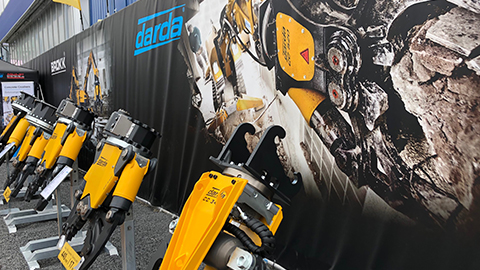





The shoring wall is a central element of urban civil engineering (underground works) and structural engineering. It secures excavation pits, utility trench excavations, and shafts against earth and water pressure, enables work in immediate proximity to existing buildings, and often forms the temporary or permanent enclosure of the excavation pit. In practice, shoring walls frequently interface with tasks of selective deconstruction: concrete must be adjusted, reinforcement separated, openings created, and boulders removed with low vibration levels in confined excavation pits. At these interfaces, depending on structural analysis, accessibility, and boundary conditions, tools such as concrete pulverizer or hydraulic wedge splitter (see rock and concrete splitters) are used—always focusing on controlled, low-vibration work and traceable construction sequences.
Definition: What is meant by a shoring wall
A shoring wall is a temporary or permanent support structure for securing soil and, if applicable, groundwater. It resists horizontal earth and water pressures, limits deformations, protects adjacent structures from settlement, and creates a safe workspace. Depending on the method, shoring walls are made of steel, concrete, or wood and are stabilized by tie-back anchoring, bracing, or self-weight. Typical types are sheet pile walls, soldier pile and lagging walls (Berlin shoring), secant pile walls, diaphragm walls, and shotcrete nail walls. During execution, soil type, groundwater, excavation pit depth, adjacent development, and construction sequence influence the selection.
Types and construction methods of shoring walls
The choice of shoring type depends on geology, groundwater conditions, spatial constraints, environmental requirements, and the planned construction sequence. Each type has characteristic advantages and disadvantages in terms of watertightness, stiffness, installability, and removability—and thus different requirements for later adaptations, breakthroughs, or deconstruction.
Sheet pile wall
Made of steel sections that are driven or vibrated. Advantageous in confined conditions and with high groundwater inflow; watertight depending on the sealing system. Vibrations during installation and removal must be considered. For subsequent openings or connections, steel cutting, welding details, and corrosion protection must be coordinated in the design; steel members can, after structural release, be separated with a steel shear or suitable hydraulic demolition shear.
Soldier pile and lagging wall (Berlin shoring)
Vertical steel beams are set in boreholes; the spaces between are lagged with timber or concrete panels. Flexible to adapt and easy to remove. For adaptations, proceed selectively: lagging can be dismantled or locally cut; for concrete lagging, concrete pulverizer is frequently used for selective removal to avoid vibrations and damage to the beams.
Secant pile wall
Contiguous bored piles (overlapping or tangent) form a stiff wall. Well suited in sensitive locations; watertightness depends on the system. Creating breakthroughs or recesses requires controlled concrete removal and exposing reinforcement. Here, a concrete pulverizer enables step-by-step removal and targeted cutting free of rebar with suitable cutting tools.
Diaphragm wall
A reinforced concrete wall constructed using a support-fluid method with high stiffness and watertightness; often a permanent external wall. Openings for pipes, anchors, or construction stages require particularly gentle methods. Concrete noses, offsets, or local corrections can be executed with control-oriented crushing and cutting tools; low-vibration removal reduces risks for neighboring buildings.
Shotcrete nail wall
Temporary stabilization with reinforced shotcrete on anchored or nailed soil or rock. It requires careful layer-by-layer removal, e.g., for profile corrections or embedded components. Local removal of shotcrete can be done precisely with handheld tools without large-scale loosening; mesh reinforcement is cut with suitable cutting tools.
Load transfer, deformations, and construction stages
Shoring walls transfer earth pressure, traffic loads, structural loads, and, if applicable, water pressure via tie-back anchoring, bracing (strutting), or fixed-base action. Limiting deformations serves to protect the surroundings. Any work on the shoring wall—such as breakthroughs, recesses, or anchor exposure—must be coordinated with construction stages so that load redistribution occurs in a controlled manner. Low-vibration techniques and low system weight of the tools reduce dynamic effects and help comply with specified limits.
Shoring wall in the context of concrete demolition and special demolition
Near shoring walls, vibration and noise performance are often decisive. Where impact energy and high vibration would be critical, methods with hydraulic crushing or splitting are preferred. Depending on the material and target geometry, the following tools are common in practice:
- Concrete pulverizer for selective concrete removal, exposing reinforcement, and stepwise demolition of member heads (e.g., pile head, capping beam).
- Hydraulic wedge splitter for non-explosive, low-vibration cracking of rock and massive concrete elements, for example during site clearance immediately adjacent to a shoring wall.
- Hydraulic demolition shear for separating reinforced zones or composite sections in workspaces with limited accessibility.
- Steel shear for steel components such as temporary bracing, wales, or beams—only after unloading and structural release.
- Hydraulic power pack to supply energy to the tools—matched to working pressure, flow rate, and the operating environment.
Openings, breakthroughs, and recesses in existing shoring walls
Utility crossings, pump sumps, anchor exposure, or later passages often require precise openings. Procedure and tool selection depend on shoring type, reinforcement layout, and watertightness. A concrete pulverizer enables controlled edges, minimizes crack formation, and protects adjacent components. Reinforcement can be cut with suitable cutting attachments. For water-retaining systems, injection and sealing concepts must be planned; interventions are carried out only in coordinated construction stages and with documented control.
Pile head treatment and capping beams
For bored pile or pile foundations, the head zone is removed to the specified elevation after curing and the reinforcement is exposed. In excavation pits with shoring walls, this is a typical task with high sensitivity to vibrations. A concrete pulverizer removes the pile head layer by layer so that shaft friction is not unintentionally released. Colliding boulders or rock lenses in the excavation area can be cracked with a hydraulic wedge splitter at low vibration levels to continue excavation.
Rock excavation and tunnel construction: shoring-like stabilizations
In tunnel and drift construction as well as on rock faces, shotcrete, rock bolts, and anchors assume the function of a temporary shoring wall. For profile corrections or cross-section enlargements, an exact, low-vibration approach is crucial. Hydraulic splitting limits shock waves in the rock; handheld crushers allow removal of shotcrete layers and exposure of reinforcement meshes. This supports a controlled construction sequence in rock excavation and tunnel construction.
Groundwater, vibrations, and environmental protection
Groundwater control, watertightness requirements, and vibrations affecting adjacent structures shape execution. Low-vibration methods reduce risks of settlement and impacts on potable-water-relevant strata. Dust and noise reduction, settling basins for wash water, and separate disposal of concrete, reinforcing steel, and timber lagging are standard environmental measures. Monitoring concepts (ground vibration monitoring, settlement, noise emission) accompany sensitive interventions.
Occupational safety and legal framework
Work on shoring walls requires an approved structural design, hazard analysis, and clear responsibilities. Load-bearing members may be modified or removed only after unloading and explicit release. Requirements regarding dust, noise, groundwater control, hazardous substances, and machine use must be observed. Legal requirements are project-specific; information is fundamentally general and non-binding. Safety equipment, safe access, and a coordinated emergency plan are mandatory.
Planning, interfaces, and construction sequence
A coordinated construction sequence between geotechnics, shell construction, and deconstruction is crucial. Prior to any intervention, reinforcement and anchor layouts must be located, deformation limits defined, and monitoring points installed. Tool selection, hydraulic power pack, carrier machine, and waste disposal logistics are adapted to the spatial constraints of the workspace. Coordination with neighboring sites and utilities prevents clashes and delays.
Typical application scenarios
Urban deconstruction at the shoring wall edge
Selective concrete removal on capping beams or impact beams without transmitting vibrations into adjacent components; a concrete pulverizer and handheld cutting tools reduce vibration and protect existing façades.
Utility crossings through the excavation pit enclosure
Creation of small openings with controlled removal, safeguarded reinforcement cutting, and subsequent sealing. Required construction stages are defined in advance, and the intervention is monitored by measurements.
Dismantling temporary bracing
Removal of struts and wales after load redistribution into the final state. Steel is—after documented unloading—cut with a steel shear or suitable cutting devices; cutting sequences and safety measures are predefined.
Tools and hydraulic power packs: selection criteria
For work at and near shoring walls, compact form factors, finely controllable hydraulics, and low added loads are advantageous. Important factors are compatibility of tool and hydraulic power pack (working pressure, flow rate; see compact hydraulic power units), reach in the confined workspace, line of sight to the intervention point, and the possibility of stepwise removal. A hydraulic wedge splitter acts inside the member and limits structure-borne sound; a concrete pulverizer enables controlled edges and targeted exposure of reinforcement.
Quality assurance and documentation
Before, during, and after the intervention, condition surveys, measurement data (deformation, vibration), photos, and test protocols must be documented. Construction waste separation and traceability within the waste management chain are part of the process, as is checking execution against the released design. Deviations are assessed and released promptly.
Avoiding common mistakes
- Unplanned vibrations due to unsuitable impact methods in sensitive locations.
- Missing construction-stage releases before cutting reinforcement or steel beams.
- Inadequate locating of anchors, utilities, or reinforcement bundles.
- Unsuitable tool–hydraulic power pack combinations with poor controllability.
- Unmanaged groundwater control when creating breakthroughs in watertight shoring walls.
- Overly large removal steps instead of a stepwise, controlled approach.