





















A deep adit is an underground gallery driven at great depth into the rock mass to drain water, provide access to deposits, dewater structures, or interconnect infrastructure. In the context of underground tunneling, rock mechanics, and special foundation engineering, the deep adit plays a key role—both in new construction and in rehabilitation and selective deconstruction. In practice, deep adits intersect numerous application areas, including rock demolition and tunnel construction, concrete demolition and special deconstruction, as well as special operations in sensitive environments. During support installation, maintenance, and deconstruction, material-conserving methods with low vibration levels are used, including concrete pulverizers and hydraulic wedge splitters that, powered by hydraulic systems, enable precise interventions in concrete and rock structures.
Definition: What is meant by a deep adit
A deep adit is generally understood to be a horizontally or slightly inclined, minerally driven cavity running at greater depth below ground level. It serves as a drainage adit, exploration or access adit, drainage and ventilation structure, as part of tunnel or storage facilities, or for preserving and rehabilitating existing underground infrastructure. Characteristic features include its deep location, a geotechnically demanding environment with elevated in-situ stresses and groundwater inflows, and the need for a structurally stable support (e.g., shotcrete, masonry lining, anchor). In construction, operation, rehabilitation, or deconstruction, specialized procedures are used that ensure the integrity of the rock mass and operational safety while minimizing vibrations, noise, and emissions.
Use and significance of deep adits in underground works
Deep adits perform central functions: they dewater excavation pits and deposits, provide safe access for advance and material transport, serve as retention and control chambers for water management, and enable investigation of geological conditions. In existing facilities, the cross-section is often adjusted, linings are renewed, or selective deconstruction steps are implemented. Here, concrete pulverizers are key for controlled removal of concrete linings, and hydraulic wedge splitters are used for low-vibration rock and concrete removal. This enables pinpoint interventions as part of concrete demolition and special demolition as well as rock excavation and tunnel construction without unnecessarily affecting the surrounding rock mass.
Geological fundamentals and planning
Planning a deep adit begins with a detailed geological and hydrogeological analysis. Rock classification, joint systems, shear planes, water inflows, and stress conditions determine the choice of excavation method and support. A precise alignment with sufficient forefield knowledge reduces risks, limits change orders, and accelerates the construction process. In rehabilitation and deconstruction projects, as-built records, geotechnical measurements, and condition assessments are combined to size interventions as small as possible and as large as necessary.
Rock mass behavior and water regime
At depth, rock pressure increases, and water can occur under high pressure. Proactive water management with filter sections, drains, and controlled outflows is essential. Temporary supports (e.g., anchor, shotcrete) and permanent linings are matched to hydraulic and mechanical loads. For local stress relief or treatment along fracture lines, hydraulically operated splitting methods can be used to initiate controlled cracks in the rock.
Surveying and guidance
Mine-surveying precision is crucial in deep adits. Position and elevation control, alignment toward target points, transfers from shafts or access adits, and continuous documentation ensure geometric quality. In rehabilitation, additional scans and re-surveys help reliably capture voids, deposits, and spalls.
Advance and construction methods in deep adits
Depending on geology, drill-and-blast, mechanical excavation, or combined methods are used. In urban or sensitive areas, alternatives with low vibration levels are preferred. In addition to conventional techniques, the hydraulic splitting process has become established as a complementary method to loosen rock in a controlled manner or to recess concrete—particularly where blasting is not possible or not desired.
Drill-and-blast advance
Conventional advance combines boreholes, blasting charges, and controlled cycles of re-supporting, mucking, and installing support. Key factors are vibration forecasts, delays, and charge limitations. In existing adits with sensitive structural surroundings, this method is often used only to a limited extent or not at all.
Hydraulic splitting and separating
Hydraulic wedge splitters and rock splitting cylinders generate defined split cracks using hydraulic pressure. The method is quiet, low in vibrations, and precisely controllable. It is suitable for local cross-section enlargements, opening window adits, exposing utilities, and controlled removals on linings. In combination with concrete pulverizers, the concrete cover can be removed layer by layer while splitters create load-free separation joints in the background.
Support, stabilization, and cross-section design
The choice of support depends on rock mass behavior, water inflow, and service life. Typical solutions include shotcrete, mesh inserts, steel sets, anchors, and in special cases masonry linings or concrete segments. In rehabilitation, damaged linings must be removed and replaced in sections—cleanly separated edges and minimal secondary damage are then advantageous.
Selective concrete removal
Concrete pulverizers create defined fracture lines and enable staged pinching-off of concrete without continuous saw cuts. Reinforcing bars can then be separated with steel shear or multi cutters. In this way, the remaining load-bearing structure is affected as little as possible, and subsequent support can proceed without extensive rework.
Rock exposure and profile control
For profile correction in rock, hydraulic wedge splitters enable controlled removals. Local load redistributions are minimized—especially important in drainage adits and access drifts under ongoing operation. Continuous profile control ultimately ensures uniform load sharing by the support.
Water management, drainage, and ventilation
Controlling the water regime is a core element of every deep adit. Outflows, channels, slot drains, and sumps must be designed for the maximum inflow rate. In parallel, tunnel ventilation ensures adequate air exchange, temperature control, and removal of dust and exhaust from deployed equipment.
Components of water conveyance
- Outfall channels and collection lines with gravity alignment
- Filter and drainage layers along the adit invert
- Retention areas for sediments and suspended solids
- Monitoring points for measuring quantities and qualities
Logistics, power supply, and hydraulics
Underground, compact, robust, and energy-efficient systems are required. Hydraulically driven tools are supplied by compact hydraulic power units that provide a stable flow rate. Hose routing, couplings, and distribution points must be planned to minimize trip and crush hazards. Clear logistics for materials, mucking, and supply/exhaust air keep operations safe and orderly.
Safe operation of hydraulic systems
Pressure ranges, temperature windows, tightness, and leak control must be checked regularly. Shut-off and relief devices must be arranged so that tools such as concrete pulverizers can be depressurized quickly in an emergency. An orderly maintenance plan increases availability and reduces downtime.
Rehabilitation, extension, and special deconstruction
Existing deep adits often need to be upgraded, enlarged, or decommissioned. Impacts on adjacent structures, groundwater, and the surroundings must be strictly limited. Quiet and low-vibration separation and splitting methods are particularly advantageous in these scenarios.
Selective deconstruction of linings
When removing damaged linings, controlled splits are made first, after which the concrete is removed with concrete pulverizers. Reinforcement and embedded parts can be separated with steel shear or multi cutters. This allows step-by-step deconstruction with minimal edge effects—a plus for concrete demolition and special demolition.
Fittings and utility systems
Deep adits contain pipes, shafts, cable tray systems, ventilation ducts, and occasionally tanks. Their dismantling requires clean separation cuts and control of sparks. Depending on the material, multi cutters, steel shear, or a cutting torch are suitable, particularly in special operations under confined conditions.
Quality assurance and documentation
Continuous monitoring of convergence, measurements of water levels and pressures, and documentation of construction and support steps are essential building blocks. Tests of surface quality, pull-off strength for shotcrete, tightening torques of anchors, and re-surveying of the cross-section provide robust evidence. For selective interventions, cut edges, splitting paths, and residual cross-sections are recorded.
Environmental and neighborhood aspects
Deep adits often affect sensitively used areas. A low-emission construction site, control of vibrations, dust, and noise, and careful handling of ground and surface water are central goals. Material separation already underground facilitates recycling; low-vibration methods such as hydraulic wedge splitters reduce side effects on flora, fauna, and buildings. Early construction waste separation supports a higher recycling rate.
Typical application fields for deep adits
- Drainage and dewatering in deposits and rock masses
- Access drifts for rock excavation and tunnel construction with subsequent cross-section enlargement
- Rehabilitation of linings in storage, pressure, or exploration adits
- Selective concrete demolition and special demolition in existing facilities
- Special operations in urban projects with stringent vibration protection requirements
Procedure for selecting methods in deep adits
The choice of a suitable construction or deconstruction method follows a structured assessment of geology, existing condition, environmental requirements, and target deadlines. A pragmatic guide:
- Geotechnical assessment: rock class, water inflows, stress state, existing support.
- Objective definition: cross-section, tolerances, residual load-bearing capacity, permissible vibrations.
- Method comparison: drill-and-blast, mechanical removal, hydraulic wedge splitting, cutting/pressing.
- Trial area: small-scale tests to calibrate parameters and measure emissions.
- Execution: combination of concrete pulverizers for concrete lining and hydraulic wedge splitters for rock—supported by suitable hydraulic power packs.
- Monitoring and adjustment: ongoing measurements, quality assurance, and fine-tuning.
Occupational safety and operational safety
Underground work entails heightened requirements for organization, escape routes, tunnel ventilation, and explosion protection. Work with hydraulic tools requires training, clear signaling, and redundant safety mechanisms. Safety equipment, safe setup areas, and orderly hose routing are mandatory. In water-bearing adits, slip and electric shock risks require particular attention.
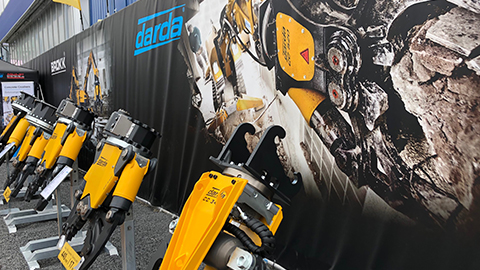
Relation to Darda GmbH products and application areas
In deep adit projects, precise, robust, and compact tools are decisive. Concrete pulverizers support selective removal of linings in concrete demolition and special demolition. Hydraulic wedge splitters enable low-vibration rock excavation and tunnel construction and profile adjustments. Complementary equipment includes hydraulic power packs, rock wedge splitters, combination shears, steel shear, multi cutters, and a cutting torch—particularly in special operations, in gutting works and cutting of built-ins, and in natural stone extraction where deep adits serve as exploration or extraction drifts. Selection always depends on geology, existing condition, and the project’s objectives.