
















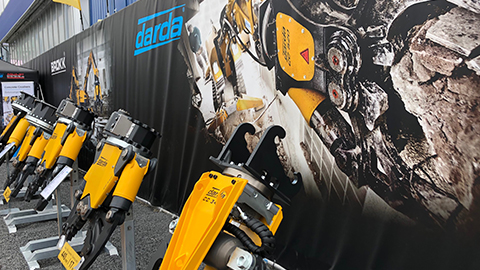





Retaining walls secure terrain, contribute to terracing slopes, and protect traffic routes, excavations, or shorelines against earth and water pressure. In practice, they appear as retaining walls made of concrete, reinforced concrete, natural stone, or as gabion-like constructions. As soon as existing structures must be adapted, deconstructed, or strengthened, material-appropriate, low-vibration methods are typically used. In many projects, Darda GmbH concrete crushers as well as hydraulic rock and concrete splitters are relevant, for example when creating openings, trimming projections, or controllably dividing massive components.
Definition: What is a retaining wall
A retaining wall (also called a retaining wall or embankment wall) is a structure that takes up lateral earth and water loads and transfers them into the ground. It creates permanent grade changes, holds slopes, and protects structures. Typical types are gravity walls made of concrete or natural stone, cantilever retaining walls made of reinforced concrete, anchored walls, gabion walls, and reinforced earth. Depending on the construction method, self-weight, shape, reinforcement, and possibly anchors counteract horizontal loads. Drainage elements such as drain pipes, filter gravel, and weep holes reduce the water pressure behind the wall.
Structure and functioning of a retaining wall
The basic configuration follows the load path. The rear face of the retaining wall is in contact with backfill of soil or rock that generates loads. The wall transfers these loads through its cross-section and the foundation base into the subsoil. Water in the backfill zone is particularly critical: lacking drainage can increase surcharge and uplift, promote cracking, and reduce overturning and sliding safety. For gravity walls, self-weight provides stability; cantilever retaining walls use T- or L-shaped cross-sections and reinforcement to resist bending moments. Anchors additionally tie the wall into competent soil layers. For existing structures this means: interventions such as creating openings, partial removal of the wall coping, or removing projections should not impair global stability. Therefore, for modifications, concrete crushers are often used for controlled removal and stone and concrete splitters for precise separation joints to minimize vibration and cracking in the remaining component.
Materials and construction methods
The choice of construction method depends on geometry, load level, subsoil, and environmental conditions. In existing structures, the following are most common:
- Gravity walls of unreinforced concrete or natural stone masonry with large wall thickness.
- Cantilever retaining walls (L- or T-elements) of reinforced concrete, as cast-in-place or precast.
- Anchored walls (e.g., bored-pile or sheet pile walls) as temporary or permanent solutions.
- Gabion walls with gravel or stone fill, often used in landscaping and shoreline protection.
- Reinforced earth with facing panels or masonry facings.
During modification and deconstruction of concrete retaining walls, concrete crushers are suitable for edge-near removal, notching, and dimensionally accurate profiling. For natural stone or massive concrete, stone splitting cylinders in combination with hydraulic power packs are proven to split blocks in a controlled manner along defined rows of boreholes. Steel shears or multi cutters cut reinforcement, while combination shears facilitate switching between breaking concrete and cutting steel parts.
Geotechnical actions: earth and water pressure
The decisive factors for the durability of a retaining wall are the actions from soil and water. Active earth pressure increases with structure height and backfill density; passive resistance acts at the wall toe. Water significantly increases loads, especially with fine-grained, low-permeability backfills. A functioning drainage system with filter layers, drain pipes, and weep holes is therefore essential. In practice, drainage elements are often retrofitted during rehabilitation, for which openings and grooves must be created in the existing structure. Low-vibration devices such as concrete crushers and stone and concrete splitters reduce risks to stability.
Typical damage and rehabilitation in existing structures
Common damage patterns include overturning, sliding, settlements, cracks, spalling, washouts behind the wall, and reinforcement corrosion. Causes often lie in clogged drains, changed backfills, or additional loads such as traffic or fills. Rehabilitation measures range from renewing drainage to strengthening the wall to partial deconstruction.
Component-appropriate partial deconstruction
For targeted interventions, e.g., removing the wall coping, exposing corroded reinforcement, or creating recesses, concrete crushers are suitable because of their controlled, low-splinter operation. Stone and concrete splitters create defined separation joints that divide massive cross-sections without blasting. Rebar is then cut with steel shears or multi cutters. Hydraulic power packs provide the power supply in confined site conditions.
Deconstruction and special deconstruction of retaining walls
Complete or partial deconstruction falls within the application areas of concrete demolition and special deconstruction. The challenge: proximity to traffic routes, utilities, or adjacent buildings limits conventional demolition methods. Low-vibration methods prioritize safety and protection of components.
Step-by-step procedure
- Stability check and definition of the deconstruction sequence with temporary safeguards.
- Create controlled separation cuts with stone and concrete splitters along rows of boreholes.
- Selective removal of wall segments with concrete crushers from top to bottom.
- Cut reinforcement with steel shears or multi cutters, switching with combination shears where appropriate.
- Orderly logistics for lifting, intermediate storage, and transporting the pieces away.
- In parallel: adjust or rebuild the drainage to safely discharge backfill water.
For natural stone walls, stone splitting cylinders can open blocks along predefined lines, thereby dividing the volume into manageable elements. Near rock, rock outcrops behind the wall can also be worked using splitting technology, which is advantageous for special operations in sensitive environments (e.g., historic sites).
Retrofit openings and penetrations
Dimensionally accurate voids are required for drainage openings, service channels, or maintenance access. Concrete crushers enable clean contours with low vibration and minimize secondary damage. Where massive cross-sections exist, pre-split notches with stone and concrete splitters create a defined fracture line. Reinforcement is then cut free with steel shears. This approach fits the strip-out and cutting domain, especially in confined situations without large-area cutting technology.
Interfaces with rock excavation and tunneling
In mountainous regions, retaining walls often adjoin exposed rock. When cutting free, widening, or replacing a wall, targeted processing of the rock restraint is crucial. Stone and concrete splitters here draw on rock excavation methods: they open rock along drilled lines without explosives and with low vibration. This allows the backfill to be adjusted, a new foundation base to be created, or a changed wall geometry to be prepared.
Material-appropriate work on natural stone retaining walls
For natural stone walls, preserving visible faces, protecting the bond, and controlled load redistribution are paramount. Splitting technology with stone splitting cylinders enables opening individual stones or blocks along the grain. This reduces flying fragments and avoids damage to adjacent stones. For removing projections or reworking bearing surfaces, concrete crushers are suitable, provided stone size and strength allow it.
Occupational safety and environmental protection
Work on retaining walls often takes place on slopes, along roads, or near water. Fall protection, safe traffic management, retention systems for falling parts, as well as dust and noise reduction must be considered. Low-vibration methods with concrete crushers and splitters help minimize effects on neighboring buildings and infrastructure. When working with water, the entry of fines must be avoided; discharges must be controlled. Legal requirements are project-specific and should generally be observed and coordinated with the relevant authorities.
Planning, design, and execution at a glance
Planning includes subsoil investigation, load assumptions, verification against overturning, sliding, and bearing failure, as well as verification against uplift. Drainage, filters, and backfill materials must be coordinated. In existing structures, the sequence of temporary stabilization, controlled intervention, and immediate re-stabilization is defined. For execution, an integrative approach has proven successful, combining geotechnical boundary conditions with the practical capabilities of the selected equipment:
- Preparation: documentation, surveying, determination of as-built properties and drainage function.
- Equipment selection: concrete crushers for precise, edge-near removal; stone and concrete splitters for separation cuts in massive cross-sections; hydraulic power packs as the energy source; steel shears/multi cutters for reinforcement.
- Site logistics: sequencing, intermediate storage, crane or lifting equipment, material separation for disposal or recycling.
- Quality assurance: continuous monitoring of stability, crack patterns, and drainage.
Fields of application and typical uses
Work on retaining walls touches several application areas of Darda GmbH:
- Concrete demolition and special deconstruction: selective removal, controlled disassembly, removal of foundation projections.
- Strip-out and cutting: openings, chases, recesses, penetrations in existing structures.
- Rock excavation and tunneling: working on the backfill and adjacent rock, exposing the footing.
- Natural stone extraction: supplying suitable natural stones or processing blocks for repairs.
- Special operations: work in tight, vibration-sensitive environments, during ongoing operations, or on historic structures.
Practical notes for site operations
A clear sequence reduces risks and improves execution quality.
- Create load-free areas; secure traffic and surroundings.
- Check the drainage condition; create weep holes if necessary.
- Create separation cuts with splitting technology to define predetermined fracture lines.
- Segment-by-segment removal with concrete crushers; cut reinforcement with steel shears.
- Adjust the backfill section by section and secure it temporarily.
- Renew the drainage and protect surfaces before follow-on work begins.
This sequence supports controlled load redistribution and minimizes vibration and dust. When altering the load-bearing system, the structural behavior should always remain in view.
Quality features of a functional retaining wall
Recognizably good retaining walls exhibit a clear load path, suitable backfill with functioning drainage, a construction that is sufficiently stiff or sufficiently heavy, robust surfaces, and low-damage joints and connection areas. In deconstruction, quality is characterized by controlled component sizes, clean separation faces, and minimal impact on adjacent structures—all aspects supported by the targeted use of concrete crushers and stone and concrete splitters.