












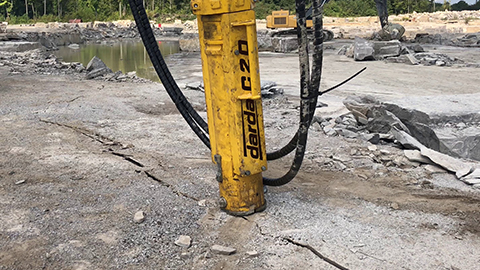



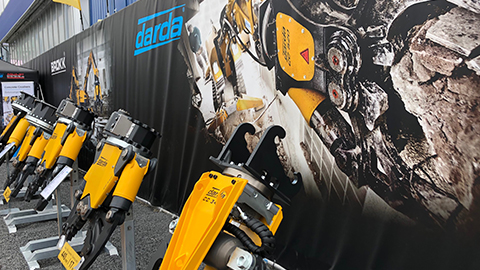





Prestressing systems are central elements of prestressed-concrete technology. They bundle and transmit tensile forces via tendons into concrete or rock members to control load-bearing capacity, crack width limitation, and deformation behavior. In deconstruction, the prestressing system acts as a stored energy source that must be controlled and safely released during cutting, breaking, or splitting. Tools such as Darda concrete crushers or hydraulic rock and concrete splitters from Darda GmbH are used to remove concrete in a controlled manner, expose tendons, and execute cuts or splits with defined effects – in application areas from concrete demolition and special deconstruction through building gutting and cutting to rock demolition and tunnel construction.
Definition: What is meant by a prestressing system
A prestressing system refers to the complete system of tendons (strand, wire, cable), anchorages, stressing heads, ducts, and, where applicable, grout, used to introduce prestress into concrete or rock members. The aim is to generate defined compressive stresses in the concrete and/or introduce tensile forces into anchors in order to carry loads, control crack formation, and limit deformations. A distinction is made between pre-tensioning in a casting bed (prestressing before concreting) and post-tensioning (prestressing after hardening), each with bonded (grouted) or unbonded (external) tendons. The prestressing system is therefore both a load-transfer element and a safety-relevant component—in construction and in deconstruction.
Structure and mode of action of prestressing systems
A prestressing system consists of tendons stressed in tension, which are introduced into the concrete or rock via anchorage heads. The prestressing force is applied using hydraulic stressing jacks and transferred into the member through friction and bond. In bonded systems, grout ensures the bond between tendon and concrete; in ungrouted systems, force transfer occurs at anchorage and deviator points. The force flow creates compression zones in the concrete cross-section and stabilizes the member under live and dead loads. During deconstruction, these very forces—including relaxation, friction losses, and deviator forces—must be considered to plan and execute cuts, breaking operations, or splits safely and in a controlled manner.
Components and variants
Prestressing systems differ by geometry, type of bond, and installation position. Standardized components have become established from a construction perspective, which must be identified and assessed during planning, execution, and deconstruction.
Typical components
- Tendon: Single- or multi-strand tendons, wires, or cables acting in tension
- Duct/channel: Guidance of the tendon, corrosion protection, grout space
- Anchorage head/stressing head: Force transfer, wedge or screw anchorage systems
- Grout: Bonding medium for bonded post-tensioning
- Deviators/guides: Geometric guidance, change of force lines
- Corrosion protection systems: Greases, fillers, sheathing for unbonded systems
Prestressing procedures
- Pre-tensioning in a casting bed: Tendons are stressed before concreting and released after the concrete has hardened, transferring the prestress into the concrete.
- Bonded post-tensioning: Tendons are stressed afterward and then grouted; the bond ensures permanent force transfer.
- Unbonded (external) post-tensioning: Tendons remain free to move, force transfer at anchorages/deviators; inspectable and replaceable.
Prestressing system in concrete demolition and special deconstruction
Prestress in prestressed concrete members influences every deconstruction strategy. The stored energy can be released abruptly during cutting, breaking, or splitting. An orderly approach reduces risks and enables controlled load redistribution.
Typical risks
- Snap-back of strands/wires during cutting
- Uncontrolled crack propagation and sudden member rotation
- Release of prestress energy at anchorage and deviator points
- Concealed tendon layouts with unclear force levels
Work sequence in deconstruction
- Investigation: Drawings, preliminary surveys, locating tendons and anchorage zones; define cutting and de-tensioning sequences.
- Exposure: Selective concrete removal (e.g., with concrete crushers) to make strands and anchorages visible; observe dust and noise mitigation.
- De-tensioning/cutting: Defined cut sequence, controlled de-tensioning; cutting tendons with steel shears or multi cutters, shielding against snap-back where necessary.
- Controlled breaking/splitting: Moderate cross-section reduction and crack initiation with rock and concrete splitters to deliberately modify stress states.
- Follow-up works: Removal of remaining reinforcement, haulage, documentation.
Hydraulically powered tools from Darda GmbH—including compact hydraulic power units—enable low-emission work steps, particularly for building gutting and cutting indoors as well as for special applications with restricted access.
Prestressing system in building gutting and cutting
Selective deconstruction of prestressed slabs, hollow-core units, or girders demands precise separation. Cutting and severing operations are planned so that field moments and support reactions do not rise to unacceptable levels.
Tool selection and cut layout
- Concrete crushers: Local removal of cover concrete layers, exposing tendons without large-scale loss of member material; good control near anchorage edges.
- Steel shears/multi cutters: Cutting strands, wires, and reinforcement; high cutting force for concentrated cross-sections.
- Rock and concrete splitters: Introducing a defined crack path to redistribute loads prior to cutting and to reduce residual prestress.
The combination of these methods enables clean progress with controlled force release—an essential factor for safety in existing structures.
Prestressing system in rock demolition and tunnel construction
Prestressed systems are also used underground and on slopes, such as rock anchors and pre-tensioned straps for rock mass and excavation support. These prestressing systems stabilize the ground by introducing targeted tensile forces.
Deconstruction and modification
- Expose anchor heads and bearing plates using concrete crushers or point splitting of the support areas.
- Cut tension members with steel shears or multi cutters, taking into account residual prestress and possible snap-back.
- Removal or partial de-tensioning to adapt construction states, for example prior to cross-section enlargements.
In rock demolition and tunnel construction, low-vibration, precise methods are required. Rock and concrete splitters enable blast-free removal in stress-carrying areas without endangering surrounding structures.
Condition survey and locating of tendons
Before intervening in load-bearing members, the position and condition of the prestressing system must be determined. This is especially true for historic structures or where documentation is incomplete.
Investigation methods
- Localization: Indirect locating methods, visual inspections after selective removal, borescope inspections in accessible ducts.
- Condition: Assessment of corrosion indicators, grouting quality (in bonded systems), and damage in the anchorage region.
- Measurements: Indications from deformations, crack patterns, and hammer sounding or simple resistance tests; supplementary testing per recognized engineering practice where required.
Important: Results must be documented in work and cutting plans and cross-checked with the de-tensioning and cutting sequence. Changes in the structural state must be continuously monitored.
Planning certainty, occupational safety, and environmental aspects
Occupational safety starts with planning. Prestressing systems require a step-by-step, controlled approach with defined chains of responsibility. The statements in this article are general and do not replace project-specific planning.
Principles
- Hazard analysis focusing on stored energy and unpredictable member behavior.
- Exclusion and protection zones against snap-back of strands; shielding at cutting points.
- Dust and noise reduction through appropriate removal and splitting techniques; water management to minimize environmental impact.
- Personal protective equipment, safe setup of hydraulic power packs, depressurized coupling.
Typical use cases
Prestressing systems are found in bridges, large-span slabs, hollow-core units, prestressed concrete girders, silo walls, and prestressed beams. This leads to recurring scenarios in deconstruction.
Examples
- Bridge span separation: De-tensioned separation cuts in edge areas, exposure and sequential cutting of strands, controlled cross-section reduction with concrete crushers.
- Slab openings: Local de-tensioning using rock and concrete splitters, followed by cutting tendons with steel shears and safe removal of segments.
- Prestressed girders: Expose anchorage heads, defined cutting sequence, load redistribution, final downsizing for transport.
Tool technology and interfaces
Appropriate tool technology supports the safe control of prestressing systems. Hydraulic systems enable high forces in a compact form—an advantage indoors and in confined situations.
Selection criteria
- Concrete crushers: Jaw opening, crushing force, weight; suitable for exposing anchorage heads and removing cover concrete.
- Steel shears/multi cutters: Cutting force and opening width relative to strand bundles, wires, and reinforcement.
- Rock and concrete splitters: Split stroke, wedge geometry, and borehole diameter matched to member thickness and desired crack path.
- Hydraulic power packs: Oil flow, pressure, and connection interfaces matched to the tool combination; safe hose routing.
Design and material aspects at a glance
Prestressing systems influence structural behavior over the entire life cycle. For planning and deconstruction, it helps to understand fundamental effects.
- Prestress losses: Immediate losses (anchorage seating, friction) and time-dependent effects (steel relaxation, concrete creep and shrinkage).
- Force deviation: Additional transverse forces at deviators; must be particularly secured during deconstruction.
- Crack patterns: Crack widths and directions provide indications of prestress direction and residual force levels.
- Bond quality: Decisive for load transfer and deconstruction behavior in bonded systems.
Practical tips for planning and execution
- First expose, then cut: A visible work area reduces surprises.
- Work from low-stress to stress-carrying areas: Plan the sequence.
- Small steps, multiple safeguards: Segmenting instead of large-scale interventions.
- Use combined methods: Concrete crushers for removal, steel shears for cutting, rock and concrete splitters for targeted de-tensioning.
- Snap-back protection: Shields, restraint systems, and defined catch directions for strands.
- Keep documentation continuously updated: Structural states, exclusion zones, and measured changes.