
















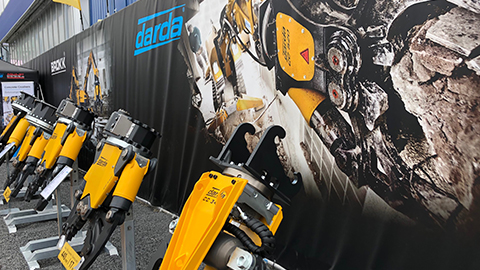





Silo demolition refers to the controlled deconstruction of cylindrical storage vessels made of reinforced concrete or steel. It combines engineering planning with practical deconstruction expertise: from emptying and building gutting through segmental separation to source-separated recycling. Depending on the construction type, mechanical, hydraulic, and saw- or splitter-assisted methods are used. In practice, concrete pulverizers as well as hydraulic rock and concrete splitters are often used, supported by compact hydraulic power units and steel cutting technology. Silo demolition is a classic part of concrete demolition and special demolition and adjoins the application fields of building gutting and concrete cutting and—where massive foundations are involved—techniques from rock excavation.
Definition: What is meant by silo demolition
Silo demolition means the planned, safety- and environment-oriented deconstruction of silo installations. This includes reinforced concrete and steel silos, single and battery silos, including built-in components, conveying equipment, attachments, foundations, and connections. The goal is selective, low-vibration and low-emission removal, the separation of construction materials (concrete, reinforcing steel, steel sheet) and orderly disposal or recycling. The term covers both complete demolition and dismantling of partial areas (e.g., superstructures, roof cones, discharge hoppers) as well as preparation by building gutting and concrete cutting.
Challenges and methods in silo demolition
The choice of method depends on material, wall thickness, structural behavior, surroundings, accessibility, and protected assets. Typical challenges include dust and noise, possible explosion hazards due to residual dusts, handling reinforcing steel and sheets, working at height, and limiting vibrations in sensitive environments. Proven approaches include mechanical biting with concrete pulverizers, controlled splitting with hydraulic wedge splitters, cutting of steel with steel shear, multi cutters or tank cutters, as well as saw- and wire-based segmental deconstruction. Hydraulic power packs provide the energy supply—stationary or mobile.
Planning, preliminary investigation, and occupational safety
Existing-condition analysis and planning always come before deconstruction. This includes review of documents, site walkdown, material identification, and the consideration of load paths, ring beams, prestressing, foundations, and connections. In facilities with potentially explosive dusts or residual media, additional hazard analyses, cleaning, and, where applicable, inertization measures must be taken into account. Safety requirements, access protection, personal protective equipment, dust suppression, and low-emission working methods have high priority. Statements regarding legal obligations are always to be understood in general terms and do not replace an individual assessment.
Typical construction types and suitable deconstruction principles
Reinforced concrete silos
Reinforced concrete shafts are often selectively deconstructed from top to bottom. Concrete pulverizers crush the shell, ring beam, and roof cone; the reinforcing steel is cut or taken along and separated later. For thick walls, hydraulic wedge splitters offer advantages: By creating controlled crack lines, vibrations are reduced and removal remains predictable—useful in special demolition near sensitive installations. Hydraulic power packs supply the tools; where access is tight, compact units are used.
Steel silos
Steel silos are dismantled in segments. Steel shear or multi cutters cut shell plates, stiffening rings, and gusset plates; tank cutters handle thicker sections and attachments. Structural behavior and buckling risk require a well-planned cutting sequence and load transfer. The cutting technique can be combined with wire- and saw-based measures, for example when setting down roof domes.
Hybrid and composite constructions
With mixed construction—such as a steel sheet shell on a concrete foundation or steel elements filled with concrete—methods are combined. Splitting techniques open massive pedestals and foundations, followed by separation of steel parts with shears. This keeps material separation source-separated, which facilitates recycling.
Deconstruction strategies and sequence at a glance
Deconstruction strategies depend on structural analysis, surroundings, and logistics. Common are segmental deconstruction from top to bottom, saw- and wire-supported dismantling of larger components, as well as splitter- and shear-based removal for controlled, low-vibration results.
- Selective removal with concrete pulverizers: controlled biting of concrete elements while simultaneously exposing the reinforcing steel; suitable for concrete demolition in sensitive neighborhoods.
- Splitting technique for massive walls: hydraulic wedge splitters create defined cracks and reduce force input and vibrations—advantageous in special demolition scenarios.
- Cutting technology on steel components: steel shear, multi cutters and tank cutters separate sheets, profiles and built-ins; suitable for building gutting and concrete cutting and the dismantling of steel silos.
- Saw and wire methods: for precise, straight separation cuts when components are to be set down or moved as a whole.
Emissions, vibrations, and environmental protection
Dust and noise reduction, vibration control, and careful water management are key quality criteria. Where technically possible, dust suppression, shielded cutting areas, and low-emission methods are preferred. Hydraulic wedge splitters and concrete pulverizers support low-vibration and quieter work, which is particularly relevant in special demolition within existing facilities.
Explosion and fire protection
Special precautions apply to residual dusts and media. Potential hazards are assessed during planning; cleaning, inertization, and ignition source control measures are aligned with local conditions. Cutting operations are shielded and monitored; spark generation is limited.
Sustainability and recycling
Silo demolition aims for high recycling rates. With concrete pulverizers, concrete can be crushed so that reinforcing steel is largely exposed. Steel fractions are separated with shears and cutters. Source-separated fractions simplify transport and recycling, reduce disposal costs, and conserve resources.
Logistics, accessibility, and equipment selection
Equipment selection and access planning are closely interlinked. Criteria include the load-bearing capacity of the surroundings, drop heights, crane and lifting installation, and the required drive power of the hydraulics. Hydraulic power packs supply attachments and handheld tools; compact solutions are advantageous indoors or where load-bearing capacity is limited.
Confined sites and interior demolition
In production facilities or densely built environments, deconstruction must be especially compact, quiet, and controlled. Here, splitter- and shear-based methods with small carrier machines and suitable power supply have proven themselves—an application of building gutting and concrete cutting in combination with special demolition.
Foundations, shafts, and attachments
Foundations, discharge hoppers, and impact walls often have high reinforcement ratios. Hydraulic wedge splitters open massive cross-sections, followed by separation of the reinforcing steel. Techniques known from rock excavation can be adapted to direct forces and release components in a controlled manner.
Material separation and circular economy
Sorting follows removal: mineral fractions, reinforcing steel, clean steel sheet, and possibly residual equipment. Concrete pulverizers and shears facilitate separation already during the process. The aim is reuse or high-quality recycling, for example as recycled aggregate or secondary raw material. Storage and transport are kept separate, and routes short, to minimize emissions.
Quality assurance and monitoring
Documentation, progress checks and—where necessary—measurements of dust, noise, and vibrations are standard. Complete documentation supports evidence, disposal, and later site use. Statements on measurement and limit values must be verified on a project-specific basis.
Practice-oriented scenarios
- Agricultural silo on a farmstead: small clearances, sensitive neighboring buildings. Splitting and shear techniques reduce vibrations and dust; hydraulic power packs enable the use of compact tools.
- Cement silo at a plant: heavy reinforcement, massive ring beams. A combination of concrete pulverizers and hydraulic wedge splitters, plus shears for reinforcing steel, ensures controlled removal.
- Steel silo in a chemical environment: increased requirements for spark control. Cutting technology with steel shear, multi cutters or tank cutters in shielded areas; segment-by-segment lowering.
Links to application areas and product categories
Silo demolition lies at the intersection of concrete demolition and special demolition as well as building gutting and concrete cutting. Depending on the task, product categories such as concrete pulverizers, hydraulic wedge splitters, hydraulic power packs, combination shears, multi cutters, steel shear and tank cutters are used. Transferable techniques from rock excavation and tunnel construction are particularly helpful when opening massive components or foundations. Darda GmbH stands for these working methods as a technological reference point in planning and execution, without the choice of method replacing the necessary project-specific verification.