





















The silicone joint is an elastic sealing of construction joints and connections that absorbs movements and protects against moisture, dirt, and noise. In solid and concrete construction it appears on façades, in wet rooms, at window and door connections, and with precast elements. In deconstruction, during gutting and during the gentle separation of components, the silicone joint influences the work sequence: It is often removed before the use of hydraulic tools to obtain clean edges and to prepare material separations—such as with concrete demolition shears or rock and concrete splitters—in a targeted manner. For planners, contractors, and specialists in concrete demolition, the silicone joint thus provides important cues to movement and connection zones that can be strategically utilized in deconstruction and refurbishment.
Definition: What is meant by silicone joint
A silicone joint is understood to be the construction joint filled with a silicone-based joint sealant or the elastically sealed connection between two different building materials. The sealant cures elastically, remains permanently deformable, and can accommodate movements resulting from temperature changes, vibrations, or settlement. Silicone joints primarily serve sealing against water and air, not structural functions. In contrast to acrylic or polyurethane sealants, silicones are characterized by high aging resistance, resistance to moisture, and a wide temperature spectrum. They are used in interior areas (wet cells, kitchens, laboratory areas) and on exterior components (façade connections, windows, natural stone claddings).
Composition, properties, and use in construction
A silicone joint consists of the adhesion flanks (e.g., concrete, mortar, natural stone, metal, glass), a suitable backer material to avoid three-sided adhesion, and the elastic sealant. The performance of the joint depends on joint width and depth, adhesion to the flanks, movement accommodation, and climatic exposure. In concrete construction, proper preparation of the adhesion surfaces—dust-free, dry, and sound—is decisive. On critical substrates, primers are used to improve bonding.
Material systems and curing
Silicone sealants cure through ambient humidity. There are neutral-curing systems (low odor, compatible with metals and natural stones) and acetoxy systems (vinegar odor, possible risk with sensitive metals). Neutral-curing products are often better suited for concrete and natural stone, as they are less prone to edge-zone discoloration.
Mechanical properties
Essential parameters are Shore hardness, permissible total deformation, and recovery behavior. A correctly dimensioned silicone joint can permanently accommodate cyclic movements from expansion and compression. Decisive are the joint width, the joint cross-section (rule of thumb: width to depth ≈ 2:1), and ensuring two-sided adhesion.
Compatibility and adhesion
Adhesion to concrete, cement plaster, brick, and metals is generally good, provided the substrate is sound, clean, and dry. With natural stone, edge discoloration may occur depending on the formulation. Preliminary tests are advisable. Release agents, formwork oil residues, dust, or old sealant residues reduce adhesion.
Typical application areas on concrete and precast elements
- Connection joints of window and door frames in concrete or masonry openings
- Joints on precast concrete elements, façade claddings, and balcony slabs
- Floor-to-wall connections in wet rooms and laboratories
- Expansion joints at transitions between components with different deformations
- Movement joints on stair flights, stair landings, and support areas
The role of the silicone joint in deconstruction, gutting, and separation
In the context of concrete demolition and special deconstruction as well as interior demolition and cutting, silicone joints often mark functional separation lines between components. They can serve as “reading traces” in the existing structure to identify connection points and plan the dismantling sequence. Before using concrete demolition shears or rock and concrete splitters, the silicone joint is often removed so that a clear, defined component edge is created, minimizing peak loads and spalling. At the same time, removal prevents soft sealant from contaminating tool grippers or obscuring visibility of cracks and embedded elements.
Influence on demolition methods
In areas with elastic connection joints, components can often be released in separation steps: first remove sealants and insulating materials from joints, then release mechanical connections (anchors), and subsequently cut concrete in a targeted manner with concrete demolition shears or split with stone and concrete splitters. The sequential approach reduces damage to adjacent components and facilitates construction waste sorting of materials.
Special situations
- Façade elements: Silicone joints seal panel seams; before lifting or a shear cut, remove joints and expose brackets/anchors.
- Balconies/arcades: Edge joints at connections mark movement zones; plan shear cuts outside the sealing.
- Interior areas: In wet rooms, silicone joints indicate sealing layers that are cleanly deconstructed during interior demolition.
Removal of silicone joints: Procedure in existing buildings
The following sequence is intended as a general, non-binding orientation. It must be adapted to the project, substrate, and work environment and carried out in compliance with applicable occupational safety and environmental protection rules.
- Survey and marking of joints: Record width, depth, adjacent materials, and potential hazardous substances in the vicinity.
- Mechanical release: Use sharp knives, draw knives, or scrapers to cut the joint on both sides and pull out the strip of sealant.
- Residual cleaning of adhesion flanks: Carefully remove silicone residues; use only compatible cleaners, do not roughen substrates, and do not damage edges.
- Remove backer material: Completely remove backer rods and soft inserts, exposing the joint cavity.
- Prepare component separation: Visual inspection for anchors, reinforcement, and embedded parts; mark the planned gripping or splitting points for concrete demolition shears or stone and concrete splitters.
- Carry out the dismantling/deconstruction step: Grip, separate, split, or cut; subsequently separate material streams by construction waste separation.
Dust and emissions protection
During mechanical removal, dusts, fibers from backer materials, or odors may be released. Suitable dust extraction, personal protective equipment, and a low-dust working method are advisable. In sensitive areas (e.g., hospitals), protective enclosures and negative-pressure arrangements should be considered.
Waste and disposal
Residues from silicone joints, backer materials, and contaminated cleaning cloths must be disposed of according to their composition. Regional requirements apply. Separate collection facilitates construction waste recycling and recovery paths for concrete, metal, and glass from deconstruction.
Interfaces to Darda GmbH tools and workflows
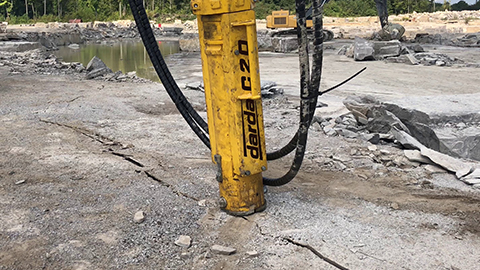
In work sequences during concrete demolition, clean exposure of joints supports the precise application of hydraulic tools. Concrete demolition shears benefit from clearly recognizable edges and exposed adhesion flanks to create controlled fracture lines. Stone and concrete splitters work particularly effectively when joint areas have first been freed of soft sealants and the splitting wedges are set in sound concrete. Hydraulic power packs supply the energy for these separation processes; multi cutters, steel shears, or combination shears can, after joint removal, cut through metal profiles, reinforcement, or façade substructures. In special operations, such as during tank dismantling, elastic sealing connections are likewise identified and removed before tank cutters or other separation tools are used.
- Interior demolition and cutting: Remove silicone joints at window and door connections, remove frames, and then separate load-bearing components with concrete demolition shears.
- Façade deconstruction: Open panel seams, expose anchors, release elements, and remove them section by section with stone and concrete splitters or shears.
- Natural stone extraction and rock excavation: Silicone plays hardly any role here; mineral separation joints are more relevant. The approach remains focused on precise, controlled splitting processes.
Quality, damage, and refurbishment of silicone joints
The serviceability of a silicone joint depends on correct dimensioning, a suitable formulation, and professional execution. Typical damage patterns impair tightness and appearance and can harm adjacent materials.
- Edge adhesion failure: Insufficient adhesion on one flank, often caused by contamination, missing primer, or three-sided adhesion.
- Embrittlement/cracks: Aging, UV exposure, or an unsuitable formulation for the stress.
- Mold growth: Moisture, organic residues; for sanitary joints, use fungicidal systems and ensure good ventilation.
- Edge-zone discoloration: Incompatibility with natural stone or plasticizer migration.
- Undermining by water: Incorrect joint profile, insufficient depth, or voids.
Remediation principle
Defective silicone joints are completely removed, adhesion surfaces cleaned, and—if necessary—pretreated with a compatible primer. Renewal follows the original joint design. For concrete components, it is advisable to also inspect and document adjacent cracks and edges in the course of joint refurbishment.
Planning, design, and execution notes
For a durable silicone joint, carefully coordinate joint width, permissible total deformation, and substrate condition. Backer material (e.g., closed-cell rod) ensures two-sided adhesion, keeping the joint profile elastic and insensitive to cracking. Application is carried out at suitable temperature and humidity; surfaces are tooled cleanly. In areas with subsequent deconstruction, well-documented joint routing is advantageous, as it simplifies later dismantling steps.
Compatibility with adjacent building materials
Neutral-curing silicones are often the first choice for concrete, metal, and natural stone to avoid corrosion and edge discoloration. For coated metals, glass-fiber-reinforced plastics, or old coatings, sample areas and pull-off adhesion tests are useful. Plastics sensitive to plasticizers should be avoided or combined with suitable systems.
Notes on legal and standard conformity
The selection and application of joint sealants are subject to technical rules and manufacturer specifications. Requirements for fire protection, indoor emissions, or weather resistance must be checked on a project-specific basis. Binding statements for individual cases cannot be made here; the applicable standards and approvals are authoritative.
Specifics in tunneling and large-volume structures
In areas such as rock demolition and tunnel construction, joints are rarely executed with silicone, but with elastomer seals, injection resins, or segment-related sealing systems. However, silicone joints may occur at ancillary installations, technical rooms, or interior fit-out. For deconstruction, the same applies: identify elastic connection seals, remove them without damage, and subsequently carry out mechanical separation and splitting processes in a targeted manner.