












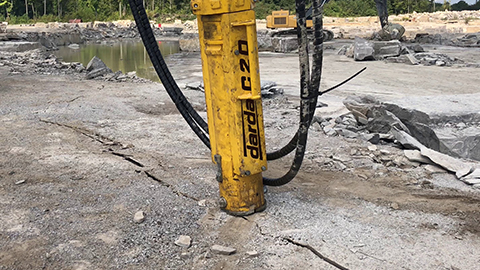



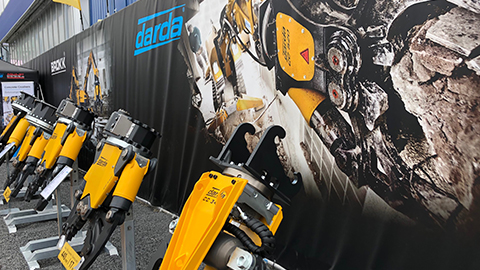





A screening bucket is a tool mounted to excavators or other carrier machines for the mechanical separation of materials by particle size directly on the construction site. In demolition, deconstruction, recycling, civil engineering, and natural stone processing, it enables pre- and post-screening of concrete, masonry, rock, excavated material, topsoil, or backfill. In combination with tools such as concrete demolition shears or stone and concrete splitters, the screening bucket supports an efficient process chain: process, sort, reuse.
Definition: What is meant by a screening bucket
A screening bucket is a hydraulically driven bucket attachment whose bottom or interior functions as a screen. Using grid systems, screening basket inserts, rotating drums, or star rotors, material is separated into undersize (passing through) and oversize (remaining in the bucket). The goal is to produce defined particle size fractions, remove foreign materials, and reduce transport, landfill, and disposal costs. Unlike stationary or mobile screening plants, the screening bucket works directly at the point of material generation, shortening travel distances and allowing flexible interventions in the material flow.
Design and operation of screening buckets
Screening buckets typically consist of a robust main body with suspension, a screening module (e.g., grid bottom, interchangeable cassettes, drum, or rotors), a hydraulic drive with torque transmission, and wear parts (cutting edges, teeth, bushings). Separation occurs through mechanical action: when tilting, shaking, or rotating, the material moves across the screen openings; fines fall through, oversize is separated. Interchangeable inserts enable different mesh sizes and thus adjustable target gradations. Modern designs allow adaptation of rotational speed and, in part, the aggressiveness of material motion to moisture content, particle shape, and cohesiveness.
Types and screening technologies
Depending on the material, desired particle fraction, and carrier machine, different designs are used. The choice of technology influences performance, separation precision, and wear.
Drum screening buckets
Material rotates in a cylindrical, perforated basket. The drum provides uniform mixing and good discharge. Suitable for excavated material, soil, topsoil, and construction debris with a moderate fines content. Interchangeable drums with variable perforations allow flexible screening sizes.
Rotor screening buckets with star or shaft modules
Several parallel shafts with star discs or paddles convey material across adjustable gaps. This design tolerates moist, cohesive material and reduces clogging. It is suitable for pre-screening in concrete demolition and special deconstruction as well as for soil conditioning.
Grid screening buckets (skeleton-bucket)
A reinforced grid bottom enables simple classification of coarse fractions. It is robust, requires no complex drive, and is particularly resistant in harsh applications, such as rock excavation and tunnel construction or natural stone extraction.
Replaceable screening modules
Interchangeable frames with different mesh sizes, hole patterns, or bar spacing allow adaptation to target gradation and material properties. This facilitates combination with concrete demolition shears and stone and concrete splitters, as the appropriate fraction can be provided or reclassified in each case.
Typical applications and process chains
Screening buckets deliver particular benefits in integrated workflows. The following examples show typical process chains and their added value.
- Concrete demolition and special deconstruction: Pre-screening fines from construction debris, removing adhering soil, providing defined fractions for further processing with concrete demolition shears. After size reduction: post-screening for classification into recycled construction materials.
- Strip-out and cutting: After removing metallic installations with cutting tools (e.g., shears), the screening bucket separates mineral fractions, reduces mixed content, and facilitates source-segregated disposal.
- Rock excavation and tunnel construction: Sorting the muck pile into oversize and undersize, separating backfill material and lining aggregate, pre-screening to stabilize temporary site access roads.
- Natural stone extraction: Classifying rubble stone, separating overburden and fines, preparing formats after splitting with stone splitting cylinders or stone and concrete splitters.
- Special applications: Producing bedding material for utility line installation, processing contaminated material within approved procedures, pre-screening ahead of smaller crushing or splitting operations in sensitive areas.
Interplay with concrete demolition shears
In deconstruction, the screening bucket can remove fines from demolition material before concrete demolition shears size-reduce load-bearing components. This reduces wear at cutting/crushing points, lowers dust, and improves visibility. After size reduction, the screening bucket produces uniform fractions for transport or reuse as backfill material, provided the framework conditions allow.
Interplay with stone and concrete splitters
When splitting massive components or natural stone blocks, a mixture of fragments and fines is produced. The screening bucket separates these into usable fractions. In this way, undersize can be provided for subgrade or bedding, and oversize for further splitting or cutting. This conserves resources and stabilizes cycle times in special deconstruction as well as in natural stone extraction.
Selection criteria: sizing, particle sizes, and carrier machine
The right configuration is crucial for performance, cost-effectiveness, and safety.
- Carrier machine and hydraulics: Operating weight, lifting forces, and hydraulic performance (flow, pressure) must match the screening bucket. For handheld applications, hydraulic power packs supply other tools in the same process chain; the screening bucket itself is usually powered by the excavator’s on-board hydraulics.
- Screen geometry: Mesh size, hole shape, and open screen area determine throughput and separation precision. Larger openings increase throughput but reduce separation precision.
- Material properties: Moisture, cohesiveness, particle shape, and contamination influence the choice between drum, rotor, or grid designs.
- Target gradation and specifications: Requirements for recycled construction materials or backfill define tolerances. On-site tests and documented grading curves can be useful.
- Wear protection: Hardfacing, replaceable wear strips, and bolted edges increase service life and maintainability.
- Work environment: Space constraints, emissions (noise, dust), and material logistics influence the sensible size of the screening bucket and the pacing of the process chain.
Operation, occupational safety, and environmental aspects
Operating screening buckets requires a working method matched to the carrier machine, clear procedures, and qualified personnel. Safety distances and a forward-looking material flow contribute to safe and efficient operations. Legal and occupational safety requirements are site- and project-specific; any statements here are general in nature.
Safety notes
- Keep hazard zones around the slewing radius clear; keep personnel at a safe distance.
- Observe pinch and shear points; service the bucket only with hydraulics shut down.
- Ensure secure support when changing screening modules; use suitable lifting gear.
- Depressurize hydraulic lines; regularly check for leaks.
- Plan dust and noise mitigation; use appropriate personal protective equipment.
Emissions and circular economy
On-site screening reduces transport distances, produces fewer mixed fractions, and increases recoverable material streams. This supports circular construction site logistics and improves the environmental balance, especially in combination with precise separation tools such as combination shears, multi-cutters, steel shears, or tank cutters, which make metal content sortable.
Maintenance, wear, and cost-effectiveness
Regular maintenance increases availability and lowers overall costs. Daily visual inspections for cracks, play in bearing points, and tooth and edge wear are recommended. Rotating systems require well-maintained bearings, intact seals, and correctly tensioned drives. From an economic perspective, throughput, availability, wear part costs, and transport reduction determine overall performance. A mesh size tuned to the downstream process (e.g., concrete demolition shear or stone and concrete splitter) avoids double screening and improves cycle accuracy.
Practical examples of material flow
Selective deconstruction: Metallic installations are removed with cutting tools, load-bearing components are pre-crushed with concrete demolition shears, and fines and contaminants are separated with the screening bucket. Result: source-segregated fractions, reduced disposal, usable recycled aggregates.
Rock removal and tunnel advance: After controlled splitting with stone and concrete splitters, the muck is classified into oversize and undersize with the screening bucket. Undersize serves as backfill or grading material; oversize goes on for further processing or logistics.
Natural stone extraction: After splitting raw blocks, overburden is screened out. Reusable fractions are available as road base or bedding material, provided project-specific requirements are met.