












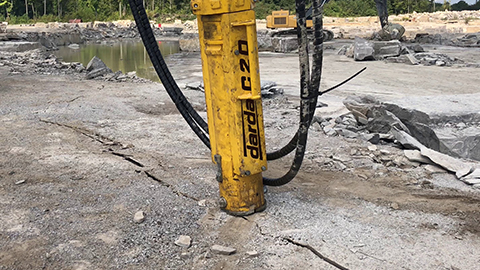



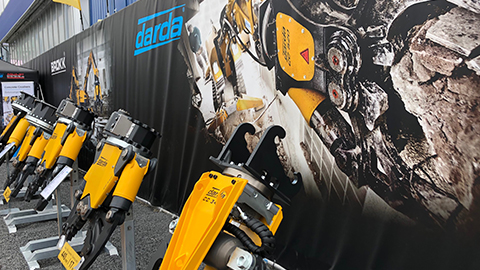





Thrust force describes the rectilinear force with which a drive pushes components, separates materials, or advances wedges. In demolition, interior demolition, rock excavation, and natural stone extraction it is a key parameter because it directly determines how efficiently tools such as concrete demolition shears or rock and concrete splitters operate. In hydraulic applications by Darda GmbH, thrust force is generated by pressure in cylinders, translated through lever mechanisms, and delivered as usable working force at cutting edges, jaws, or splitting wedges.
Definition: What is meant by thrust force
Thrust force is the axially directed compressive force of a drive, usually a hydraulic cylinder. It acts as feed or clamping force in the direction of motion. It is distinct from tensile force (axially opposite), shear force (transverse to the surface), and bending forces. In hydraulic tools, thrust force typically arises from the product of hydraulic pressure and effective cylinder area. Through kinematics (levers, wedges, eccentrics), this cylinder force is transformed into splitting, cutting, or crushing forces as required by concrete demolition shears or rock and concrete splitters.
Calculating thrust force in hydraulic systems
The theoretical thrust force F of a hydraulic cylinder is ideally given by F = p × A. Here p is the hydraulic pressure and A is the piston area (during the pressure stroke), while for the retraction stroke the rod cross-sectional area is subtracted. For practical values, efficiencies η for friction, seals, and kinematics are considered: F_eff ≈ p × A × η.
Influencing factors
- Hydraulic pressure p: Pressure level of the hydraulic power pack; high-pressure systems use up to several hundred bar.
- Piston diameter and rod diameter: Larger area means more thrust force; during the return stroke the rod reduces the effective area.
- Tool kinematics: Lever arms, wedge angles, and pivot points determine how the cylinder force is translated into cutting or splitting force.
- Friction and losses: Seals, guides, and joints reduce the effective force; regular maintenance keeps η high.
- Hydraulic oil temperature and viscosity: Influence flow losses and thus the available force at a given delivery rate.
Example calculation (simplified pressure stroke)
Given: pressure p = 700 bar (70 MPa), piston diameter d = 90 mm. Piston area A = π × d² / 4 ≈ 0.00636 m². Theoretical thrust force F = 70,000,000 Pa × 0.00636 m² ≈ 445,000 N = 445 kN. With a conservative overall efficiency η = 0.85, ≈ 378 kN remain at the cylinder. Through a wedge with a 1:4 mechanical advantage, ≈ 1.5 MN are available at the splitting element.
Thrust force in rock and concrete splitters
Rock and concrete splitters use the thrust force of a hydraulic cylinder to drive a wedge set into pre-drilled boreholes. The wedge angle generates a strong radial splitting force that separates the material along its planes of weakness. The thrust force must overcome friction between wedge and counter-wedges, borehole friction, and the material’s tensile strength in the splitting direction.
Practical aspects
- Borehole geometry: Diameter and depth influence the friction component and the effective splitting depth.
- Wedge angle: Shallow angles increase force transmission but raise friction and require good lubrication.
- Rock/concrete: Anisotropy, grain structure, reinforcement content, and moisture dictate the required splitting force.
- Setting sequence: Evenly setting multiple splitting points reduces restraint and lowers the thrust force needed per tool.
Thrust force in concrete demolition shears
In concrete demolition shears, the thrust force of the hydraulic cylinder is converted via lever arms and joints into a large pressing and cutting force at the jaws. Beyond pure thrust force, jaw kinematics, blade geometry, and residual stresses in the material determine the actual breaking performance. For reference, see Combi-Shears HCS8.
Force path and transmission
- Cylinder stroke and levers: Short jaws with a large lever ratio deliver high jaw force at low jaw speed.
- Blade shape: Profiled, wear-resistant blades concentrate contact pressure and reduce the force required to bite in.
- Reinforcement: Reinforcing steel increases the required peak force; favorable attack points at cracks and edges reduce the demand.
Hydraulic power packs: pressure, flow rate, and thrust force
Hydraulic power packs supply the necessary system pressure and oil volume. In practice, appropriately matched hydraulic power units are selected to meet pressure and flow requirements. The maximum achievable pressure limits the thrust force, while the flow rate determines the feed speed. A higher pressure level increases available thrust force, but only within the permissible pressure ratings of the cylinder and fittings. Low temperatures increase viscosity and thus losses; warm, stable oil temperatures favor consistent force development.
Practical tuning
- Check the tool’s maximum pressure rating and set the power pack accordingly.
- Select hose lengths and cross-sections to keep pressure losses low.
- Implement a return line without constrictions to avoid backpressure.
Sizing for application areas
The required thrust force strongly depends on the application. In concrete demolition and specialized deconstruction, reinforcement ratio, member thickness, and concrete age matter; in rock excavation and tunnel construction, rock class, bedding, and moisture dominate. In natural stone extraction, controlled, low-crack separation is desired, so uniform thrust force development and reproducible wedge forces are paramount. For interior demolition and cutting, precise, metered forces are important to protect adjacent structures. Special operations often require individual testing and safety margins.
Material and environmental influences on the effectiveness of thrust force
The bare number for thrust force says little if material behavior and environment are not considered. Moisture, temperature, and microstructure determine where the applied force acts and when separation cracks form.
Key influences
- Concrete: Compressive strength, crack widths, carbonation, and reinforcement ratios change the force demand and fracture pattern.
- Rock: Foliation, joint spacing, and grain bonding define the splitting direction and the required wedge force.
- Temperature: Cold = higher oil viscosity and more friction losses; warm = lower viscosity, but respect thermal limits.
- Lubrication: Regularly lubricate wedge guides and joints to reduce friction components.
Measurement and monitoring of thrust force
In practice, thrust force is rarely measured directly. It is common to monitor system pressure and derive cylinder force from the known piston area. For verification, calibrations with load cells or standardized test setups can be performed. Measurement and test procedures should generally follow recognized engineering practice; binding statements for individual cases cannot be derived from this.
Indicators of sufficient thrust force
- Constant pressure values without pronounced pressure spikes.
- Smooth tool feed without jerking or blocking.
- Reproducible splitting or breaking behavior across multiple setting points.
Typical failure modes and remedies
If the available thrust force does not reach the workpiece location, this is often due to losses or unfavorable kinematics.
Common causes
- Pressure losses: Hoses that are too long or narrow, restricted couplings, contaminated filters.
- Friction: Dry wedges, worn guides, insufficient lubrication.
- Poor attack point: Bite far from edges, unfavorable jaw positioning, unsuitable borehole placement.
- Tool wear: Dull blades, damaged wedge faces increase force demand.
Practical tips
- Check hydraulic pressure with a calibrated gauge and verify the return line.
- Clean and lightly lubricate wedges and joints; maintain wear dimensions.
- Select attack points that address natural planes of weakness.
- Work in several moderate setting steps instead of one maximum push.
Example force chains in selected tools
The conversion of thrust force into working force follows the tool’s force path. Understanding this chain facilitates proper application and troubleshooting.
Rock and concrete splitters
- Cylinder thrust force → wedge feed → mechanical transmission through wedge angle → radial splitting force in the borehole → crack propagation along material weaknesses.
Concrete demolition shears
- Cylinder thrust force → shear lever mechanism → concentrated pressing and cutting force at the jaws → crushing and splitting action in concrete, potentially cutting reinforcing steel.
Selection criteria for the right thrust force
The suitable thrust force results from member thickness, reinforcement ratio, material class, and the desired separation quality. Tools should be chosen to provide sufficient reserves without exceeding permissible pressure and load limits.
Guiding questions
- How thick is the member or how large is the block?
- What material properties (strengths, jointing) are present?
- What access is available and which attack points can be used?
- Which hydraulic power packs are available with what pressure/flow rate?
Maintenance and preservation of thrust force
Only well-maintained hydraulic systems deliver the calculated thrust force. Tightness, cleanliness, and proper lubrication are essential. Wear on blades, jaws, and wedge faces acts like an additional resistance and reduces the force that reaches the workpiece.
Recommendations
- Change hydraulic oil per manufacturer specifications and monitor filter condition.
- Regularly check hoses, couplings, and seals for tightness.
- Replace wear parts in time; document functional dimensions.
Force interplay and interaction with the material
Thrust force unfolds its effect in combination with other mechanical influences. In concrete demolition shears, thrust force plus lever transmission creates local contact pressure that initiates cracks. In splitters, thrust force becomes a high, radially oriented splitting stress. The optimal operating point is where local material strength is exceeded without generating unnecessary peak forces. This enables controlled deconstruction with reduced side effects such as vibration or overloads.