
















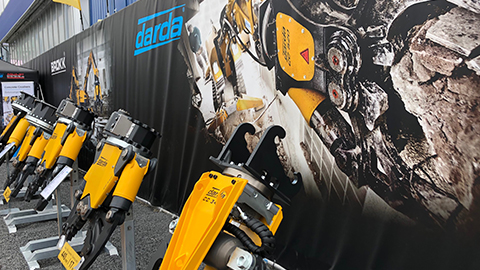





Hose lines are the connecting element of modern high-pressure hydraulics – they transmit energy safely and flexibly between the hydraulic power pack and the tool. In the applications of Darda GmbH, such as in concrete demolition and special demolition, in gutting works and cutting, as well as in rock demolition and tunnel construction, hose lines must reliably cope with high pressures, dynamic load cycles, vibrations, and abrasive environments. Whether on concrete demolition shears, hydraulic splitters for stone and concrete, Multi Cutters, steel shears, or tank cutters: The performance and availability of the equipment stand and fall with the correct selection, routing, care, and inspection of the hose line.
Definition: What is meant by hose line
A hose line is a flexible, pressure-bearing hydraulic line consisting of a medium-resistant inner tube, one or more reinforcement layers (braid or spiral), and a protective outer cover. Fittings (insertions, press sleeves, connection fittings, and couplings) are permanently attached at the ends. Hose lines are used to safely conduct hydraulic fluids at high static and alternating pressures. They differ from rigid piping through their flexibility, which enables a compact and vibration-decoupled connection of tools such as concrete demolition shears or hydraulic splitters.
Structure and mode of operation of hose lines
The fundamental build combines media compatibility, strength, and environmental protection. The inner tube (e.g., NBR, thermoplastics, or PTFE) seals against the hydraulic medium. The reinforcement layers (steel wire braid or spiral) carry the working pressure and absorb pressure spikes. The outer cover protects against abrasion, weathering, and chemical influences. End fittings provide a force- and media-tight connection to the hydraulic system. Quick couplings, often in flat-face design, reduce leakage during coupling and facilitate tool changes between concrete demolition shears, Multi Cutters, or tank cutters on Darda Hydraulic Power Units.
Materials and pressure ratings
Typical materials include rubber-based compounds (for high flexibility and good cold bend performance), thermoplastic hoses (low weight, low volumetric expansion), and PTFE linings (high media and temperature resistance). Reinforcements made of wire braid provide good impulse resistance; spiral windings carry high continuous pressure loads. In high-pressure hydraulics applications, working pressures are in the range of several hundred bar; the hose line must therefore be designed with a sufficient safety factor, suitable impulse resistance, and an appropriate temperature class.
Connections and couplings
Connection fittings (e.g., metric, BSP, UNF) are crimped into the insertion. Quick couplings enable safe, quick disconnection—even with gloves and under construction site conditions. Dust caps and careful cleaning before coupling protect the system against particles, which is particularly important for hydraulic splitters and concrete demolition shears, as dirt ingress puts stress on valves and seals.
Requirements in concrete demolition, special demolition and rock breakout
Hose lines in demolition are exposed to harsh conditions: abrasive dusts, edges, impacts, varying bending radii, and frequent coupling cycles. At the same time, flow and pressure supply must remain stable to ensure the required closing force and cycle time of concrete demolition shears or the controlled pressure generation in hydraulic splitters. In tunnel construction, confined spaces, long hose runs, and heightened requirements for fire protection and emission reduction are added.
Hose lines on concrete demolition shears
With concrete demolition shears, hose sizing directly influences closing and opening speed. Tight bending radii near the tool connection, torsion due to movements, and chafing edges are typical loads. Suitable kink protection, swivel connections, and wear-resistant protective sleeves increase service life. The return line should be designed for low back pressure to minimize heating and performance losses.
Hose lines on hydraulic splitters for stone and concrete
Split cylinders require a pressure-stable and impulse-resistant supply line. In the borehole environment, mechanical protection and clean coupling processes are essential, as concrete and rock dust put heavy stress on the coupling system. Long hose lines between hydraulic power pack and splitter require careful design for pressure loss and volumetric expansion so that the splitting process remains controlled and reproducible.
Selection criteria and sizing
- Nominal diameter (DN) matched to the required flow rate for the tool
- Working pressure, impulse resistance, and safety factor suited to the hydraulic system
- Permissible bending radius in operation, including movement allowances
- Temperature range (ambient and medium), cold bend behavior
- Media compatibility (mineral oil, bio-based fluids, water-glycol)
- Hose length considering pressure loss, volumetric expansion, and handling
- Surface protection against abrasion, sparks, and weather
- Weight and flexibility for low-fatigue manual handling
Pressure loss and velocity
Pressure loss increases with length and decreases with larger inner diameter. Excessive flow velocities cause heating, noise, and efficiency losses. A well-matched DN keeps pressure loss and oil velocity in the optimal range so that concrete demolition shears work quickly and powerfully and hydraulic splitters build their splitting pressure precisely.
Installation, routing, and protection
- Route hoses without tension, avoid torsion (a marking stripe helps with inspection)
- Observe bending radii: no kinking, sufficient length reserves for movements
- Use chafe and edge protection, hose clamps with large-area support
- Bundle hose packages, provide clear routing and strain relief at tool connections
- Vibration decoupling between hydraulic power pack and tool
- Dust caps and cleaning of the couplings before every coupling operation
Hose packages in practice
In many applications, feed and return, sometimes with leak oil or control lines, are combined into a hose package. Strain reliefs and defined handover points facilitate the tool change between concrete demolition shears, Multi Cutters, and other tools from Darda GmbH.
Safety, testing, and framework conditions
The safe use of hose lines requires regular visual and functional checks, documented intervals, and replacement when visible damage is present. Pressure testing and assembly should only be performed by competent parties. Appropriate safety equipment must be used when coupling and under pressure. Notes on legal or normative requirements are to be understood in general; in individual cases, the currently applicable regulations apply.
Typical inspection characteristics
- Cracks, blistering, bulging, or flattened bends
- Leakage at press sleeves and couplings
- Corrosion or mechanical damage to the fittings
- Illegible marking or missing identification
- Excessive heating during operation (indication of too small DN or restrictions)
Maintenance, cleaning, and storage
Cleanliness is crucial: clean couplings, use caps, flush hoses during initial commissioning. Regularly check the filter condition of the hydraulic power pack. Store cool, dry, protected from light, and without stress; avoid tight winding. Inspect for external damage before each use and disconnect only when depressurized.
Hydraulic media and environmental aspects
Hose materials must match the medium—whether mineral oil, rapidly biodegradable fluid, or water-glycol. Check compatibility with seals and outer cover. Low leakage during coupling (e.g., flat-face systems) reduces fluid release, which is advantageous in tunnel construction, natural stone extraction, and special applications. Any released medium must be properly contained and disposed of.
Common failure patterns and causes
- Abrasion marks from contact with edges or reinforcement – optimize protection and routing
- Internal delamination due to strong pressure pulsation – check impulse resistance and DN
- Overheating due to an undersized hose cross-section – reduce flow velocity
- Media incompatibility – adjust material selection
- Assembly errors at fittings – use only professionally crimped insertions
Practical examples from the fields of application
Concrete demolition and gutting works
When switching between concrete demolition shear and tank cutter, clean, smooth-running couplings facilitate rapid changeover. Longer hose lines from the hydraulic power pack located outside the dust zone reduce the system’s dust exposure; chafe protection and defined handover points prevent damage at edges.
Rock breakout and natural stone extraction
Hydraulic splitters often operate with long supply lines into boreholes. Mechanical protection, clear marking, and avoiding tight radii increase operational safety. Before uncoupling, depressurize the line, clean couplings, and protect them immediately with caps.
Tunnel construction and special operations
Confined areas and poor lighting require robust hose packages with unambiguous marking. Low leakage during coupling reduces emissions. Reliable routing prevents trip hazards and minimizes the crushing hazard at moving components.