












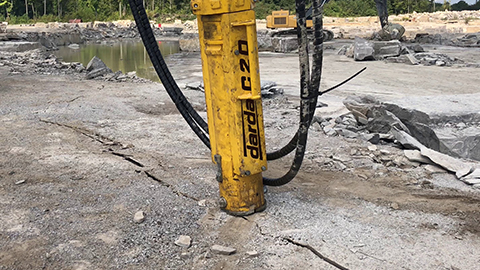









A slurry layer forms when water binds fine solids such as cement paste, rock flour, dust, and abrasion particles, and settles as a thin film or as a soft-plastic layer on components, rock surfaces, or the construction site floor. In demolition, deconstruction, rock processing, and during sawing or drilling, this layer is frequently encountered. It affects workflows, surface adhesion, visibility of cracks and reinforcement, as well as stability and slip resistance. For the use of Darda GmbH tools—such as concrete demolition shears or hydraulic rock and concrete splitters—the correct handling of slurry layers is a decisive factor for precise, safe, and efficient work steps.
Definition: What is meant by a slurry layer
A slurry layer is a fine-grained, water-bound deposit of mineral particles and binders that accumulates on horizontal or inclined surfaces, at component edges, or in depressions. It may appear as a thin lubricating film (slurry film) or be several millimeters to centimeters thick. Characteristic features include increased moisture content, reduced load-bearing capacity of the surface, and a lower coefficient of friction. Depending on its origin, the layer contains cement fines, filler dust, rust particles, drill cuttings, rock flour, additives from cooling or drilling fluids, and organic constituents. In tunnel heading, a so-called filter or filter cake layer from bentonite suspensions can occur; during wet cutting, cement-bearing slurry forms, which can leave a hard crust when drying.
Formation and properties of slurry layers
Slurry layers typically arise from wet processes such as core drilling, wire sawing, wall sawing, joint cutting, high-pressure water applications, or wetting for dust suppression. During rock and concrete drilling, flushing water and fines promote deposition in hollows and channels. In heading operations with support fluids, a thin filter layer forms at the contact surface to the rock, often reducing bearing capacity. Physically, cohesion (internal bonding) and adhesion (bonding to the substrate) act: this can make the layer lubricious, reduce the coefficient of friction, impair visibility of component structures, and influence water and fine-particle management on the construction site.
Slurry layer in concrete demolition and special deconstruction
In concrete demolition using wet methods, fine cement constituents deposit as a slurry film on surfaces and fracture edges. This has practical consequences for gripping, cutting, and separating components: a moist, smooth layer reduces friction between tool and component, obscures potential crack lines, and can cause the shear jaw geometry to seat unfavorably. Especially with concrete demolition shears, safe positioning at prominent edges and clear visibility of reinforcement layers are important.
Influence on gripping and cutting processes
A pronounced slurry layer can cause shear jaws to slip more easily, cutting lines to be followed less precisely, and additional positioning steps to be necessary. Areas with high water presence make it harder to achieve reproducible cutting and fracture results. After wet cutting, it is generally advisable to clean contact surfaces so that frictional contact is restored. The same applies to subsequent work with combination shears, Multi Cutters, or steel shears when slurry impairs visibility of the material composite.
Occupational safety on slip-prone surfaces
Slurry films increase the risk of slipping for personnel and machines. Transitions between dry and wet partial surfaces, ramps, and slopes are particularly critical. Secure setup of the carrier machine and the avoidance of shear and crushing hazard require load-bearing, grippy standing areas. In practice, this includes targeted water and slurry management with drainage and collection.
Relevance in rock excavation and tunnel construction
In rock excavation, slurry layers occur especially where drilling is done with flushing or water is used for dust suppression. In tunnels and galleries, suspensions (e.g., bentonite) form a filter layer at the tunnel face. This thin but often smooth layer can reduce friction at contact surfaces and make it harder to identify natural discontinuities. These conditions are typical for rock demolition and tunnel construction.
Impact on hydraulic splitters
When using hydraulic splitters as well as stone splitting cylinders, the splitting forces act through boreholes into the material. Slurry-filled or wet boreholes dampen the initial bite, worsen bonding at the borehole wall, and can delay controlled crack initiation. In practice, thorough borehole cleaning has proven effective so that the splitting forces can be introduced in a defined manner.
Visibility, orientation, and geometry
Slurry can obscure rock structures, joint geometries, and drilling marks. For precise crack steering, targeted separation of blocks, and alignment to joint sets, a clear surface is helpful. This applies to rock removal in tunnels and on slopes as well as to natural stone extraction.
Building gutting and cutting: Clean cut surfaces as a process advantage
In building gutting with wall, wire, and joint saws, cement slurry frequently forms. This film impairs subsequent work such as biting off remaining webs with concrete demolition shears or placing combination shears at saw kerfs. Clean, grippy contact zones support positive and frictional engagement and make it easier to control crack paths and reinforcement exposure.
Quality of cutting and fracture results
Reduced surface adhesion due to slurry can lead to unwanted micro-movements. The result is ragged edges, spalling, or higher material loss. Appropriate cleaning between process steps contributes to dimensional accuracy and facilitates repeatability.
Natural stone extraction: fines, water flow, and block separations
In stone quarries, a slurry layer forms through drilling, sawing, or wetting of dusty surfaces. Moist fines deposit in joints, at discontinuities, and on bedding planes. For splitting and separation work with stone splitting cylinders, borehole cleanliness is important; for gripping and cutting operations, a clear surface helps to exploit natural separations and read interfaces.
Special applications: interiors, tanks, sensitive areas
In sensitive zones—such as in plant areas, shafts, or when working on tanks—slurry can mix with operation-related residues. Increased requirements apply to cleanliness, slip protection, and the separation of fresh and wastewater. For measures with tank cutting equipment, controlled drainage and collection of the resulting slurry material are essential to avoid contaminating adjacent areas. Project-specific requirements regarding media, emissions, and occupational safety must be observed before starting.
Effects on tools, hydraulic power packs, and interfaces
Slurry-laden environments stress bearings, joints, and moving parts through abrasive fines. At couplings, connectors, and hydraulic power packs, the ingress of slurry should be avoided. Clean connection points support functional safety. On the working surfaces of concrete demolition shears and cutting tools, a slurry film affects friction and thus tool seating. A brief cleaning step before gripping or cutting increases process reliability.
Wear and service life
Fines act like abrasives. Where slurry adheres permanently, fits can loosen faster and surfaces can fatigue. This applies especially to contact zones where high surface pressures occur. Prevention in this context means reducing slurry ingress and regularly cleaning exposed areas.
Occupational safety and surface stability
Slurry layers reduce grip, diminish the load-bearing capacity of temporary traffic areas, and increase the risk of slipping, skidding, or settlement. Sufficient surface stability is required for the safe operation of equipment and for personnel. This includes firm setup areas for the carrier machine, low-slip pathways, and the avoidance of water accumulation.
Practical measures on the construction site
- Plan water routing: Provide slopes, channels, and capture points for collection and sedimentation areas.
- Concentrate slurry purposefully: Define inlets, pump sumps, and retention volumes early.
- Increase slip resistance: Regularly remove smooth slurry films from walking and working surfaces.
- Clean contact surfaces: Before placing concrete demolition shears or using hydraulic splitters, remove surface films to improve frictional contact and precision.
- Blow out/dewater boreholes: Remove fines and water from boreholes so that splitting forces act in a defined manner.
- Ensure visibility: Expose markings, cracks, and reinforcement before starting gripping or cutting processes.
Environmental and disposal aspects
Depending on the process, slurry layers contain cement fines, filler dust, and metallic particles. Uncontrolled distribution can burden water bodies, soil, and drainage systems. In practice, slurries are collected, the solids fraction is separated, and the remaining water—after general treatment and within the applicable requirements—is retained or discharged.
Typical steps in slurry management
- Collection at defined points (channels, basins, trays) to prevent sheet flow.
- Separation by sedimentation, screening, or filtration (e.g., geotextile filter, mobile separation technology).
- Interim storage and transport of solids in accordance with project-specific requirements.
- Optional conditioning (e.g., thickening) to reduce volume.
- Verification of basic parameters such as solids content and, if necessary, pH value within general requirements.
Legal aspects vary by project, location, and method. Requirements for discharges, separation, and disposal must be observed; case-by-case assessments are carried out by the project.
Measurement and assessment of the slurry layer
For practice, simple, reproducible assessment is often sufficient: visual inspection, tactile checking, and spot thickness measurement provide indications of whether friction, bearing capacity, and visibility are sufficient. For sensitive work, e.g., in special deconstruction, defined acceptance criteria (e.g., maximum permissible layer thickness) help to release process steps.
Indicators for action
- The layer is recognizable as a continuous, glossy film and feels lubricious.
- Tools show a tendency to slip when being placed or held.
- Markings, cracks, or reinforcement are not clearly visible.
- Footpaths and driving routes lose noticeable grip.
Impacts on material quality and recycling
Slurry increases the moisture and fines content in the material flow. For high-quality recovery of concrete demolition or natural stone, it is advantageous to separate slurry portions early. This improves material purity, reduces cleaning effort in processing, and can increase the quality of recyclates.
Practical recommendations for controlled handling
A planned approach helps limit the effects of the slurry layer and ensure process quality. The following recommendations have proven themselves in various applications:
- Plan the process sequence: Remove slurry generated by wet processes promptly before it dries and forms crusts.
- Secure access: Keep work and escape routes clear and, if necessary, make them slip-resistant.
- Prepare contact points: Briefly clean contact surfaces before gripping, splitting, and cutting.
- Protect equipment: Keep couplings, connectors, and moving components protected from slurry ingress and clean.
- Drilling management: Remove drill cuttings, keep boreholes clear, and avoid water accumulation.
- Use water sparingly and purposefully: Wet enough to bind dust, but avoid standing water and uncontrolled slurry distribution.
Relation to products and application areas of Darda GmbH
Slurry layers affect numerous applications: concrete demolition shears in concrete demolition and special deconstruction require grippy contact surfaces; hydraulic splitters work more reliably in clean boreholes kept free of slurry. Combination shears, Multi Cutters, and steel shears benefit from clear lines of sight and contact points, especially after wet cutting or sawing. In rock excavation and tunnel construction, slurry influences orientation to joint systems; in natural stone extraction, clean separation geometry facilitates targeted setting-down of blocks. Hydraulic power packs operate reliably when connection points are kept free of slurry ingress. In special deployments—such as work on tanks—controlled slurry and water management is a fundamental part of safe operations.