
















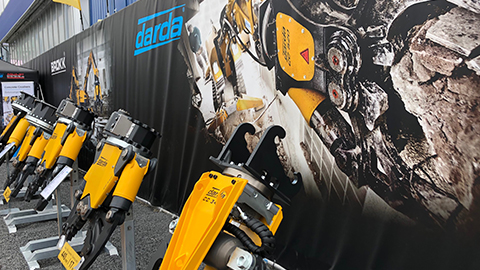





Slag recycling refers to the proper processing and use of metallurgical by-products from iron and steel production as well as from non-ferrous metal processes. The aim is the safe, economical, and ecological conversion of these materials into secondary raw materials for the construction industry, the cement sector, and road construction. In practice, teams in concrete demolition and special demolition as well as in building gutting and concrete cutting frequently encounter solidified slag blocks, founded installations, and concretes penetrated by slag. Tools from Darda GmbH—especially concrete demolition shears and rock wedge splitters and concrete splitters—play a role when low-vibration crushing, selective separation, and preparation for further processing are required.
Definition: What is meant by slag recycling
Slag recycling encompasses all processes for the processing, classification, quality testing, and material utilization of blast furnace slags (ground granulated blast furnace slag), steelmaking slags (e.g., LD/BOF and EAF slags), and slags from non-ferrous metallurgy. Utilization includes mechanical size reduction, metal recovery, grading-band adjustment, stabilization of reactive phases, and use in applications such as cement and concrete production, base layers, asphalt, fills, or noise barrier construction. It conserves resources, reduces landfill risks, and can lower greenhouse gas emissions when primary raw materials are substituted.
Processing and processes of slag recycling
The process chain begins with cooling (air-cooled or water-granulated), followed by the pre-crushing of massive pieces, screening and sorting by particle sizes, separation of magnetic and nonmagnetic metals, adjustment of defined grading bands, and quality assurance. In industrial areas with limited space and sensitive surroundings, low-vibration methods are often chosen: concrete demolition shears for slag-bearing concretes, foundations, and superstructures, and rock wedge splitters and concrete splitters for oversized, basalt-like hard slag boulders. After piece size reduction, additional crushing stages follow, conditioning may be applied to ensure volume stability (for free CaO/MgO), and tests for environmental compatibility are conducted. The result is recycled construction material with documented quality for defined uses.
Types of slags and technical properties
Slags differ depending on origin, cooling, and chemical composition. These differences determine density, particle structure, reactivity, and thus suitability for various utilization pathways.
Blast furnace slag (ground granulated blast furnace slag)
Water-granulated blast furnace slag is glassy, latently hydraulic, and, after grinding, suitable as an interground component in cement or as a binder component. Air-cooled variants form coarse-crystalline, rock-like aggregates for base layers and fills. Critical aspects include consistent quality, sulfide contents, particle shape, and polishing characteristics.
Steelmaking slags (LD/BOF and EAF slags)
Steelmaking slags are strong, tough, and often metal-bearing. They typically exhibit higher densities and require thorough processing for metal recovery and to ensure volume stability. Free CaO/MgO can cause delayed reactions; appropriate conditioning and testing are essential.
Non-ferrous slags
Slags from copper, nickel, or zinc processes are more heterogeneous. Depending on the process, they can be used as blasting abrasives, mineral fillers, or, after stabilization, as construction materials. Environmental requirements are particularly in focus here.
Applications and utilization pathways
Utilization takes place in clearly defined fields, whose suitability is determined by standards, technical regulations, and site-specific requirements.
- Cement and binder technology: Use of ground granulated blast furnace slag as a clinker-saving component in CEM II/CEM III or other binder concepts.
- Road construction: Unbound base layers, asphalt base courses, frost protection layers, and shoulders, provided suitability and environmental criteria are met.
- Concrete with recycled aggregate: Air-cooled slags as aggregates in selected applications with verified parameters.
- Earthworks and hydraulic engineering: Retaining bodies, embankments, noise barrier walls, and backfilled excavation pits with documented environmental compatibility.
- Industrial applications: Blasting abrasives, filter materials, or fillers depending on particle size and chemical composition.
Traceable test certificates, consistent grading bands, suitable particle shape, and defined physico-chemical properties are decisive for marketability.
Size reduction, selective separation, and tools
The choice of size-reduction and separation technology determines the efficiency, safety, and quality of slag recycling. Mechanical, selectively acting methods reduce vibrations, dust, and secondary damage to adjacent components—an essential aspect in concrete demolition and special demolition as well as in building gutting and concrete cutting within existing facilities.
Concrete demolition shears when handling slag
Concrete demolition shears open slag-bearing concretes, foundation bodies, and superstructures in a controlled manner. They separate reinforcing steel from the mineral matrix and create defined piece sizes for subsequent crushing stages. In slag-bound soils and foundations in steel plants or foundries, the shear allows quiet, precise work with good visibility of the separation joint.
Rock and concrete splitters for oversized slag blocks
Rock wedge splitters and concrete splitters generate controlled cracks from boreholes in massive, dense slag blocks (for example, EAF slag). This includes the use of hydraulic rock and concrete splitters. The method is low-vibration, avoids uncontrolled brittle fractures, and can be used in halls or near sensitive peripheries. The resulting fragments often present advantageous edges for conveying and sorting processes.
Supplementary tools in industrial environments
- Rock splitting cylinders: For deep, directional splitting of thick monoliths.
- Combination shears and multi-cutters: For exposing and cutting embedded parts, profiles, ducts, and plant components during building gutting.
- Steel shears: For cutting heavy steel structures, beams, and plates from process environments of slag processing.
- Tank cutters: For dismantling cylindrical vessels, granulation basins, or piping systems in the vicinity of slag facilities.
- Hydraulic power packs: As the energy source for hydraulic attachments and handheld tools; selection and sizing of hydraulic power units according to power demand and deployment environment.
Quality assurance, testing, and acceptance criteria
The quality of screened slag products is demonstrated through mechanical and chemical tests. The goals are volume stability, reliable particle size distribution, suitable particle shape, and compliance with environmentally relevant parameters.
Tests for volume stability
Free CaO/MgO can cause expansion. Conditioning phases, storage, and standardized expansion tests support assessment. For use in asphalt or base layers, polishing and abrasion values are also relevant.
Environment and water balance
Leachate and seepage water tests assess the release of soluble constituents. Requirements may vary by region and intended use. Project stakeholders coordinate utilization in advance with the competent authorities and document results transparently.
Process chains in deconstruction and rehabilitation
In existing metallurgical facilities, deconstruction teams frequently encounter slag in foundations, ducts, basins, and processing zones. Structured workflows enhance safety and efficiency.
- Survey of existing conditions: Record material types, reinforcement, embedded parts, potential contamination, and accessibility.
- Securing and separation: Isolate media, cordon off areas, establish fire protection and dust protection.
- Pre-crushing: Use concrete demolition shears to open slag-bearing concretes; use rock wedge splitters and concrete splitters to split oversized slag blocks.
- Exposing metals: Separate relevant metal fractions with combination shears or steel shears to improve sorting quality.
- Classification: Screen, separate, set grading bands; temporary storage by quality classes.
- Documentation: Record tests, delivery notes, and material destination without gaps.
Occupational safety, emissions, and operating practice
Dust, noise, sparks, and residual thermal heat are typical risks in slag logistics. Low-vibration methods with targeted size reduction support emission control. Personal protective equipment, low-spark working methods, dust extraction, and coordinated yard traffic routing are proven measures. Increased caution and coordinated permits apply to hot or freshly solidified slags.
Ecological and economic aspects
By substituting natural aggregates and clinker content, slag recycling contributes to resource conservation and potentially to CO₂ reduction. Economically relevant factors include stable quality, short logistics routes, minimal rework, and avoidance of off-spec batches. Careful pre-crushing with appropriate tool selection reduces process costs in downstream crushing stages.
Challenges and solution approaches in slag recycling
- Heterogeneity: Achieve consistent grading bands through finely tuned screening and targeted secondary size reduction.
- Oversized monoliths: Use rock wedge splitters and concrete splitters to split large blocks in a controlled manner and enable conveyance.
- Metal adherences: Expose with concrete demolition shears, then cut with shears to increase metal recovery.
- Volume stability: Plan for conditioning, storage times, and tests; select application areas accordingly.
- Confined sites: Use low-vibration, precise tools and mobile hydraulics to protect adjacent structures.
- Documentation: Anchor quality assurance and traceability as fixed components of the process chain.
Relation to typical application areas
In practice, slag recycling touches multiple application areas: In concrete demolition and special demolition, slag-bearing components are selectively opened; in building gutting and concrete cutting, precise separation cuts and the release of embedded parts in plant rooms are required. Parallels to rock excavation and tunnel construction arise due to the high strength of some slags—techniques of directional splitting are transferable. Requirements known from natural stone extraction regarding particle shape and grading bands are similarly found in slag processing. In special demolition—for example, in sensitive areas with strict emission requirements—low-vibration methods with controlled size reduction have proven their worth.