




















The wheelbarrow is an inconspicuous yet central tool of construction logistics on construction site operations. Especially in confined conditions, from building gutting to special demolition, it enables the controlled removal of concrete debris and rock fragments as well as reinforcement pieces. In combination with the quiet, low vibration levels tools from Darda GmbH—such as concrete demolition shear or hydraulic rock and concrete splitters—manageable fragment sizes are created that can be moved efficiently and safely by wheelbarrow. This supports a low-disruption workflow in concrete demolition and in special operations where heavy construction machinery cannot be used or can only be used to a limited extent.
Definition: What is meant by a wheelbarrow
A wheelbarrow is a manually guided transport device with a tray, frame, wheel, and handles. The load rests predominantly over the wheel, is stabilized by the operator, and is guided via the handles. Typical tray capacities are about 60 to 120 liters; practical payload depends on the ground, tray material, tires, and the operator’s physical capacity. In addition to single-wheel versions, variants with two wheels exist for higher stability. In construction, the wheelbarrow transports construction debris, fragments of concrete and natural stone, reinforcement parts, and auxiliary materials such as mortar, chippings, or sand.
Design and operating principle
A wheelbarrow consists of a tray (steel or plastic), a torsion-resistant frame, one or two wheels with axle and bearings, and ergonomically shaped handles. Its operating principle uses leverage: when lifting, the center of gravity shifts over the wheel so that the load’s weight is largely rolled rather than carried. This makes short-haul transport easier, through doors, corridors, and over ramps. With proper loading, the tray can be tipped in a controlled manner to discharge material precisely into collection points or containers.
Fields of application in concrete demolition and special demolition
In interaction with hydraulic tools from Darda GmbH, the wheelbarrow proves its worth wherever precise, low vibration levels cutting or splitting processes take place and the resulting materials must be removed from the work area without delay:
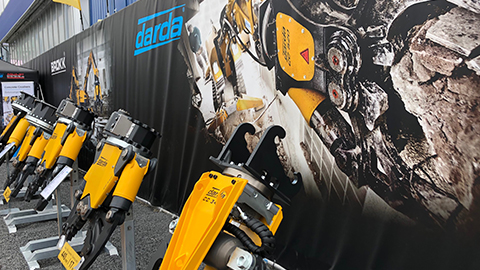
Concrete demolition shear: Control breakage, manage piece weights
In selective deconstruction, a concrete demolition shear enables crushing and separating concrete while simultaneously exposing the reinforcement. Through targeted notches, fragments are produced that can be transported in the wheelbarrow within ergonomic limits. Shorter routes and sensible pre-segmentation reduce the risk of overloads, particularly during building gutting and cutting in existing structures.
Rock and concrete splitters: Low vibration, operator-friendly
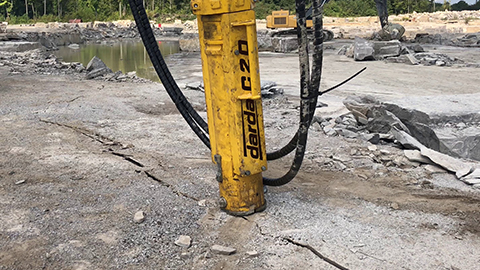
Rock and concrete splitters as well as rock wedge splitter systems create low-noise split joints in concrete and natural stone. The split result is often angular and predictable—ideal for manual removal via stairwells, shafts, or tunnel portals. In rock excavation and tunnel construction, the wheelbarrow is used to bring separated wedges and remnants to collection areas, where further secondary breakage or construction waste sorting takes place.
Combination shears, multi cutters, steel shear
When cutting reinforcing steel, profiles, and pipes, sections are produced that, for safety reasons, must be neither too long nor too heavy. By shortening with combination shears, multi cutters for steel sections, or a steel shear, transportable lengths can be produced that do not overload the tray or the routes. This helps prevent pinching, edge damage, and instability during tipping.
Special operations and tank cutters
In sensitive areas, such as work on vessels where cold cutting with the tank cutter is used, controlled logistics play an important role. Short routes with wheelbarrows minimize additional risks from mobile machines and facilitate clean separation of the cut segments. Company-specific safety measure must be observed.
Technical characteristics and selection criteria
The appropriate wheelbarrow depends on material, route length, ground conditions, and the planned work sequences in deconstruction.
Tray material and corrosion protection
Steel trays are robust, resist sharp-edged concrete debris, and are suitable for high point loads. Hot-dip galvanized surfaces provide corrosion protection but require careful cleaning after contact with cement paste. Plastic trays (e.g., HDPE) are lighter, noise-damping, and corrosion-resistant, but they reach their limits more quickly with sharp-edged fragments. For recurring contact with abrasive materials, a steel tray with a reinforced edge is recommended.
Tires, bearings, and ground contact
Pneumatic tires distribute loads well and dampen shocks on uneven ground. Puncture-proof solid rubber or PU wheels avoid downtime due to nails or shards but transmit more vibration. Ball or roller bearings in the hub area reduce pushing forces at high loads. On smooth interior floors, profiled tires improve traction and reduce slip risk, especially when wet cutting or when dust suppression is used.
Ergonomics and tipping behavior
Handle height, handle diameter, and frame stiffness influence physical strain. A balanced geometry ensures that the tipping moment remains controllable even with partial loads. Wide stands prevent sinking on soft ground. For stair runs, the clearance under the tray is crucial to negotiate steps safely.
Work organization and logistics planning
In concrete demolition, well-thought-out construction logistics determine cycle time and safety. The wheelbarrow is the link between the separation or splitting process and the collection point.
Routing, ramps, and handover points
Routes should be free of tripping hazards, hoses from the hydraulic power pack, and loose reinforcement bar ends. Keep ramp gradients moderate and secure transitions at door thresholds with edge protection. Discharge points close to the crushing or sorting zone avoid return trips with empty runs. Where possible, define one-way routes and reduce opposing traffic.
Sensibly limiting piece weights
By selecting the attack points of the concrete demolition shear and by controlled splitting, piece sizes can be managed so that resulting loads remain ergonomic. General occupational safety requirements and in-house rules on manual handling must be observed; concrete feasibility always depends on the specific case, the person, and environmental conditions.
Capacity planning in practice
A straightforward approach to estimating logistics needs:
- Record the material quantity: volume or mass of the concrete debris or rock fragments per cycle.
- Define the usable volume of the wheelbarrow: use a realistic fill level instead of the nominal capacity.
- Control piece size: choose a splitting or cutting strategy that allows even filling.
- Measure route time: determine outbound, unloading, and return times under real conditions.
- Calculate the number of trips per cycle and add buffers for bottlenecks, ramps, and waiting times.
The result is a reliable basis for personnel and cycle planning as well as for arranging additional collection points or intermediate storage.
Safety and health protection
Safe work with the wheelbarrow starts with loading: heavy pieces at the bottom, center of gravity centered over the wheel, cover sharp edges. Roll on level, load-bearing routes; on slopes, move slowly and use both hands. Personal protective equipment—especially gloves with good grip and sturdy footwear—reduces risks. Cutting and splitting processes with Darda GmbH tools should be planned so that no unsecured fracture edges protrude into traffic routes. Dust suppression and noise reduction measures provide additional relief. Legal requirements must always be checked on an organizational basis and generally observed.
Care, maintenance, and service life
Regular cleaning prevents cement residues from adhering and extends service life. Lubricate bearings; check tires for condition and pressure; inspect trays and frames for cracks or distortion. Replace damaged handles and stands promptly. Store dry for extended periods and prevent corrosion.
Alternatives and complements
On long transport routes or steep ramps, motorized small equipment can complement the wheelbarrow. In confined existing buildings with limited load-bearing capacity, however, the manual wheelbarrow often remains the most reliable means. The precise working method of the concrete demolition shear, concrete splitter, and other tools from Darda GmbH supports this because they produce controlled, manageable fragment sizes that can be handled without heavy construction machinery.
Practical examples from typical application areas
Gutting and cutting
During the deconstruction of interior walls and slab fields, material is segmented with a concrete demolition shear and transferred directly into wheelbarrows. Shorter steel portions, produced with a steel shear or multi cutters, prevent lever action against the tray edge.
Rock excavation and tunnel construction
After splitting with rock wedge splitter systems, wedges and fragments are taken short distances to collection points. The wheelbarrow enables cycle-stable workflows in cross-sections where larger equipment cannot maneuver.
Natural stone extraction
In the environment of extraction, the wheelbarrow facilitates the removal of overburden or remnants from the splitting process. Tray robustness and puncture-proof tires are decisive features here.
Special operations
In sensitive areas, for example in facilities with special requirements, the wheelbarrow supports calm, controlled logistics. Routes remain free of unnecessary machine traffic, and cut segments from tank demolition cutting work can be removed transparently and safely.
Terminology and regional variants
Depending on the region, the wheelbarrow is also referred to as a “Schubkarre” or “Handkarre.” Regardless of the designation, its purpose remains the same: short, safe material transports in demanding environments—especially where Darda GmbH tools enable precise cutting and splitting and orderly construction logistics support the quality and safety of execution.