












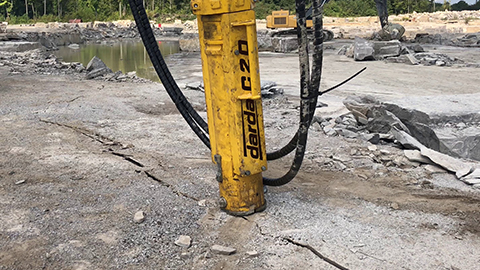









A formwork plan is the central working basis for concrete placement in building and civil engineering. It translates structural and architectural requirements into an executable solution made of formwork sheathing, formwork scaffold, anchors, props, and work sequences. Precisely planned formwork shortens construction times, secures the required surface quality, and minimizes rework. Where dimensional corrections, openings, or the removal of defects are still required, construction companies often use low-vibration methods as part of concrete demolition and special demolition—for example, concrete demolition shears or controlled splitting with rock and concrete splitters, powered by suitable hydraulic power units. This preserves the existing structure and maintains the durability of adjacent structural elements.
Definition: What is meant by a formwork plan
A formwork plan is a set of drawings and calculation data that governs the production of a concrete member using a temporary mold—the formwork. It contains geometry, layer build-up of the formwork sheathing, spans and prop spacings, anchor and joint grids, concrete placement sections, permissible fresh concrete pressures, assembly and dismantling sequence, as well as notes on occupational safety. In contrast to the reinforcement plan, the formwork plan describes the shaping and load-bearing auxiliary structure and its actions during concreting. It may include 2D and 3D elements and is often linked with the formwork structural analysis, the work schedule, and approval protocols.
Structure and contents of a formwork plan
The content depends on the member, construction method, and fair-faced concrete requirements. For safe and economical execution, at least the following information is required:
- Member geometry with axes, elevations, formwork sheathing thickness, and joint layout; identification of fair-faced concrete areas
- Formwork system, formwork sheathing material, and permissible loads, including permissible fresh concrete pressures and placing rates
- Load-bearing structure: props, yoke beam girders, cross beams, shoring towers and their spacings, bearings, and subgrade requirements
- Anchor points, anchor spacing, anchor forces, edge distances, and blockouts for anchors
- Concrete placement sections, sequencing, construction joints, start and end areas
- Blockouts, embedded items, penetrations (MEP, fixings) with tolerances
- Assembly and stripping notes, stripping times, and protection against early damage
- Quality targets: surface classes, edge detailing, fair-faced concrete matrix, cleaning and release agent notes
- Inspections, approvals, inspection intervals, and documentation of dimensional accuracy
Load assumptions and fresh concrete pressure
The design is based on fresh concrete pressure development, self-weight and additional loads (e.g., placement rate, temperature, concrete composition), wind, and assembly loads. The placing rate must be selected so that permissible formwork pressures are not exceeded. Standards and codes are to be observed project-specifically; specific limit values and verifications are to be provided by qualified professionals.
Surface requirements and joints
For fair-faced concrete, the formwork sheathing, joint grid, and anchor pattern are defined early. Uniform sheathing qualities, clean transitions, and clearly defined construction joints prevent rework. If ridges, spalls, or honeycombs nevertheless occur, the defective concrete is first removed to a sound core; for precise edge corrections, concrete demolition shears are often used.
Creation: From preliminary design to work instruction
- Document review: structural analysis, reinforcement plans, architectural plans, construction stages, subsoil
- Concept selection: formwork system, sequencing, concrete logistics, crane and lifting device
- Pre-design of the load-bearing structure, definition of anchor spacing and prop spans
- Preparation of drawings including bills of materials and assembly sequence
- Coordination with execution, reinforcement, and MEP; resolve clashes
- Approval processes and—where required—verifiable calculations
- Site briefing, checklists, visual inspections, and documentation
Interfaces with reinforcement, MEP, and openings
Most deviations during execution arise at penetrations, blockouts, and embedded items. A good formwork plan visualizes these interfaces and defines tolerance windows. If openings in concrete are later enlarged or newly created, for example during building gutting and cutting, low-vibration methods should be used. In practice, the combination of pre-drilling, controlled splitting with hydraulic wedge splitters, and precise removal with concrete demolition shears, driven by suitable hydraulic power packs, has proven effective. This allows service shafts, door openings, or niches to be produced to size without damaging adjacent components.
- Breakthroughs: clearly define location, size, reinforcement routing, and edge protection in the plan
- Embedded items: formwork anchors, brackets, anchor channels—observe anchorage and watertightness
- Stripping aids: release agents, negative forms, retention systems for damage-free removal
Quality assurance, tolerances, and documentation
To ensure dimensional accuracy, anchor spacing, prop spans, plumb faces, bearings, and protective measures are checked before concreting. After stripping, visual and dimensional inspection takes place, documented by measurement logs and photo documentation. Typical defects include honeycombs, voids, ridge formation, and edge spalling. Proper rework includes:
- Removing loose or damaged zones down to sound concrete, for example with concrete demolition shears
- Local, low-vibration splitting of larger defective concrete areas using hydraulic wedge splitters
- Reprofiling, fine finishing, and curing in accordance with technical data sheets
Occupational safety and logistics
Workplaces on the formwork require access, fall protection, and sufficient load-bearing capacity. Crane and lifting points must be defined, and load transports coordinated. When using hydraulic tools, pressure, hose routing, couplings, and emergency stop devices must be checked in advance. Safety requirements and instructions must be adapted to the specific site conditions.
Formwork plan in existing structures, conversion, and deconstruction
When building within existing structures, temporary shoring, deconstruction formwork, and cut lines are part of the planning. In building gutting and selective deconstruction, concrete and reinforcement are removed in sections to control load redistribution. For openings in load-bearing members, temporary supports are first installed according to the plan; removal then proceeds in small increments. Concrete demolition shears allow precise nibbling along marked cut lines, while hydraulic wedge splitters separate massive zones with low vibration. Steel shears for cutting reinforcement can cut reinforcement without the spark generation associated with thermal cutting.
- Concrete demolition and special demolition: positionally accurate work with limited access and sensitive neighboring structures
- Decoupled hydraulic power packs: energy-efficient tool supply with low emissions
- Dust and noise reduction: choice of methods and increment sizes according to the site environment
Formwork planning in tunneling and structural concrete construction
In rock and tunnel construction, cycles, formwork travelers, inner forms, and pouring windows shape the formwork plan. Joint patterns, anchor zones, and blockouts for embedded items (drainage, cables, ventilation) must be coordinated early. For over- or under-profiles, targeted rock excavation may be required before formwork assembly. In portal and tie-in situations, hydraulic wedge splitters help shape rock edges precisely without endangering surrounding structures through vibrations.
Thermal and scheduling boundary conditions
Temperature, heat of hydration, and member thickness influence fresh concrete pressure, stripping times, and curing. In cold weather, protective measures against cooling must be planned; for large member thicknesses, construction joints and cooling concepts must be considered.
Typical errors in the formwork plan and their correction
- Missing or colliding blockouts: clash detection in planning; if needed on site, precise rework with concrete demolition shears
- Insufficient anchor spacing: retrofit anchors and adjust the placing rate
- Overlooked load cases (e.g., wind, assembly): strengthen the shoring structure, add bracing
- Unfavorable joint layout: correct by changing the sequencing; if necessary, mill or nibble edges and reprofile
- Unrealistic placing rates: adjust to permissible formwork pressure, adapt the logistics
Digital planning and BIM-supported formwork plans
3D models with 4D scheduling enable visual control of sequencing, anchor and joint grids, and clashes. Bills of materials, assembly sequences, and inspection points are derived directly from the model. On site, digital checklists support acceptance. For later conversions, the as-built model provides a reliable basis to plan openings and deconstruction cut lines in a material-conserving manner.
Sustainability and reuse
Good formwork planning maximizes the reuse cycles of formwork sheathing and formwork scaffold, reduces offcuts, and avoids rework. Low-vibration removal methods—such as controlled splitting and targeted nibbling—reduce noise and dust, protect neighboring buildings, and facilitate clean separation of concrete and steel. This is particularly advantageous in special-use scenarios with sensitive surroundings.
Terms and distinctions
The formwork plan describes the auxiliary structure for shaping. The formwork structural analysis provides the verifications for the support scaffold and anchors. The reinforcement plan governs internal reinforcement, and the work schedule organizes dates and resources. In execution, these documents interlock and are consolidated in approval processes—the quality of the formwork plan has a direct impact on construction time, surface appearance, and the extent of subsequent rework.