












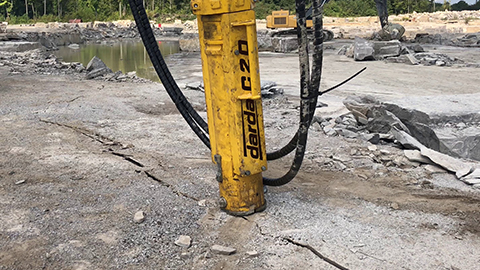









As the immediate contact surface between fresh concrete and formwork, the formwork sheathing shapes the final appearance and surface quality of concrete elements. It influences dimensional accuracy, pore pattern, joint imprint, and thus the requirements for later deconstruction. For planners, contractors, and teams in concrete demolition, it is important to understand how the material, condition, and workmanship of the formwork sheathing determine the concrete surface and demolition behavior. This makes it possible to tailor approaches for selective deconstruction, for example with concrete demolition shears or rock and concrete splitters by Darda GmbH.
Definition: What is meant by formwork sheathing
Formwork sheathing (also referred to as the outer form face) is the outermost, smooth or textured layer of the formwork that is in direct contact with the fresh concrete. It can be made of wood-based panels, coated boards, plastic, or metal. Its properties—among others flatness, absorbency, stiffness, temperature resistance, and surface texture—determine the resulting concrete finish from exposed concrete to technically functional surfaces. The formwork sheathing is therefore both a design element and a technical factor for strength, durability, and subsequent workability.
Structure and materials of the formwork sheathing
The choice of material depends on the required surface quality, rate of re-use, radii of curvature, and economic considerations. Common options include:
- Wood-based materials such as multiplex with phenolic film: balanced cost-performance ratio, limited re-use, moderate absorbency.
- HPL or plastic boards: low pore formation, easy to clean, homogeneous exposed concrete finish, often higher initial investment.
- Steel or aluminum surfaces: very high flatness, robust edges, low deformation, preferred for precast elements and circular tanks; consider thermal expansion.
- Textured liners: targeted surface textures for architectural effects; proper backing and joint layout are crucial.
Key parameters of the formwork sheathing include bending stiffness, surface hardness, edge quality, joint tightness, water absorption, and chemical resistance to cement paste and release agents. These parameters affect concrete compaction, stripping, and the risk of bugholes or imprints.
Surface appearance: exposed concrete, joints, and pores
The surface appearance results from the interaction of formwork sheathing, concrete mix design, compaction, and release agent. For demanding exposed concrete, a deliberate panel layout and uniform conditions are essential.
Joint pattern and anchor points
Butt joints and anchor points are defining features. Tight joint tapes, taped edges, and reproducible grids ensure a calm appearance. Imprints from screws or unevenness can be avoided through precise assembly and careful inspection before concreting.
Pores, voids, and color tone
Pores are caused by entrapped air. Causes include overly viscous release agents, uneven compaction, or highly absorbent formwork sheathing. Coordinated compaction, suitable consistency, and sparing, thin release-agent layers reduce porosity. Color variations are minimized by consistent moisture and temperature conditions.
Release agents, cleaning, and care
Release agents enable damage-free stripping and protect the formwork sheathing. They are applied thinly and evenly. Excess promotes pores and stains.
- Preparation: clean, dry surface; remove old residues completely.
- Application: uniform, thin, without runs; check material compatibility.
- Care: clean gently by mechanical means, repair edges, check seals.
Well-maintained formwork sheathing extends the re-use rate and stabilizes surface quality over many concreting cycles.
Service life, re-use, and sustainability
Service life depends on mechanical stress, cleaning, the concretes used, and storage of the elements. Repairs (e.g., filling damage, edge repair) maintain functionality. Reusable formwork sheathings reduce material consumption and emissions. Prerequisites are documented uses and an early decision on when replacement is more economical than repair.
Factors influencing service life
- Loading from fresh concrete pressure and compaction.
- Weathering, UV exposure, and moisture cycles.
- Type and dosage of release agents.
- Transport and storage concepts, edge protection.
Planning and selection to suit requirements
The selection of the formwork sheathing depends on member geometry, exposed concrete class, tolerances, and scheduling. Flexible panels or liners are suitable for tight radii or free-form surfaces; metal faces are often used for high flatness and series production. In execution planning, panel joints, anchor patterns, and stripping times should be defined and documented to reliably achieve the desired surface appearance.
Influence of the formwork sheathing on deconstruction
The concrete surface produced by the formwork sheathing has a direct impact on deconstruction. Dense, low-porosity exposed concrete surfaces and well-compacted edges exhibit different cracking and spalling behavior than absorbent, more porous surfaces. This is relevant for the choice of demolition tools, the precision of the approach, and protective measures for adjacent components.
Concrete demolition shears: selective removal and edge control
In selective concrete demolition, concrete demolition shears by Darda GmbH can be used to remove material layer by layer in a controlled manner. On high-quality exposed concrete, defined starting points are important to avoid uncontrolled spalling. The choice of jaw opening, cutting geometry, and pressing strategy is aligned with edge quality and proximity to reinforcement. Goal is low-vibration deconstruction with minimized follow-up work on remaining surfaces.
Rock and concrete splitters: low vibration for massive sections
Rock and concrete splitters by Darda GmbH create controlled crack joints in predrilled cored holes. On very dense surfaces produced by metallic formwork sheathings, the splitting direction is often well predictable. The advantage is the low vibration—e.g., in existing structures, on exposed concrete walls near sensitive areas, or in special demolition. The positioning of the drill holes takes into account joint patterns, anchor points, and any edge densification caused by the formwork sheathing.
Hydraulic power packs and combination shears working together
Hydraulic power packs provide the necessary energy for mobile deconstruction tools. Combination shears, multi cutters, steel shears, and concrete demolition shears by Darda GmbH are combined according to reinforcement level, element thickness, and desired cut line. The nature of the concrete surface—smooth, textured, or with joint grids—often dictates the most economical sequence of work steps.
Application areas related to the formwork sheathing
In Darda GmbH’s typical applications, the formwork sheathing plays a role in different ways:
- Concrete demolition and special demolition: Exposed concrete façades, column heads, or bridge caps require controlled attack points to avoid damaging the defined joint and pore pattern beyond adjacent areas.
- Interior demolition and cutting: When exposing anchor points and joint aids, working deliberately along panel joints leads to cleaner separation surfaces; surface hardness influences cutting progress and tool wear.
- Rock excavation and tunnel construction: Segment rings and cast-in-place inner linings were often produced with metal sheathings; this results in a compact matrix that can favor crack propagation during splitting.
- Natural stone extraction: Although produced without formwork, insights into crack behavior from splitting concrete are transferable to brittle fracture and notch effects.
- Special applications: In sensitive environments, low-dust and low-vibration methods are required; surface characteristics and edge quality influence the choice of sequences and tools.
Execution steps for consistent concrete surfaces
- Create a panel plan with a defined joint and anchor pattern.
- Inspect and clean the formwork sheathing; repair damaged edges.
- Apply a compatible release agent sparingly and thinly.
- Ensure a uniform concrete mix design and compaction.
- Strip at the appropriate time, protect edges, and document.
Documentation and quality assurance
Photos, mock-ups, and a usage log of the formwork sheathing (number of uses, cleaning, release agent used) enhance reproducibility. This data is valuable for planned deconstruction because it provides indications of surface hardness, density, and potential crack paths.
Deconstruction-friendly details already in the planning phase
Those who consider deconstruction early design joint patterns, anchor points, and component separations so that later cutting and splitting lines can be utilized. Uniform panel grids and marked anchor axes facilitate positioning of concrete demolition shears. Drill-hole patterns for rock and concrete splitters can likewise be planned along structurally predefined weakenings.
Typical mistakes and how to avoid them
- Release-agent film too thick: leads to pores and stains; remedy: apply sparingly and evenly.
- Leaky joints: cause fins and bleed marks; remedy: joint tapes and edge checks.
- Non-uniform formwork sheathing within one element: varying pore patterns; remedy: consistent panel selection.
- Improper stripping: edge spalls; remedy: appropriate stripping times and edge protectors.
- Lack of documentation: reduced reproducibility and more complex deconstruction; remedy: logs and photo sequences.
Safety and general notes
Work with formwork and on concrete surfaces requires trained personnel, suitable personal protective equipment, and risk-aware planning. Standards and recognized rules of technology must be observed. Manufacturer information on release agents, substrate preparation, and stripping times must always be taken into account. During deconstruction, structural boundary conditions, protection of adjacent areas, and low-emission methods must be carefully reviewed.