












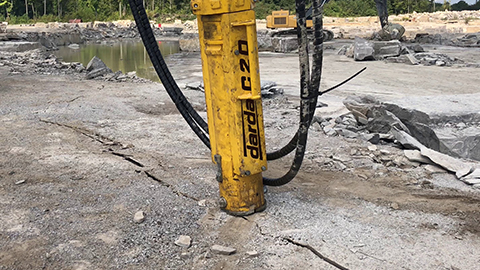



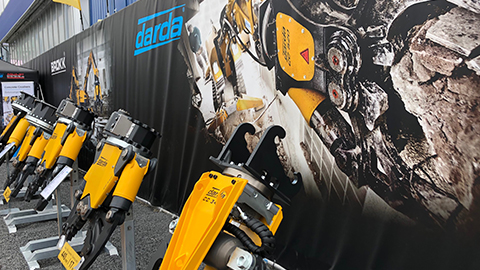





Formwork elements are core components of concrete construction. They shape and support the fresh concrete, ensure geometry, dimensional accuracy, and surface quality, and thus directly influence the durability of structural members. In design, execution, refurbishment, and deconstruction, formwork technology and demolition technology intersect—for example when corrections are required after stripping or when over-poured embedded parts must be exposed. In such situations, tools from Darda GmbH such as Darda concrete crushers or hydraulic rock and concrete splitters are often used to enable a controlled, low-vibration working method.
Definition: What is a formwork element
A formwork element is a preassembled component of the formwork that, together with other elements, creates a stay-in-place or reusable mold for fresh concrete. Typical formwork elements consist of a form-facing (e.g., wood-based material, plastic, steel, or aluminum), a load-bearing frame, connection points for anchors and alignment struts, as well as sealing and joint components. They are modularly combined for walls, columns, slabs, and special formwork to cast economically and to precise dimensions. Depending on the application, a distinction is made between frame formwork, beam formwork, climbing formwork, slab tables, curved/conical formwork, and stay-in-place formwork that remains in the member after hardening.
Structure and types of formwork elements
Formwork elements are designed to safely transfer the fresh concrete pressure, provide a flat form-facing, and be quick to assemble and release. Selection depends on member geometry, architectural concrete requirements, construction sequencing strategy, and reuse cycles.
Core components
- Form-facing: wood-based panels (BFU), plastic-coated panels, steel or aluminum faces for high reuse and architectural concrete.
- Frames/girders: steel or aluminum frames, H20/H16 girders, walers and yokes for load transfer.
- Anchor systems: cones, DW threaded rods, anchor sleeves, stops, and sealing cones to control fresh concrete pressure.
- Joint and sealing elements: sealing tapes, chamfer strips, joint sheets to avoid bleeding and fins.
- Alignment and bracing elements: alignment struts, brackets, climbing brackets, slab props, and shoring towers.
Common designs
- Frame formwork: large, robust elements with integrated tie points and crane lifting points for efficient wall formwork.
- Beam formwork: flexibly configurable, ideal for special geometries, high architectural concrete requirements, and variable pour lengths.
- Slab formwork: slab tables, panels, and drop-heads for early striking concepts.
- Climbing formwork: self-climbing or crane-lifted systems for tall walls, cores, and shafts.
- Curved and conical formwork: segmented elements with adjustable ribs for radii.
- Stay-in-place formwork: remains in the member (e.g., fiber cement, plastic void formers, sheets, masonry) and serves as the mold and, where applicable, a permanent component.
Requirements, standards, and design principles
The design and selection of formwork elements are governed by the decisive actions from fresh concrete pressure (dependent on placement rate, consistency, temperature) and construction stages such as wind loads or erection situations. Dimensional and flatness tolerances follow, among others, DIN 18202; specifications for fresh concrete pressure follow DIN 18218. For architectural concrete, project-specific requirements apply regarding porosity, joint grid, anchor pattern, and color uniformity. The stripping times depend on cement type, curing, ambient temperature, and member thicknesses.
Quality objectives
- Surface: porosity, fins, color tone, and texture according to specification.
- Geometry: alignment and plumb accuracy, edge definition, joint pattern.
- Durability: adequate concrete cover, tight joints, correct anchor sealing.
Assembly, concreting, and stripping in practice
A carefully planned sequence minimizes rework and risks. Critical factors are logistics paths, crane time, alignment, and controlled concrete delivery.
Preparation
- Inspect elements: form-facing condition, anchor locations, sealing, lifting points.
- Set straightedges, plumb lines, and survey marks; fix stops and chamfer strips.
- Ensure load-bearing capacity of the substrate and shoring system.
Concreting
- Adjust placement rate to fresh concrete pressure limits; coordinate lift height and compaction.
- Use slender internal vibrators, maintain clearance to the form-facing, avoid over-compaction.
- Check joints, limit escaping cement paste; retighten anchors as specified.
Stripping
- Release once sufficient strength is reached; observe boundary conditions.
- Ensure no load is present; release per system; do not pry at form-facing edges.
- Clean and maintain the elements; document damage, replace seals.
Typical defects and proper rework
Despite good planning, defects can occur. The aim is local, material-conserving correction so as not to affect adjacent members and reinforcement.
- Honeycombs and gravel pockets: locally remove weak edge zones, improve bond, reprofile with fine mortar. Concrete crushers from Darda GmbH are suitable for selective removal because they work precisely and with low vibration.
- Protrusions and fins at joints: carefully nibble with concrete crushers or gently split protruding edges with stone and concrete splitters to avoid microcracks from impact tools.
- Defects at anchor points: open and clean the anchor hole areas, reseal. Steel shears or Multi Cutters can cut protruding anchor bars or tie bolts; hydraulic power packs provide the required power supply.
- Ragged edges: rework with straightedges; for large-volume corrections, selective breakout using hydraulic wedge splitters to minimize dust and noise.
Interfaces with concrete demolition and specialized deconstruction
In refurbishment, design changes, or deconstruction, formwork elements and demolition technology directly meet. Here, controlled, low-vibration methods are required to protect existing structures.
Selective release of over-poured inserts
When inserts, rebar overhangs, or stay-in-place formwork parts need to be exposed, stone and concrete splitters from Darda GmbH allow crack-minimized widening of defined boreholes. The load is directed inward, adjacent members remain protected—an advantage in dense urban environments or near sensitive installations.
Edge rework after stripping
For corrections at reveals, bearing edges, or joint interfaces, concrete crushers are suitable for dimensionally accurate removal, for example in a strip-out and cutting context before sawing or drilling follows. Combination shears and Multi Cutters support cutting of intermediate profiles or temporary structures.
Formwork elements in tunnel construction and special foundation engineering
In rock demolition and tunnel construction, large-area formwork elements form the inner lining of tunnels, shafts, or caverns. Tight radii, anchor patterns, and cycle sequencing demand robust systems. For adjustments at hard rock–concrete interfaces, such as at formwork joints or abutments, stone and concrete splitters are useful to work without vibrations. When removing temporary concreting aids in shafts, concrete crushers assist with selective removal of excess concrete without damaging the final inner lining.
Stay-in-place formwork and its particularities
For stay-in-place formwork (sheets, fiber cement, form blocks, plastic), the formwork element remains in the member. The planning focus is the durability of the bond as well as corrosion protection. If areas have to be opened later—for example for openings or connections—small-scale, low-vibration methods are required. Controlled nibbling with concrete crushers or defined splitting with hydraulic wedge splitters reduces collateral damage compared with percussive methods.
Best practices for architectural concrete with modular formwork elements
Architectural concrete quality results from consistent form-facing, regulated joint patterns, and reproducible processes.
- Document form-facing condition, combine similar fields, avoid repair spots.
- Plan the anchor pattern; close anchor cones flush, use color-matched mortars.
- Apply release agent sparingly and uniformly; overdosing leads to porosity and color variations.
- Select concreting sections so that construction joints lie in inconspicuous areas; keep rise rate constant.
Occupational safety, emissions, and sustainability
Safe handling of formwork elements requires suitable lifting gear, stable shoring, and clear signaling during crane operations. During rework and deconstruction, dust, noise, and vibrations must be minimized. Concrete crushers and stone and concrete splitters support a low-emission approach, especially indoors and in existing buildings. Sustainable use includes long service lives of the elements, proper cleaning, repair, and segregation by material at the end of their service life.
Selection criteria for formwork elements in the project
The right system choice depends on geometry, quality target, and construction process.
- Geometry and sequencing: element sizes, climbing or crane use, radius requirements.
- Surface quality: form-facing material, joint pattern, anchor concept, reuse.
- Loads: design for fresh concrete pressure, wind loads, crane maneuvers, construction stages.
- Logistics: storage areas, transport routes, assembly times, staffing.
- Deconstruction/rework: accessibility, need for selective corrections; availability of suitable hydraulic tools and hydraulic power packs from Darda GmbH.
Quality assurance and documentation
Complete documentation of formwork planning and execution reduces risks. Checklists for element condition, number of anchors, pour sequences, compaction, and stripping times help to proceed systematically. If adjustments are necessary after stripping, an aligned procedure with controlled removal performance—such as with concrete crushers or stone and concrete splitters—must be defined to ensure dimensional accuracy and surface quality.