












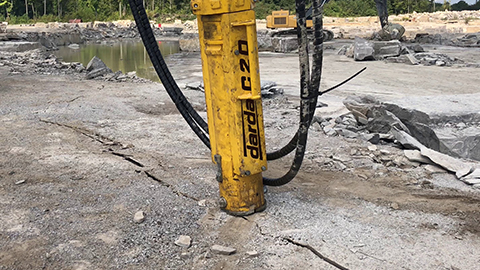



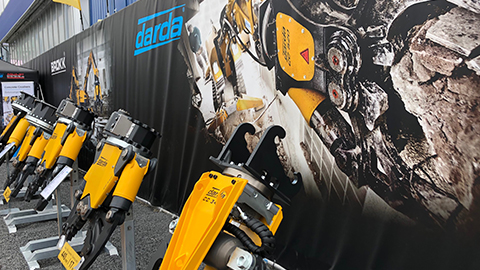





Foundation trimming refers to the targeted, controlled reduction of foundation edges, projections, or partial cross-sections made of concrete. Typical reasons include repurposing, extensions and conversions, tolerance adjustments, keeping corridors clear, or creating new connection details. In practice, the intervention is usually carried out in existing structures and requires precise execution to ensure load-bearing capacity, serviceability, and the construction process. In selective deconstruction, concrete pulverizers and hydraulic splitter (wedge) units from Darda GmbH are frequently used— including solutions such as hydraulic rock and concrete splitters—as they enable controlled removal steps in confined space with low vibration levels.
Definition: What is meant by foundation trimming
“Foundation trimming” means the partial removal of an existing foundation—such as a strip, isolated, or slab foundation edge—without removing the entire foundation. The objective is to locally adapt the geometry, eliminate upstands, create bearing surfaces, or expose reinforcement for a rebar connection. Foundation trimming is distinct from complete demolition and underpinning: while underpinning adds new load-bearing sections, trimming reduces existing component areas while complying with structural, design, and construction-operations constraints.
Use cases and objectives for trimming foundations
Typical use cases range from clearing movement space (e.g., for a machine foundation or installation areas) and tolerance corrections to the preparation of shaft, utility line, and foundation connections. In damage repair—such as edge spalling of concrete, corrosion of reinforcement, or local repairs—a precise trim is also beneficial. In concrete demolition and special demolition as well as in building gutting and concrete cutting, targeted removal allows the preservation of load-bearing functions while processing only the scope actually required. In areas with rock contact or within a tunnel context, the low-vibration principle of removal can be transferred from rock excavation and tunnel construction—for example, by hydraulic splitting, as also practiced in natural stone extraction.
Planning and structural analysis: Boundary conditions before foundation trimming
Before starting, the load-bearing conditions and the planned change in use must be assessed. This includes:
- Survey of component geometry, concrete compressive strength class, reinforcement layout, and existing built-in components
- Verification of load transfer, load redistributions, and reserves when reducing the cross-section
- Need for temporary shoring, load diversion, or interim construction stages
- Definition of cut lines, tolerances, surface requirements, and edge quality
- Coordination with subsoil, groundwater level, and adjacent components (risk of cracking and settlement)
Legal and normative requirements must be considered on a project-specific basis. Statements regarding approvals, verification obligations, or site protection are always of a general nature; concrete decisions lie with the planning and execution stakeholders.
Methods and tools for trimming foundations
Low-vibration concrete splitting
Hydraulic splitter (wedge) units with suitable split cylinders operate via borehole splitting and are suitable for massive foundations, thick edges, or hard-to-reach areas. The concrete is split in a controlled manner without extensive microcracking in adjacent zones. Advantages include low vibration levels, reduced noise emission, and good control over fracture paths.
Targeted removal and edge finishing
Concrete pulverizers allow the step-by-step biting-off of edges, upstands, and projections—particularly advantageous in selective deconstruction within tight surroundings, such as along existing walls or in facilities that remain in operation. For exposed inserts and reinforcement, steels can be separated with steel shears or a rebar cutter. Comparable outcomes can be achieved with concrete crushers for selective removal.
Hydraulics as the system base
A hydraulic power pack provides the necessary power supply for split cylinders, pulverizers, and shears, typically delivered by compact hydraulic power units. The combination enables a graduated approach: pre-cutting, splitting, edge removal, fine finishing.
Separation and preparatory works
Depending on requirements, separation cuts are placed to steer cracks, boreholes are created, and the trimming line is marked. For heavily reinforced foundations, exposing and orderly cutting of the reinforcement is an essential step to achieve a clean edge.
On-site sequence: step by step
- Define the trimming geometry, marking, survey reference, and protection of the surroundings
- Create boreholes for split cylinders or place separation cuts along defined lines
- Hydraulic splitting for controlled crack guidance, relief, and preconditioning
- Edge removal with concrete pulverizers; orderly extraction of partial segments
- Cut exposed reinforcement; safe handling and debris clearance of the broken pieces
- Post-processing of cut edges: leveling, chamfering, surface profile for subsequent works
- Cleaning, tolerance checks, documentation, and release for the further construction process
Quality assurance and tolerances
Flatness, squareness, and edge quality are decisive for subsequent use. Typical criteria include:
- Deviations from the trimming line and permissible dimensional tolerances
- Surface roughness and bond requirements for subsequent topping or grouting works
- Prevention of spalling at edges through suitable pre-cuts or coordinated split spacing
- Adequate concrete cover and protection of the remaining reinforcement
Accompanying measurement—such as control dimensions, edge alignment, and crack monitoring—improves process reliability. For safety-relevant components, appropriate verifications and acceptance are to be planned.
Safety, environment, and emissions
In foundation trimming, the focus is on minimizing vibrations, dust, and noise, as well as safely handling heavy segments. Hydraulic splitting works with low vibration levels and reduces secondary damage to adjacent components. Dust generation is limited through suitable dust extraction or wetting measures. The mineral demolition material must be collected in a single-fraction manner; reinforcing steel is separated for recycling. If groundwater is encountered, protection and sealing measures must be taken into account. Safety aspects such as crushing hazard and cut hazards, hydraulic pressure, load handling, and the stability of temporary shoring states must be addressed in the hazard assessment.
Special situations and structural contexts
Confined spaces in existing structures
In basements, production areas, or facilities in operation, compact handheld tools and a modular equipment setup are advantageous. Concrete pulverizers and hydraulic splitter (wedge) units from Darda GmbH enable step-by-step removal sequences with high control.
Foundations with a high reinforcement ratio
With dense reinforcement, a combination of pre-cutting, splitting, and shearing helps. The sequence influences edge quality and the forces introduced into the existing structure.
Contact with rock or heterogeneous subsoil
Varying stiffness at the foundation base requires adapted split spacing and controlled load diversion. Experience from rock excavation and tunnel construction is transferable, especially for low-vibration procedures.
Interfaces to application areas
- Concrete demolition and special demolition: Selective removal with a focus on component preservation and defined fracture edges.
- Building gutting and concrete cutting: Preparation of openings, breakthroughs, and system adjustments at foundations.
- Rock excavation and tunnel construction: Splitting methodology to reduce vibrations around sensitive structures.
- Natural stone extraction: Transferred splitting techniques for controlled joints and piece-size control.
- Special operations: Works under difficult conditions, such as restricted access or elevated protection requirements.
Typical sources of error and how to avoid them
- Insufficient analysis of load paths prior to trimming leads to unintended settlements or crack formation.
- Missing crack steering and unsuitable split spacing cause spalling at exposed edges.
- Uncoordinated reinforcement exposure complicates removal and impairs edge quality.
- Underestimated emissions (dust, noise) burden ongoing operations and the surroundings.
- Uncoordinated tolerances hinder subsequent trades and installations.
Documentation, verification, and handover
Structured documentation includes the trimming geometry, methods used, check dimensions, photos of construction states, and disposal certificates for the demolition fractions. For subsequent works—such as casting, installing machinery, or sealing—the agreed interface characteristics (dimensions, flatness, surface roughness) must be recorded. This makes the functionality of the remaining foundation transparent and the further construction process plannable.
A proven approach is a graduated procedure that combines hydraulic splitting with targeted edge removal. Concrete pulverizers and hydraulic splitter (wedge) units from Darda GmbH cover key work steps—from controlled crack initiation to a clean edge—and support precise, low-vibration work in existing structures.