





















A pipeline trench is the primary excavation for installing water, wastewater, gas, or district heating pipes in the ground. It connects geotechnical engineering, construction sequencing, and occupational safety with precise handling of soil, rock, and existing structures. Where natural obstacles such as rock outcrops, concrete foundations, or remnants of old utilities make excavation difficult, controlled separation and splitting methods are used—for example, the targeted splitting of rock or the selective separation of concrete components with suitable hydraulic tools. This allows pipeline trenches to be constructed even in sensitive environments, such as along constrained street corridors or in industrial areas.
Definition: What is a pipeline trench
A pipeline trench is a linear excavation in soil or rock with a defined invert, lateral widening or shoring, a bedding layer, and backfill placed in layers. Width, depth, slope angle or shoring, and the type of bedding depend on pipe diameter, pipe material, traffic loads, frost depth, groundwater, and the ground conditions. The goal is a durable, load-bearing support of the pipe string with minimized settlements and without damaging the pipe system. In urban areas, vertical trench walls with shoring systems are common; in stable soils, sloped trenches are possible.
Structure and cross-section of a pipeline trench
A professional cross-section consists of coordinated layers and components. The following elements are typical:
- Formation/trench invert: a load-bearing surface with precise elevation and longitudinal grade, free of disturbances (stones, roots, concrete debris).
- Bedding: graded, usually fine-grained material (e.g., sand/gravel with suitable gradation) for uniform support, including haunch compaction along the pipe sides.
- Embedment/cover: material and pipe-axis specific, compacted in layers up to the protective layer above the pipe crown.
- Lateral shoring or slope: depending on soil stability, depth, and working space.
- Backfill/superstructure: backfilling in layers with compaction; in trafficked areas with an adapted pavement structure.
The trench width results from the pipe outside diameter plus working and compaction space on both sides. Minimum cover is governed by pipe structural design, use (e.g., roadway), and frost depth. In rocky subgrade, replacing the invert with a protective bedding is essential, as point contacts can lead to pipe damage.
Planning, ground conditions, and boundary constraints
Before excavation, ground investigation, utility records research, surveying, and a construction sequence concept are required. Particular attention is paid to groundwater, dewatering, existing foundations, and the vibration sensitivity of the surroundings. In dense urban environments, construction logistics, traffic management, and emission control are considered early.
Soil classification, bearing capacity, and settlement risk
Grain size distribution, plasticity, and moisture content determine bearing behavior, slope stability, and required compaction energy. Fine-grained, cohesive soils are more settlement-prone and require careful layer thickness and compaction. In coarse-grained soils, drainage is easier, but the pipe support must be matched to the correct gradation and the introduction of fine-grained bedding.
Handling rock, concrete, and structural remnants
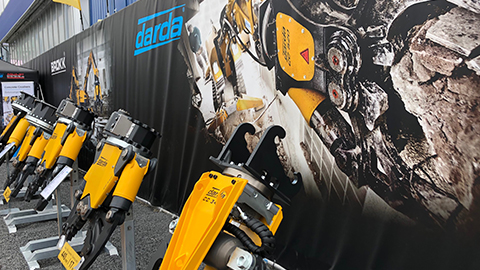
If the trench encounters rock or concrete from existing structures, low-vibration methods are often preferred. Rock and concrete splitters enable controlled widening of rock or massive concrete bodies without explosives—advantageous in areas with sensitive adjacent buildings. For reinforced concrete, cutting or crushing with concrete demolition shears is suitable to remove foundations, caps, or old sewers in sections. This reduces noise and vibration and supports precise trench alignment. Depending on the setting, such measures are assigned to concrete demolition and special deconstruction as well as rock excavation and tunnel construction.
Excavation, shoring, and occupational safety
The pipeline trench is constructed in stages: excavation, securing of trench walls, dewatering, bedding placement, pipe installation, and backfilling. The choice of method depends on depth, ground conditions, and existing loads. Depending on local requirements, sloped trenches or vertical trenches with shoring are executed. Occupational safety, escape routes, fall protection, and protection against burial always take priority.
Overview of shoring types
- Light to heavy shoring with slide-rail, frame, or panel elements for narrow excavations.
- Braced shoring with timber or steel elements for variable trench widths.
- Sheet pile walls or secant pile walls for greater depths, groundwater, or adjacent development.
- Sloped trenches with a stable angle where soil and space allow.
Dewatering and base stability
Lowering or diverting groundwater and surface water protects against bottom heave, erosion, and uplift. Options include open dewatering, filter wells, or vacuum methods—the choice depends on hydraulic conductivity and construction duration. Well-tuned dewatering preserves the ground and reduces settlement risk.
Work in sensitive environments
Near existing buildings or critical infrastructure, low-vibration methods are required. Controlled splitting of rock and selective demolition with concrete demolition shears limit vibrations compared to percussive tools. In confined trenches, compact, hydraulically powered tools with external hydraulic power packs are advantageous.
Pipe bedding, installation, and backfilling
The pipe is supported on a flat, compacted bedding. Lateral haunch compaction is crucial for uniform load transfer. Sharp-edged stones must be avoided in the invert and embedment zones. Pipe installation follows the alignment, gradient, and installation plan; fittings and house connections are installed with low stress. Backfilling then proceeds in layers with controlled compaction. In trafficked areas, the pavement structure is constructed according to loads; in green areas, restoration of the vegetation layer is the focus. Frost-protection layers and separation layers are provided as required by the project.
Crossings, structure tie-ins, and existing assets
For crossings of roads, rail tracks, or waterways, protective casing pipes, load distribution, and any temporary construction states must be considered. When pipeline trenches meet existing foundations or sewers, these are separated and removed in sections. For concrete components, concrete demolition shears are appropriate; for metallic installations such as old pipe strings or reinforcement, depending on material thickness, cutting tools such as Steel shears or multi cutters are used. In practice, such interventions fall under strip-out and cutting, often as part of orderly special deconstruction.
Quality assurance and documentation
Elevation of the trench invert, gradient, bedding density, and compaction of backfill layers are continuously controlled. For pressurized pipelines, leakage tests are standard. As-built documentation, surveying, and photo documentation support operation and later maintenance. Requirements arise from the applicable technical rules and local provisions.
Environment, emissions, and resource conservation
Careful handling of soil (separate storage of topsoil and subsoil) and the reuse of suitable excavated materials reduce transport and emissions. Dust and noise reduction and limiting vibrations protect residents and structural fabric. In rocky subgrade or near sensitive facilities, splitting of rock and separation work on concrete can be a lower-emission alternative to impact and driving methods.
Typical use cases and particularities
- City-center routes: limited space, dense utility networks, increased shoring effort; often selective removal of concrete components with concrete demolition shears.
- Industrial sites: heterogeneous subgrade, legacy steel and cast-iron lines; cutting work with steel shears or multi cutters and controlled removal of foundation remnants.
- Rocky terrain: limited slopeability, necessary dewatering; low-vibration opening of the trench using rock and concrete splitters, assigned to rock excavation and tunnel construction.
- Rehabilitation in existing assets: sectional exposure, short construction times; use of compact hydraulic tools with external hydraulic power packs, including special deployments.
Tools and equipment around the pipeline trench
The equipment fleet ranges from excavators to compaction equipment and dewatering, up to specialized hydraulic attachments and handheld tools. In practice, various tools are used depending on the task:
- Rock and concrete splitters and rock splitting cylinders for controlled opening of rock beds, boulders, or massive concrete remnants along the trench alignment.
- Concrete demolition shears for cutting and crushing reinforced concrete components, for example at foundation crossings or when removing old sewers.
- Combination shears and multi cutters for universal cutting tasks in mixed materials, e.g., when exposing and adjusting installations.
- Steel shears for precise cutting of steel pipes, sections, and reinforcement in confined trench situations.
- Tank cutters in special cases when large steel tanks or similar structures must give way to the pipeline trench.
- Hydraulic power packs for reliable energy supply to the tools mentioned, especially for mobile operations along long routes.
Benefits of controlled separation and splitting methods
Targeted, hydraulic methods enable quiet, low-vibration work, precise interventions, and minimal influence on the surrounding soil structure. This is particularly relevant near sensitive neighboring buildings, in existing structures, and in areas with high dimensional accuracy requirements for the pipeline trench.