
















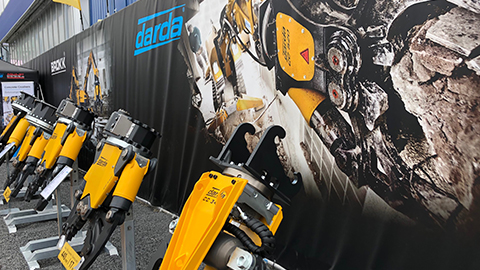





The cross wall is a core element in building and structural engineering: it organizes floor plans, braces buildings, carries loads, and separates areas in terms of acoustics and fire protection. In existing buildings, the cross wall is often the focus of alterations, openings, and deconstruction works—such as floor plan changes, the creation of door and window openings, or during strip-out. In such scenarios, mechanical and hydraulic methods are used that operate with low vibration, are controlled, and are appropriate to the material. Tools such as concrete pulverizers or hydraulic rock and concrete splitters from Darda GmbH are then practically relevant in suitable configurations to process massive components section by section and controlled.
Definition: What is meant by cross wall
A cross wall is a wall arranged in plan transversely to the main axis of a building or structure. It may be load-bearing or non-load-bearing and—depending on material, thickness, and integration—fulfills several functions: load transfer (e.g., as slab support), bracing against horizontal actions, space separation, fire protection, sound insulation, and routing of services. Cross walls appear as interior walls in residential, administrative, and industrial buildings, as well as in infrastructure structures, shafts, and tunnel construction (e.g., as separating or connecting elements between tubes). In existing structures, openings and subsequent modifications significantly influence the load-bearing and deformation behavior, which is why structural assessment and technically suitable processing methods are indispensable.
Construction, structural behavior, and building physics
Depending on their configuration, cross walls act as load-bearing or non-load-bearing components. Load-bearing cross walls take vertical loads from slabs, roofs, or overlying wall panels and contribute to bracing. Non-load-bearing cross walls are primarily responsible for room separation, sound insulation, and fire compartments. The structural behavior is determined by material (e.g., masonry, reinforced concrete, autoclaved aerated concrete, natural stone), wall thickness, slenderness, reinforcement, and integration with adjacent components.
Load-bearing and non-load-bearing cross walls
Load-bearing cross walls are often integrally connected to slabs and longitudinal walls. Openings alter their load paths, reduce cross-sections, and can lead to cracking or deformations. Non-load-bearing cross walls are installed with sliding or defined connection devices; interventions primarily affect building physics (e.g., acoustics and fire protection) and the fastening of fit-out elements. For both applies: Before making changes, verify load-bearing capacity, bracing function, and connections; temporary shoring must be planned for interventions in load-bearing structures.
Sound insulation, fire protection, moisture
Cross walls often form sound and fire compartments. Material selection, layer build-up, joints, and connections influence acoustic and fire performance. Interventions (e.g., openings, penetrations) must be planned so that the protection level is maintained with appropriate measures (e.g., claddings, fire stops). In moisture-exposed areas, capillary-breaking layers, waterproofing, and corrosion-resistant fixings must be taken into account.
Materials and types of cross walls
Cross walls occur in different construction types. Their properties directly affect processing and deconstruction methods.
- Reinforced concrete: High load-bearing capacity and bracing effect; dense matrix, reinforcement. Processing requires controlled cutting, breaking, or splitting; handling of reinforcing steel (cutting, exposing) must be planned.
- Masonry (brick, calcium silicate, autoclaved aerated concrete): Compressive strength, brittle fracture behavior; low-vibration splitting or pressing methods enable sectional deconstruction with reduced secondary damage.
- Natural stone: Historical buildings or massive industrial facilities may feature cross walls made of natural stone; splitting techniques are particularly material-appropriate here.
- Drywall: Non-load-bearing systems with metal studs and sheathing; rapid dismantling is possible, but fire and acoustic details must be observed.
- Precast elements: Assembly joints and connections determine the intervention strategy; localized separation cuts can be sensible.
Planning, connections, and interfaces
The effectiveness of a cross wall depends significantly on the connections to slabs, floors, and longitudinal walls. Load and force transfer occur via mortar or grout joints, bearing strips, connection reinforcement, or approved connectors. Movement and expansion joints allow defined deformations without restraint stresses. Service penetrations and built-in components must be routed so that load-bearing and protective properties are preserved.
Connection types
In simplified terms, three connection types can be distinguished: integral/rigid (load-bearing connection), force-transmitting with defined sliding properties (e.g., horizontal separation layer), and non-load-bearing (e.g., acoustically decoupled). The choice determines which measures become necessary during alteration and which construction methods are suitable.
Alterations, openings, and deconstruction of cross walls
Alterations to cross walls require a careful approach. Before interventions, evaluate construction documents, investigate wall build-up and reinforcement (e.g., with minimally invasive methods), and secure stability temporarily. The choice of method depends on member thickness, material, degree of reinforcement, sensitivity of the surroundings (vibration, noise, dust), space constraints, and schedule logistics. In practice, staged removal has proven effective—from creating relief openings to the controlled removal of individual wall segments.
- Concrete pulverizers: Suitable for controlled, low-vibration removal of reinforced-concrete or masonry cross walls, particularly for partial deconstruction and selective removal of wall panels. In combination with steel shears, exposed reinforcement can be cut in a targeted manner.
- Stone and concrete splitters: For splitting thick walls when vibrations, dust, and noise are to be minimized. Splitting turns material properties into a separation joint; the component can be released along defined lines.
- Hydraulic power packs: Reliably supply hydraulic tools; in tight or sensitive areas, placing the power pack outside the immediate work zone reduces emissions at the component.
- Combination shears and multi cutters: Useful when different materials occur in combination (concrete, steel, inserts) and flexible tool geometries offer advantages.
- Steel shears: For clean cutting of reinforcing bars, steel sections, or embedded metal parts after concrete removal.
- Investigation and planning: Determine material, thickness, reinforcement, services, fire and acoustic function; define boundary conditions.
- Structural approval and securing: Temporary shoring, if necessary load redistribution; define work and protection zones.
- Preparatory separation cuts or drillings: Control of fracture lines; plan dust and water management.
- Sectional removal: Use concrete pulverizers to release entire wall panels or define fracture edges with stone and concrete splitters; cut reinforcement with steel shears.
- Separation by material type and removal: Record mineral fractions, steel, and fit-out separately; organize disposal or recycling.
- Restoration of protective functions: Re-establish or extend fire protection, acoustics, and waterproofing at connection areas.
Fields of application and typical uses
Cross walls are present in almost all building types—from residential to office and commercial buildings to industry. In infrastructure and tunnels, cross walls serve, for example, to separate technical areas, guide ventilation, or as components of cross passages. In deconstruction and strip-out, cross walls are often removed selectively to create new floor plans or enable service routes. A method is required that protects the surroundings and does not unnecessarily damage the remaining structure. In thick, heavily reinforced reinforced-concrete walls, concrete pulverizers are proven for successive removal; in masonry or natural stone, stone and concrete splitters provide a particularly material-appropriate solution. In the contexts “concrete demolition and special deconstruction” and “strip-out and cutting,” such methods are established building blocks. In “rock excavation and tunnel construction,” cross walls appear as separating components in shafts or cross passages, whose controlled removal or partial opening often requires low vibrations. Also in “special operations”—such as constrained access, sensitive neighboring components, or strict emission limits—hydraulic, compact tools with external power supply are advantageous.
Typical damage, diagnosis, and repair
Depending on the construction type, cross walls exhibit characteristic damage patterns: cracks due to restraint stresses or settlement, spalling at edges, corrosion damage to reinforcement, acoustic flanking paths caused by faulty connections, and impairments to fire protection due to inadequately sealed penetrations. Diagnosis is based on visual inspection, sounding, moisture and tightness tests, and minimally invasive methods to locate reinforcement and inserts. Repair concepts range from crack injection and mortar patching to connection improvements and local strengthening (e.g., section enlargements, jacketing). Before working on load-bearing cross walls, a structural assessment is required; interventions should be chosen so that load paths are preserved and building physics are restored. If partial deconstruction is necessary to expose damage, concrete pulverizers and splitting methods can minimize the extent of secondary damage to adjacent areas.
Occupational safety, environment, and disposal
Safe and environmentally compatible work on cross walls includes the control of dust, noise, and vibrations, securing of work areas, and protection of adjacent uses. Dust can be reduced by appropriate extraction and wetting measures; when water is used, organized water management is required. Low-vibration methods such as splitting or removal with pulverizers help to protect sensitive components. Personal protective equipment, clear interface coordination, and certified rigging and shoring gear are mandatory. Materials must be separated by type; mineral fractions and steel can generally be recycled if their condition allows.
Quality assurance and documentation
Before, during, and after interventions on cross walls, traceable documentation is advisable: existing records and investigation results, approvals, measures for temporary securing, test and measurement logs (e.g., for vibrations or dust), evidence of proper disposal, and documentation of restored building physics. For repetitive operations—such as the systematic creation of openings—standardized work steps and hold points support process reliability.
Practical relevance: selecting the work method
The choice of method for openings and deconstruction on cross walls is project-specific. Decisive is the balance between structural safety, emission protection, schedule, and cost-effectiveness. The result is often hybrid approaches that combine the strengths of individual methods.
- Member thickness and reinforcement: Massive, heavily reinforced cross walls can be dismantled in a controlled, sectional manner with concrete pulverizers; reinforcement is exposed and cut with steel shears.
- Material and matrix: Brittle materials such as masonry or natural stone favor splitting methods with stone and concrete splitters that generate defined fracture lines.
- Environment and requirements: In sensitive areas, low vibrations, reduced noise emissions, and a limited water demand are advantageous—plus points for splitting and pulverizer methods.
- Accessibility: Compact tools with external hydraulic power units enable work in confined situations; multi cutters and combination shears increase flexibility with changing material combinations.
- Interfaces: For precise connections after deconstruction, edges should be produced to the required quality and protective functions (acoustics, fire) reinstated in a targeted manner.