












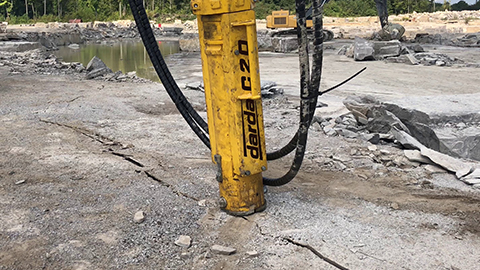



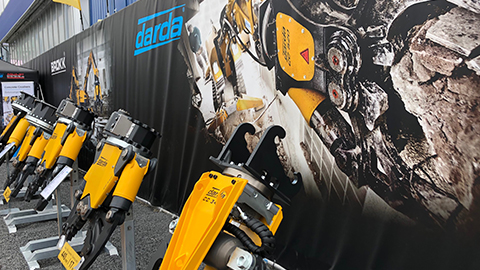





Transverse pressure describes the lateral compression acting on components made of concrete, reinforced concrete, or natural stone. It arises wherever forces are introduced transverse to an element’s primary direction—such as from bearing pressures, clamping and gripping actions, hydraulic expansion in boreholes, or from rock mass and earth loads. In demolition, dimension stone quarrying, and rock and tunnel construction, transverse pressure significantly influences crack behavior, the stability of adjacent zones, and the controllability of separation and splitting processes. For practical application with concrete crushers and stone and concrete splitters from Darda GmbH, a sound understanding of these transverse pressures is crucial to separate components targetedly and controlled without causing unintended damage.
Definition: What is meant by transverse pressure
Transverse pressure (also referred to as transverse compression or side pressure) is a compressive stress acting transverse to a component’s longitudinal axis or transverse to the preferred material orientation. Typical causes include local contact pressures from tools (e.g., jaw faces), supports and interlayers, radial expansion of boreholes during splitting, rock mass pressure on cavities, as well as edge and corner pressures during partial demolition. Transverse pressure alters the local stress state, increases shear demand, promotes spalling at edges, and can deflect or inhibit crack paths. Combined with existing tensile and shear stresses, complex fracture patterns result, knowledge of which is essential for planned dismantling and for rock and natural stone extraction.
Physical fundamentals and stress states
In solids, principal stresses, shear stresses, and deformations superimpose. Transverse pressure acts perpendicular to the main load and, via lateral strain and frictional interlock, influences crack formation. In brittle materials such as concrete and natural stone, lateral compression increases the effective tensile strength in the direction of compression but can trigger edge spalling at free boundaries. High local pressures arise at contact interfaces; these contact zones are often the origin of shear cracks, edge breakouts, or the widening of existing flaws. Decisive for the fracture pattern are material heterogeneity, moisture, fabric (joints, bedding planes), member geometry, edge distances, reinforcement, as well as the rate of force introduction by hydraulic units.
Transverse pressure in concrete and reinforced concrete
Concrete resists compression well but tension poorly. Transverse pressure increases local compression and may delay crack initiation, while simultaneously raising shear demand near edges. In reinforced concrete, reinforcing bars couple crack flanks, so transverse compression can, through bond and wedging effects, lead to splitting and spalling cracks in the cover concrete.
Influence on crack formation and edge spalling
High transverse pressures at edges or openings favor edge breakouts and slab-like flaking. When forces are concentrated via jaw faces or bearing areas, characteristic fan-shaped and shear cracks emanate from the contact zone. Adequate edge distances, sequencing of loads, and, where appropriate, relief cuts limit these effects.
Reinforcement and bearing pressure
In bearing regions with slender members, transverse pressures occur together with shear. Reinforcement layout and bearing details influence the crack patterns. During separating dismantling, positioning the tools deliberately can guide transverse pressure so that spalling is confined to the removal area.
Transverse pressure in rock and natural stone
In rock, existing rock mass and horizontal loads govern the stress field. Transverse pressure acts as lateral fixation or as contact pressure between block assemblies. It increases compressive load capacity but can promote the breakout of scales along joint planes when free faces are nearby or the direction of load introduction is unfavorable.
Rock mass pressure, bedding planes, and joint systems
The orientation of joint systems determines how transverse pressures distribute and which separation planes are activated. In conjunction with splitting, the alignment relative to exposed faces is crucial so that cracks run toward the intended extraction edge and do not propagate uncontrollably into the rock mass.
Transverse pressure when using stone and concrete splitters
Stone and concrete splitters from Darda GmbH generate radial pressures in the borehole via expanding wedges or cylinders. These local transverse pressures steer the emerging tensile cracks toward free surfaces. A suitable borehole pattern and correct load stepping ensure that transverse pressure acts as a controlling rather than a damaging factor.
- Borehole pattern planning: Choose spacings, edge distances, and orientation to joints so that cracks run toward the desired free surface.
- Stepwise loading: Increase hydraulic pressure in controlled stages to promote brittle fractures with minimal edge spalling.
- Create free faces: Relief cuts or pilot holes reduce unwanted transverse pressures in sensitive zones.
- Sequence: Work from the free edge into the member and from lower to higher restraint to relieve transverse pressure peaks.
- Secure substrates and supports: Prepare load paths so that contact pressures do not cause secondary damage.
Transverse pressure when using concrete crushers
Concrete crushers introduce forces via two jaws at points or along lines. High transverse pressure develops between the jaws, locally crushing the member and opening cracks. Near reinforcement, transverse pressures transform into splitting and bond tension; this produces characteristic spalling that can be limited with appropriate technique.
- Access orientation: Align the crusher so that crack fans run to the planned demolition edge and not into areas to be preserved.
- Stagger bite depth: Several shallower bites produce lower transverse pressure peaks than one deep bite.
- Observe edge distances: Sufficient distance reduces edge breakouts and minimizes collateral damage.
- Identify strengthened areas: Covered reinforcement bundles create wedging forces; attack these in segments and with lower initial pressure.
Relevance in application areas
Transverse pressure arises in all practice-relevant situations and shapes the choice of methods, tools, and sequences. Its deliberate control delivers clean separation planes and protects adjacent components.
Concrete demolition and specialized dismantling
For partial demolition of slabs, walls, and foundations, transverse pressures must be guided so that cracks follow the plan. Concrete crushers and stone and concrete splitters can be combined: pre-drilling and splitting reduce transverse pressure in the vicinity, and subsequent crusher use separates remaining connections under controlled edge pressure.
Strip-out and cutting
When cutting openings or removing individual components, cut edges can break out due to transverse pressure during handling. Relief cuts, intermediate supports, and sequenced crusher bites limit edge pressures and secure edge quality.
Rock demolition and tunnel construction
In tunnel construction, horizontal rock mass stresses influence the cavity shape. Splitting operations must account for the stress field: free faces are created deliberately to relieve transverse pressures and steer cracks toward the intended extraction front.
Natural stone extraction
For blocky extraction, transverse pressures stabilize the block during initiation but must not cause scaling at the free face. A coordinated sequence of drilling and splitting produces plane separation faces and minimizes waste.
Special operations
In confined conditions or sensitive environments (e.g., next to live plants), limiting transverse pressure is essential. Lower pressure stages, small incremental steps, and additional shoring keep lateral pressures predictable.
Planning, assessment, and verification
Planning considers material properties, geometry, edge distances, reinforcement, joints, and permissible contact pressures. For components to be retained, conservative edge distances and gentle load increases are advisable. Verifications for transverse pressure and shear should follow recognized engineering practice. Limits for loads and operating pressures are evaluated on a project-specific basis.
- Survey: Record fabric, cracks, reinforcement location, bedding planes, supports, and edge distances.
- Method selection: Combine splitting, crushing, and cutting and their sequence according to tolerance for transverse pressure.
- Drilling and cutting plan: Define borehole pattern, relief cuts, and access direction.
- Load control: Raise hydraulic pressure gradually; use feedback from crack progression.
- Securing: Provide shoring, coverings, and free faces for controlled crack propagation.
- Documentation: Record procedure, pressure stages, crack patterns, and removal steps.
Practice-oriented tips to minimize unwanted transverse pressure
- Enlarge contact areas to reduce local pressure peaks.
- Make relief cuts before introducing high transverse pressures.
- Place lateral supports strategically so transverse pressures do not propagate into protected areas.
- Sequence tools: first splitting to guide cracks, then crusher bites to detach.
- Use hydraulic power packs with finely adjustable pressure control to ensure shock-free load increases.
- Consider component temperature and moisture; both influence brittle fracture behavior.
Typical failure patterns and diagnosis
- Wedge-shaped edge breakouts: indication of excessive transverse pressure directly at the free edge.
- Fan-shaped shear cracks: superposition of transverse pressure with shear due to concentrated crusher bites.
- Cover concrete delamination over reinforcement: wedging from bond tension with shallow edge distance.
- Uncontrolled crack propagation into the remaining structure: missing free faces or unsuitable load sequence.
- Block ejection in rock: neglected joint orientation and sudden reduction of lateral confinement.
Measurement, documentation, and monitoring
Transverse pressure can be assessed indirectly via crack observations, spalling patterns, and deformation checks. For sensitive measures, dial gauges, markings on crack flanks, and controlled pressure logs from hydraulic power packs provide support. Continuous documentation improves crack path prediction and allows real-time adjustment of load stages.
Material and geometry influences
Concrete strength class, aggregate, moisture content, and age influence sensitivity to transverse pressure. In natural stone, joint spacing, bedding, and grain bonding are relevant. Geometrically, thickness, slenderness, openings, and edge distances are decisive; small edge distances increase the risk of local spalling under transverse pressure.
Concrete strength, aggregate sizes, moisture
Higher-strength concrete distributes transverse pressures more uniformly but fractures more brittly; moist concrete often shows greater energy absorption before failure. Coarse aggregates can deflect crack paths and thereby change the effect of transverse pressures.
Member geometry, openings, and edge distances
Openings, slots, and thin webs are sensitive to transverse pressure. Adequate edge distances for boreholes and crusher bites are therefore a central planning feature.
Relation to other tools and units
Hydraulic power packs deliver controlled energy for splitters and crushers. Their finely graduated pressure control influences how quickly transverse pressures rise. Combination shears, multi cutters, steel shears, and tank cutters act predominantly by cutting or separating; with metallic components, they can keep transverse pressures lower, whereas in mineral materials, splitting and crushers are used deliberately to steer crack paths. The combination of tools according to material and boundary conditions determines whether transverse pressures are utilized as helpful confinement or kept as low as possible.