












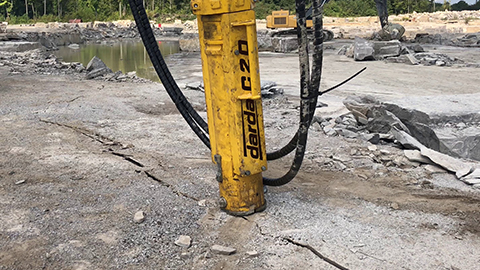



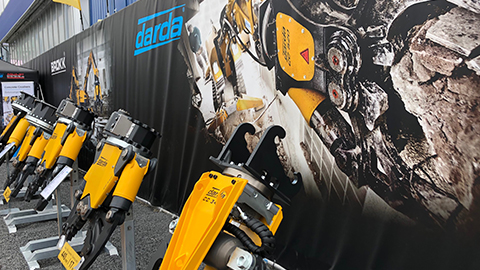





The pneumatic hammer is a classic impact tool for the demolition and deconstruction of concrete, masonry, and natural stone. It is used in excavation pits, in road construction and tunnel construction, during gutting works, and in quarries to loosen material, break edges, or prepare components. In projects in the areas of concrete demolition and special demolition, gutting works and cutting, rock excavation and tunnel construction, and natural stone extraction, the pneumatic hammer often works in tandem with hydraulic tools from Darda GmbH such as concrete demolition shears or hydraulic rock and concrete splitters, which split or cut with low vibration and in a controlled manner.
Definition: What is meant by pneumatic hammer
A pneumatic hammer is a pneumatically powered handheld tool with a reciprocating piston. Via compressed-air impulses, chisels (for example point, flat, or spade chisels) are driven against the workpiece at a high blow rate. The goal is the controlled removal, breaking, or scoring of concrete, masonry, and rock. Pneumatic hammers differ from electrically powered demolition hammers through energy supply via a compressor and their characteristic valve and piston control. Advantages include robust continuous-duty capability and insensitivity to moisture; limitations arise with precise, low-vibration work and in areas with strict noise and vibration requirements.
Role of the pneumatic hammer in combination with concrete demolition shears and hydraulic splitters
In many deconstruction and demolition workflows, the pneumatic hammer handles exposing, scoring, or localized edge breaking, while concrete demolition shears notch components, crush, or open reinforced zones in a controlled way. Hydraulic splitters, on the other hand, generate cracks along defined lines by means of controlled splitting forces—with very low vibration and reduced noise. This protects sensitive surroundings, releases components in a targeted manner, and prepares follow-up steps such as separating rebar with steel shears, combination shears, or multi cutters. The result is a combined methodology of impact, pressing, and splitting that balances performance, precision, and environmental protection.
Design and operating principle
The pneumatic hammer consists of a housing, reciprocating piston, valve control, tool holder (hex or round shank), and handles with damping elements. It is connected to a compressor via hoses. The compressed air drives the piston, which strikes the chisel against the workpiece at high frequency. In-line lubricators and water misters can be integrated into the air line to reduce wear and bind dust. Typical operating parameters are air pressure, air volume flow, blow frequency, and energy per blow. For constant performance, a suitable compressor with sufficient reserve volume and properly sized lines is important.
Application areas and differentiation
The pneumatic hammer shows its strengths in coarse break-out, removing overlays, opening pavement surfaces, loosening breakouts in rock excavation and tunnel construction, and localized removal in gutting works. When low vibration, crack control, or low noise emissions are decisive—such as in sensitive special demolition, in existing buildings, or near vibration-sensitive systems—hydraulic splitters and concrete demolition shears offer a controlled alternative. In natural stone extraction, the pneumatic hammer can be used for edge trimming and cleaning fracture faces, while splitters perform the actual block release.
Selection criteria and performance parameters
Selection is based on material, component thickness, reinforcement level, access, and environmental requirements. Important criteria are:
- Blow energy and blow frequency for material removal
- Air demand and line cross-section in relation to the compressor
- Weight class (handheld, suspended, supported) to reduce operator load
- Vibration and noise emissions as well as dust generation
- Tool geometry (point, flat, spade chisel) suited to the target
- Compatibility with complementary methods such as concrete demolition shears, hydraulic splitters, and steel shears
Chisel types and typical applications
Point chisel
For scoring and opening cracks, focusing impact energy, and removing hard top layers.
Flat chisel
For wedging, peeling, and planing surfaces when material is to be removed in layers.
Spade and grooving chisels
For forming channels, joints, and recesses as well as loosening cohesive materials.
Method: combination of impact, pressing, cutting
A practical sequence in concrete demolition and special demolition can be:
- Local opening and exposing with the pneumatic hammer, dust binding using water mist.
- Targeted splitting of larger volumes with hydraulic splitters for low-vibration separation.
- Controlled crushing or separating of reinforced zones with concrete demolition shears.
- Further trimming and rebar separation with steel shears, combination shears, or multi cutters.
This sequence reduces vibration, limits secondary damage, and creates manageable piece sizes for transport and recycling.
Practical relevance in the application areas
Concrete demolition and special demolition
For massive components, the pneumatic hammer is frequently used to open edges and remove cover concrete. The main volume can then be separated with hydraulic splitters and selectively reduced with concrete demolition shears to expose reinforcement.
Gutting works and cutting
In existing buildings, light pneumatic hammers help remove brittle layers. Where vibrations must be avoided, concrete demolition shears take over precise removal, for example on beams or walls with sensitive connections.
Rock excavation and tunnel construction
During excavation and re-profiling, the pneumatic hammer supports edge trimming and finishing. For defined separation planes and low vibration, splitting wedges are used to open the rock mass along zones of weakness.
Natural stone extraction
After splitting raw blocks, the pneumatic hammer serves to clean, chamfer, and remove loose pieces. The actual release of larger volumes is performed in a controlled manner by splitters.
Special use
Under tight access conditions or in emission-sensitive zones, impact work may be significantly limited. Here, lighter hammers are used for detail work, while the main removal is carried out with low vibration using hydraulic splitters.
Occupational safety, emissions, and environmental protection
Impact work generates noise, dust, and vibration. Suitable personal protective equipment (hearing, eye, and respiratory protection, gloves) is essential. Low-vibration working methods and breaks protect operators. Dust can be minimized by water mist, extraction, and prompt debris clearance. To protect adjacent components, it is advisable to combine with concrete demolition shears and hydraulic splitters, which significantly reduce vibrations. Requirements on emissions must be checked for each project; implementation follows generally accepted rules of practice.
Operating supplies, hydraulics, and logistics
For the pneumatic hammer, correctly sized compressors, hoses, couplings, water misters, and lubricators are critical. Hydraulic tools used in parallel (for example concrete demolition shears, hydraulic splitters, steel shears, tank cutters, or multi cutters) require suitable hydraulic power units. Coordinated construction logistics—separate routing of lines, hose protection, clear deployment windows—prevents bottlenecks and increases efficiency in combined operations.
Planning and quality assurance
Before starting, conduct material analysis and determine component thicknesses, reinforcement layout, edge distances, and vibration-sensitive areas. From this, work zones are defined: impact work where robustness is required, and controlled splitting and crushing where precision and low emissions are demanded. Ongoing monitoring of cracks, removal rates, and piece sizes, as well as flexible adjustment of the methodology—such as greater use of hydraulic splitters or concrete demolition shears—ensures result quality and adherence to schedule.