




















The site foreman is the central leadership role on the construction site, bridging planning and execution. In demolition, deconstruction and structural engineering, they steer workflows, coordinate teams, and ensure that attachments, carrier machines and power supply work together safely and efficiently. Especially with low vibration levels methods—such as using concrete demolition shears or rock and concrete splitters—their methodical planning determines schedule adherence, quality, and safety.
Definition: What is meant by Site Foreman
A site foreman (also construction site or works foreman) is a supervisory leader who is responsible for execution on the construction site. This includes organization, quality assurance, scheduling, occupational safety, and the coordination of personnel, carrier machines and attachments. In deconstruction projects, the foreman plans the sequence of work steps, selects suitable methods, and aligns the use of hydraulic power packs, concrete demolition shears, rock wedge splitters and other demolition tools with the structural conditions. They are the interface to site management, structural analysis, disposal contractors and adjacent trades, ensuring the defined demolition method is implemented in day-to-day operations.
Tasks and responsibilities of the foreman in demolition and deconstruction
In deconstruction and refurbishment works, the foreman’s tasks are particularly diverse because structures, materials, and boundary conditions vary widely. They lead the team, keep the construction process stable, and make method decisions based on existing documents, site inspections, and investigations.
- Site setup and construction logistics: access routes, load-bearing capacity, construction power supply and construction site water supply, storage areas, traffic routes, drop and transfer points.
- Method selection: mechanical crushing with concrete demolition shears, hydraulic splitters for low vibration levels, cutting and separation procedures during building gutting.
- Equipment management: selection of compatible carrier machines, hydraulic performance, tool weights, reaches, and mounting points.
- Coordination of trades: building gutting, selective deconstruction, demolition, construction waste sorting, haulage logistics, recycling.
- Quality and schedule: takt planning, quantity takeoff, updates to the schedule, interface control.
- Occupational safety: briefings, exclusion and protection zones, monitoring of noise emission and dust exposure, edge protection and fall protection.
- Environmental protection and disposal: dust suppression and noise reduction measures, sealing of media lines, source separation of concrete, reinforcing steel, wood, and plastics.
- Documentation: operation reports, machine hours, inspection and maintenance records, photo documentation and approvals.
Planning equipment use: concrete demolition shears, hydraulic splitters, and hydraulic power packs
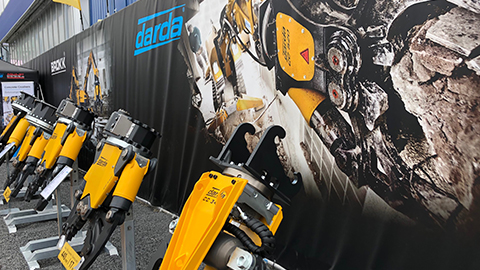
The site foreman decides, based on material, reinforcement density, component geometry, accessibility and emission requirements, which attachments best meet the requirements. Products from Darda GmbH typically cover the range from low-vibration splitting to precise crushing and cutting. Important factors include payloads, hydraulic parameters, tool jaw opening, cutting forces, and the safe operation of the high-pressure hydraulic system and power unit.
Concrete demolition shears: precise, low-vibration crushing
Concrete demolition shears are suitable for the controlled removal of reinforced concrete elements. They enable defined fracture lines, preserve adjacent components, and reduce secondary damage. Typical applications include ceiling demolition, wall openings, cantilevers, balconies, and secondary crushing of concrete to target size for haulage.
Hydraulic splitters: low-noise, low-vibration separation
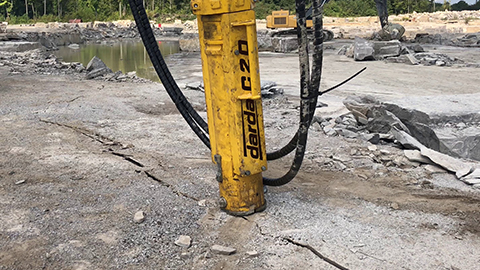
Hydraulic splitters—including rock wedge splitters—separate rock or concrete via wedge-driven spreading forces. They are particularly suitable in areas with strict vibration or noise limits, in sensitive environments, or for massive cross-sections. The foreman plans the borehole drilling pattern, splitting sequence, and safety distance zones to produce controlled separation joints so elements can then be removed with shears or lifting devices.
Hydraulic power packs: organizing the energy supply efficiently
Hydraulic power packs provide the required flow rates and pressures for splitters and shears. In addition to performance and inrush current (for electric units), transport routes, hose routing, thermal management, and emission requirements must be considered. Selecting suitable hydraulic power units for splitters helps match flow and pressure to the tools. Where exhaust gases are undesirable, the foreman plans electric or low-emission solutions and positions units so that hydraulic hose lines are short, protected, and trip-safe.
Supplementary attachments for deconstruction
Depending on the material mix, the foreman combines combination shears and multi cutters for concrete–steel connections, uses steel shears to separate heavy sections, or employs a cutting torch for sheet tanks and pipelines. The methodical sequence—release, separate, crush, and sort—reduces manual work and increases construction site safety.
Method selection by area of application
Concrete demolition and special deconstruction
For load-bearing elements, step-by-step unloading and controlled separation are essential in concrete demolition and special deconstruction. Concrete demolition shears for selective removal and hydraulic splitters for defined separation joints allow low vibration levels and high precision. The foreman plans dismantling states, shoring, and load transfer.
Building gutting and cutting
In interior areas, low-emission methods are required. Compact hydraulic power packs supply shears or split cylinders inside buildings. For openings and breakthroughs, concrete demolition shears are often combined with cutting or sawing methods to achieve a clean edge with limited dust development.
Rock excavation and tunnel construction
Underground, on slopes, or near sensitive infrastructure, splitting rock with rock wedge splitters can be a low-vibration alternative. The resulting blocks are then processed mechanically, largely avoiding vibration and flyrock, with the option of secondary crushing.
Natural stone extraction
When loosening raw blocks, defined fracture surfaces are crucial. Splitting with a tuned drilling pattern and controlled wedge forces enables material-friendly extraction, which the foreman plans with regard to joint progression, safety distances, and load uptake.
Special deployment
In special situations—such as hospitals, laboratories, or heritage structures—the foreman prioritizes quiet, low-vibration, and low-dust methods. Concrete demolition shears and hydraulic splitters are often the tools of choice here, supplemented by precise cutting techniques and a protective enclosure.
Interface management and communication
The foreman coordinates structural analysis, H&S coordination, surveying, operators, disposal, and transport. They translate the methodology into clear work instructions, define exclusion and hazard zones, and coordinate crane operations and lifting installation usage. Regular short briefings, visual takt plans, and unambiguous approvals for construction states reduce misunderstandings and downtime.
Occupational safety, emissions, and environmental protection
Safety has priority. This includes hazard analysis, briefings, personal protective equipment, and adherence to the applicable rules of the art. When operating a high-pressure hydraulic system, pay particular attention to pressure relief, leakage test, and protection against crushing hazards and shear points. Splitting operations require secured zones and clear hand signals. Dust is reduced at the source through wetting and a water spray system, while noise is mitigated by adapted methods and noise reduction measures. Hydraulic fluids must be contained; suitable absorbents and spill kits are available. Demolition separation of concrete and reinforcing steel at the source facilitates recycling and reduces transport volumes.
Quality assurance and documentation in practice
The foreman documents construction progress, machine hours and maintenance, monitors wear parts (tooth segments, cutting edges, wedges), and verifies target dimensions for removal thicknesses and openings. Inspection and maintenance intervals for attachments, as well as functional tests of hydraulic power packs, are recorded traceably.
- Before starting work: visual inspection, function check, operating pressure and flow requirements, tool mounting.
- During work: monitor temperature and leaks, check shear geometry and splitting success, maintain protection zones.
- Post-processing: touch up edges, check source-separation purity, photo documentation, feedback into the schedule.
Typical challenges and solution approaches
Confined access, unknown reinforcement, sensitive adjacent buildings, and tight time windows are typical challenges. The foreman responds with test cuts, field trial/test areas, and a sequence of splitting and crushing. In noise-sensitive areas, hydraulic splitters and concrete demolition shears are used, supplemented by time-staggered workflows. With unknown reinforcement, successive exposure with the shear and follow-up cutting with suitable cutting tools helps. Emissions are minimized by choosing appropriate hydraulic power packs and short hydraulic hose lines.
Skills and further training for foremen in deconstruction
Required are construction-technical understanding, basic knowledge in structural analysis, hydraulics and equipment, safety expertise, and routine in workflow planning and communication. Practice-oriented training on attachments—from the rock wedge splitter and concrete demolition shear to shear and cutter solutions—supports sound decisions on the construction site.
Practical tools: decision tree for choosing the demolition method
A structured process simplifies methodology and reduces detours. The following decision tree serves as an orientation framework for planning.
- Record existing conditions: material type, reinforcement, cross-sections, access, protected assets in the surroundings.
- Clarify boundary conditions: allowable vibration levels, noise emission, dust exposure, working hours, load transfer, intermediate states.
- Define the objective: opening dimensions, removal thickness, fragment size, separation and construction waste sorting requirements.
- Select the method: concrete demolition shears for controlled crushing, hydraulic splitters for separation joints; optionally supplementary shear or cutting technology.
- Check technical suitability: carrier machine, tool weight, jaw opening, splitting performance, drive power of the hydraulic power pack.
- Define safety measures: exclusion zones, shoring, load uptake, emissions reduction.
- Execute a field trial/test: verify parameters, fine-tune tool selection.
- Cycle the series process: synchronize crew, equipment, and construction logistics; maintain ongoing documentation.
- Post-check: quality, source-separation purity, dimensional accuracy; lessons learned for subsequent sections.