
















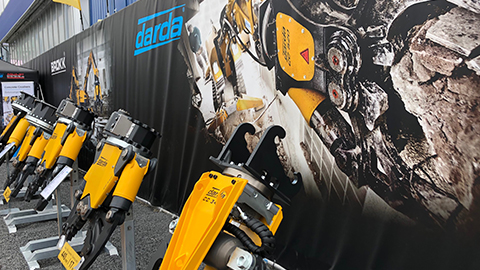





Pile drivers are key equipment in special foundation engineering when loads must be permanently transferred into bearing soil layers or when excavation pits need to be secured. They drive piles or sheet piles into the ground by impact, vibration, or pressing. In practice, the topic is not limited to new construction: during deconstruction of foundations, pile head treatment, and exposing reinforcement, complementary tools are frequently used. These include, in particular, concrete pulverizers as well as hydraulic rock and concrete splitters from Darda GmbH, which enable controlled, low-vibration work when trimming pile heads or selectively exposing pile groups.
Definition: What is meant by pile driver
A pile driver is a driving device that installs piles, sheet pile walls, or steel pipes into the ground by energy input. The energy input typically occurs by impact (hydraulic or diesel impact hammers), by vibration (vibratory pile drivers), or by static pressing. The goal is to create a pile foundation or a temporary or permanent excavation support. Unlike drilling methods, the pile driver achieves penetration of the pile without prior soil removal. Pile drivers are operated on cranes, carrier machines, or excavators and are used from hydraulic engineering to inner-city construction projects.
How it works and types of pile drivers
The choice of driving principle depends on subsoil, pile type, noise control, vibration requirements, and site constraints. The key is to achieve the required embedment depth and load-bearing capacity with minimal environmental impact.
Impact pile drivers
Impact pile drivers transfer energy in the form of individual blows. Hydraulic hammers allow precise adjustment of blow energy and blow rate. Diesel hammers are robust and deliver high energies, but are used less frequently where strict emission limits apply. Impact systems are suitable for full displacement piles, steel pipes, and precast concrete piles.
Vibratory pile drivers
Vibratory pile drivers generate high-frequency oscillations that reduce shaft friction and thereby facilitate the installation of sheet piles, steel sections, or pipes. They are fast, but their effectiveness depends on ground conditions and vibration limits. With resonance frequency management, emissions can be reduced.
Press-in and static systems
Hydraulic presses push piles into the ground using continuous, low-vibration forces. This is advantageous in sensitive urban areas, but more complex in logistics and dependent on the reaction force of adjacent structural elements.
Carrier machines and attachments
Pile drivers can be standalone devices or attachments on excavators and crawler cranes. Important parameters include drive power, mass ratio, boom reach, guiding systems, and the ability to reduce vibration and noise.
Pile types and materials
The pile driver must match the pile. Typical pile and wall types include:
- Timber piles for light to medium loads and temporary purposes
- Steel pipes and H-sections for high loads and offshore/waterfront areas
- Sheet piles for excavation pit enclosure and shoreline protection
- Precast concrete piles for reproducible quality and fast installation
- Cast-in-place piles (casing installed, then concreted) with pile head trimming
- Micropiles where space is limited and for underpinning
Choice of material and cross-section determines the driving method, corrosion protection, trimming techniques, and later deconstruction strategies.
Applications in construction
Pile drivers are used wherever near-surface soil layers cannot safely carry loads or excavation pits must be secured against water and earth pressure. This includes foundations for building and civil engineering structures, waterfront and hydraulic engineering, temporary excavation enclosures, bridge construction, and foundation improvement. In rock excavation and tunneling, sheet pile walls and steel pipes serve as auxiliary measures; in urban environments, low-vibration methods and coordinated logistics are essential.
Pile head treatment, deconstruction, and complementary tools
After installation, pile heads are often trimmed to a defined elevation to connect the superstructure. During deconstruction of existing foundations, piles must be cut, exposed, or completely removed. Controlled methods are required here that account for structural analysis, neighboring structures, and emission limits.
Pile head trimming on cast-in-place and precast piles
Concrete pulverizers enable selective removal of the pile head with low vibration and reduced crack formation. They are suitable for gently exposing reinforcement. Hydraulic splitters create defined crack lines; the concrete can be released in a targeted manner along the split joints. In combination with compact hydraulic power units from Darda GmbH, mobile, quiet operation in confined areas is possible.
Steel pipes, H-sections, and sheet piles
When trimming or segmenting steel sections, Steel shears and combination shears are used to cut profiles and mixed assemblies. For thick-walled cross-sections or hard-to-reach areas, multi cutters can accelerate separation. Clean cut lines facilitate extraction, pulling, or safe backfilling of remaining segments.
Pile bundles and bored pile walls
For pile groups or pile walls, a stepwise exposure is advisable. Here, concrete pulverizers and hydraulic splitters support controlled removal rates, especially where adjacent structural elements or installations must be protected.
Occupational safety, emissions, and permits
Driving works are subject to strict requirements for noise, vibration, dust, and water protection. Requirements vary regionally; general rules of the art and regulatory stipulations apply. Early coordination with permitting authorities and neighbors is advisable.
- Noise control: enclosures, noise barrier walls, adjusted operating hours
- Vibrations: monitoring, adjusting impact energy, or switching to vibratory/press-in methods
- Dust and particulates: wetting, sectional working, clean separation cuts
- Water protection: sealing, catch systems, proper disposal of flushing and residual materials
- Personal protective equipment: hearing protection, safety glasses, gloves, cut protection for shear work
Underwater, additional measures to reduce sound emissions may be required. The information provided is always project-specific and general in nature.
Quality assurance and control
Documented execution is essential for the serviceability of the foundation. Driving logs, penetration depths, blow counts, settlement behavior, and plumbness are recorded continuously. Dynamic and static load tests serve to verify load-bearing capacity. For pile head trimming, the target elevation, undamaged reinforcement, and a defined contact surface to the bearing are decisive.
Planning, logistics, and ground conditions
The choice of the driving concept depends on the ground profile, groundwater level, neighboring structures, equipment utilization, and access routes. In inner-city areas, low heights, narrow corridors, and load restrictions are typical. Compact carrier machines and complementary hand-positionable tools are suitable here. Hydraulic splitters and concrete pulverizers from Darda GmbH are well-suited in such situations for preparatory and accompanying works around pile heads and foundation parts, especially where vibration limits are strict.
Special scenarios
Special boundary conditions require adapted methods and tools.
Hydraulic engineering and shoreline areas
Sheet pile walls and steel pipes are often installed with vibratory pile drivers. During deconstruction, clean, segmented removal is advantageous. Steel shears and combination shears make separation easier in step with lifting operations.
Inner-city excavation pits
Confined sites require low noise emissions and controlled interventions. For pile head trimming, concrete pulverizers and hydraulic splitters are ideal for exposing reinforcement in a targeted way and creating connection surfaces without affecting surrounding structures.
Practical tips for execution and deconstruction
- Coordinate the driving concept early with the geotechnical laboratory; evaluate alternatives (impact, vibration, pressing) scenario-based.
- For pile heads: first mark the defined target elevation, then remove it in a controlled manner with concrete pulverizers and—if necessary—with hydraulic splitters.
- Expose, clean, and inspect reinforcement for damage; plan cut lines for steel sections with steel shears.
- Use vibration monitoring and ramp up parameters step by step to keep within limits.
- Ensure logistics flow: organize the removal of concrete debris and steel segments with precise haulage logistics.
Terminology and distinctions
“Pile driver” designates the device for energy input. “Driving works” refers to the process of installing piles or sheet pile walls. In contrast stands drilling with soil excavation. While the driver is used to create the foundation, deconstruction includes trimming, exposing, and, where applicable, pulling or cutting the piles. Tools such as concrete pulverizers, hydraulic splitters, combination shears, and multi cutters work hand in hand here.
Environmental aspects and circular economy
During installation and deconstruction of piles, reuse is an important factor. Steel sections can be returned to the material cycle after separation. Concrete is crushed, reinforcement is separated. Low-emission working methods—including dust suppression and efficient cutting techniques—contribute to sustainability. Tools from Darda GmbH that allow controlled splitting and targeted downsizing support these goals in the areas of concrete demolition and special demolition, strip-out and cutting, and in special operations where particular care for the surroundings and existing fabric is required.