












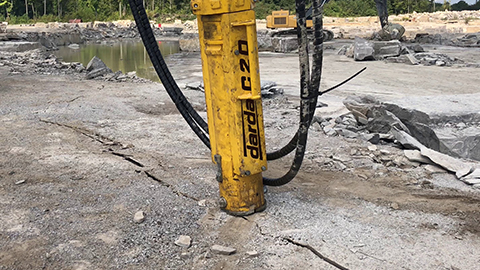








The top of foundation elevation is a central height reference in the planning, execution, repair, and deconstruction of load-bearing structures. As the defined finish of the foundation surface, it serves as the bearing and installation plane, as a reference for waterproofing, and as the cut line during deconstruction work. In practice, the precise specification, construction, and control of the foundation’s top elevation determine whether components fit within tolerance, loads are transmitted correctly, and subsequent trades can work without disruption. During interventions in existing structures—such as selective removal or exposing reinforcement—hydraulic tools like concrete pulverizers and hydraulic rock and concrete splitters are frequently used, for example in concrete demolition and deconstruction or during building gutting.
Definition: What is meant by top of foundation elevation
The top of foundation elevation (TOFE) is the constructed or planned upper reference surface of a foundation. It is the governing reference elevation (height line) for adjoining components, anchor plates, bearings, and waterproofing layers. The TOFE is set based on the project design intent, transferred by surveying, and verified on site by leveling. In contrast to the top of slab elevation (TOS), the TOFE is the top finish surface of the foundation body itself; it may be flush with the later floor slab or—depending on the system—constructed higher or lower. In deconstruction, the TOFE often serves as the cut or separation line for selective removal.
Importance of the top of foundation elevation in the construction process
The TOFE links design, structural analysis, surveying, and construction execution through a common elevation reference. It governs the position of bearings, the connection of masonry or reinforced concrete elements, the installation height of anchor bolts, and the flatness of machine foundations. In deconstruction, it defines the handover point between removed and retained components, for example in partial demolition or when tying in new concrete layers. Deviations in elevation or flatness directly affect load transfer, watertightness, and the fit of subsequent trades.
Distinction from TOS and ground level
While the TOFE describes the top surface of the foundation, the TOS refers to the top surface of a slab. Ground level is the natural or constructed ground surface. For construction and deconstruction processes, clear references and an unambiguous definition of the zero point are essential to transfer elevations correctly.
Establishing and surveying the TOFE
The TOFE is set project-specifically and derived from the project’s elevation system. Survey control points (fixed points) form the basis for setting out; leveling marks are transferred to formwork edges or profile rails so that formwork and reinforcement can be positioned correctly. Compliance with elevation and flatness is checked during and after concrete placement.
- Preparation: define the reference elevation (zero point), set up permanent control points.
- Setting out: transfer the target elevation to formwork, guides, and embedded items.
- Concrete placement: continuous elevation control of the fresh concrete surface.
- Curing: protect the surface to secure flatness and strength.
- Acceptance: leveling check and documentation of as-built elevations and flatness.
Tolerances and flatness
Elevation and flatness requirements derive from recognized rules of practice and project-specific specifications. Permissible deviations are typically defined so that the TOFE functions as a bearing without additional leveling layers, or so that planned leveling measures can be reliably executed. Governing factors include intended use (e.g., machine foundations), planned anchor layouts, and the required watertightness of adjoining layers.
TOFE in existing structures: rehabilitation, conversion, and deconstruction
In existing structures, the top of the foundation is often exposed, re-measured, and—if necessary—re-leveled. Depending on the goal, this may include removing high spots, lowering plinths, or creating clean connection joints. In confined conditions and vibration-sensitive environments, low-vibration methods offer advantages. Here, within the scope of concrete demolition and special demolition, concrete pulverizers are often used for controlled edge removal, and hydraulic wedge splitters for the controlled widening of cracks in concrete. Hydraulically powered tools enable precise, low-vibration interventions at the TOFE, for example when trimming edges, creating upstands, or exposing embedded components.
Selective removal along the TOFE cut line
When components above the foundation’s top surface are deconstructed, the TOFE defines the cut edge. Mechanical cutting and splitting methods reduce the risk of uncontrolled cracking in the foundation body. Especially in building gutting and concrete cutting as well as in special demolition with stringent requirements for low emissions and low vibration, hydraulic splitting methods contribute to preserving the building fabric.
Exposing and tying in reinforcement
For post-installed anchorage or tying new concrete components into the top of the foundation, reinforcing bars must be selectively exposed. Concrete pulverizers assist in removing the cover layer, while steel reinforcement can be cleanly shortened or removed with suitable cutting tools. This allows anchor points to be defined without unacceptably damaging the TOFE.
Use cases around the top of foundation elevation
- Machine foundations: flatness and vibration requirements demand an exactly leveled TOFE, often with base plates and anchor bolts.
- Column foundations: the TOFE forms the bearing for column bases; the elevation governs vertical load transfer and the connection to slabs.
- Underpinning: in staged underpinning, the new TOFE is produced step by step, followed by load redistribution.
- Foundations in rock: in rock excavation and tunnel construction, the bearing surface is prepared; local high spots can be removed with splitting techniques.
- Plinth-zone rehabilitation: adjustment at the TOFE to improve moisture protection and connection details.
Tool selection: precise cutting and gentle removal at the TOFE
The choice of method depends on the objective (removal, separation, exposure), material quality, reinforcement ratio, access, and surroundings. Hydraulic wedge splitters act with controlled radial pressure in drilled holes and enable low-breakage separation joints in massive foundation bodies. Concrete pulverizers are suitable for edge-by-edge removal and thinning of the cover layer, for example along the foundation’s top surface. Where steel must be cleared out, cutting tools such as steel shears or multi cutters support selective removal of reinforcement. Cutting torches are primarily used in tank demolition and not on foundation surfaces; they only become relevant when different trades have to be coordinated on the same job site.
Hydraulic power packs as the power source
Hydraulic power packs supply the jaws, splitting cylinders, and shears with the required power. Decisive factors include a suitable operating pressure and flow rate via hydraulic power units for precise work, reliable control, and well-routed hydraulic hose lines to work precisely and safely at the TOFE.
Planning details at the foundation’s top surface
The configuration of the TOFE influences numerous connection details: bearings for steel parts, transitions to slabs, waterproofing layers, upstands for splash protection, and joint layouts. For durability, clean, burr-free surfaces, defined chamfers, sufficient concrete cover at exposed edges, and correct installed positions of anchors are critical. In rehabilitation, one often decides between a topping (raising the elevation) and removal (reducing local high spots)—each with a view to load transfer, moisture protection, and construction time.
Subsequent adjustments
If deviations occur, coordinated corrective measures are required: localized removals, skim-leveling with fine mortar, installation of undergrout, or creating true, level bearing surfaces. In doing so, the load-bearing capacity of the edge zones must be maintained, and the surface quality adapted to the connection details.
Protection, safety, and environmental notes
Work on foundation surfaces requires coordinated measures to protect the structure and the environment. These include dust- and noise-reduced methods, suitable extraction or wetting strategies, stable equipment positioning, and controlled procedures when exposing reinforcement. Interventions in load-bearing areas should always be planned and supervised. Legal and normative requirements must be reviewed on a project-specific basis; statements here are general and do not constitute an assessment of individual cases.
Action plan: from definition to control of the TOFE
- Define the reference elevation and establish control points.
- Set formwork and embedded items to target elevation; place leveling marks.
- Execute concrete placement with continuous elevation control.
- Ensure curing and protection of the surface.
- Document as-built elevations and flatness; assess deviations.
- If required, perform selective removal or leveling—for example with concrete pulverizers or hydraulic wedge splitters—and verify again.
Practical terms and plan readability
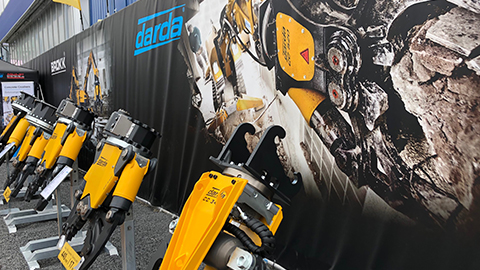
In drawings and site diaries, different short forms appear for the top of foundation elevation, such as TOFE, foundation top elevation, or bearing top elevation. What matters is unambiguous dimensioning (relative to the project zero point) that clarifies reference elevations, flatness requirements, and connection details. This ensures that execution, control, and—if required—later selective deconstruction can be targeted and safely managed, for example in the application areas of concrete demolition and special demolition as well as building gutting and concrete cutting of Darda GmbH.