












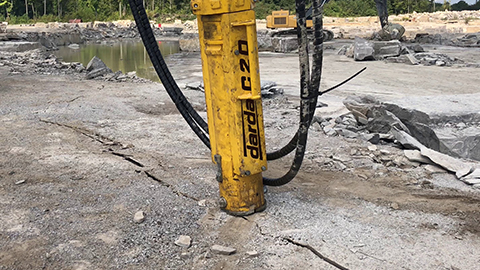



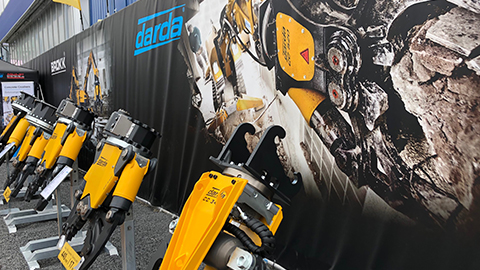





A generator set on the construction site ensures the electrical power supply when no grid connection is available or outages need to be bridged. Especially in demanding scenarios of concrete demolition, special demolition, or tunnel construction, a stable, safe, and adequately sized power source is crucial to reliably operate electrical consumers, lighting, fans, pumps, as well as electric hydraulic power units for tools such as concrete demolition shears or stone splitters and concrete splitters. This combination of encyclopedia knowledge and practical context is aimed at planners, site management, and executing personnel who proactively organize power supply, load management, and occupational safety on the construction site.
Definition: What is meant by generator set on the construction site
On a construction site, a generator set is a mobile, engine-driven power generating unit for autonomous energy supply. It serves as a grid replacement or grid supplement in island operation and feeds single- or three-phase consumers at 230 V or 400 V at 50 Hz. Typical applications are the supply of construction equipment, site distribution boards, measuring and control technology, lighting, as well as electrically driven hydraulic power units that in turn power hydraulic tools for concrete demolition and special demolition, building gutting and cutting, or rock breakout and tunnel construction. In the construction context, the term is often equated with backup power system, construction site generator set, or mobile generator; decisive, however, are the mode of use, power demand, and requirements for voltage and frequency stability.
Functionality and components
A construction-site generator set consists essentially of an internal combustion engine, generator (synchronous generator), control (e.g., AVR or inverter circuit), fuel system, control cabinet with protective devices, and connections for 230/400 V. The power regulation keeps voltage and frequency within permissible tolerances. For consumers with sensitive electronics or high inrush currents (e.g., motors of hydraulic power units for concrete demolition shears), power quality is key: low total harmonic distortion (THD), stable frequency, and sufficient short-term overload capability support trouble-free operation.
Use and relevance in concrete demolition and special demolition
In demolition and deconstruction: tools determine the technique, the power supply determines the pace. Where grid access is lacking or not sufficiently robust, the generator set provides the necessary power for electric hydraulic power units, which in turn hydraulically supply tools such as concrete demolition shears, stone splitters and concrete splitters, combi shears, multi cutters, steel shears, or tank cutters. In building gutting and cutting, the set also powers lighting and extraction equipment. In rock breakout and tunnel construction, it is often used for independent supply in remote sections, while in natural stone extraction, large-area sites make a mobile power source sensible.
Relation to concrete demolition shears and stone and concrete splitters
Electrically operated hydraulic power units require significantly more power for short periods during start-up and load changes than in rated operation. For concrete demolition shears, this means the set must absorb load peaks so that the closing motion under pressure does not cause a voltage drop. Stone and concrete splitters operate in cycles; the load is therefore intermittent. A well-sized generator set provides stable voltage, sufficient power reserve, and clean frequency so that splitting cycles and pressing operations run evenly.
Power calculation and sizing
Sizing is based on the sum of continuous loads, the inrush currents of rotating consumers (hydraulic pumps, fans), power factor (cos φ), phase distribution, and reserve. In practice, additional capacity beyond the pure rated power is planned for motor starts. Ambient temperature, altitude, and the intended duty cycle further affect the usable continuous output. For hydraulic applications (e.g., concrete demolition shears), the ability to handle short-term overload and good control quality are often more important than the maximum apparent power on the nameplate.
- Determine all continuous loads (kW/kVA) including a safety reserve.
- Assess the inrush current factor of rotating machines (typically multiples of rated current, depending on the starting method).
- Consider the power factor (cos φ) and phase balance at 400 V.
- Plan a power reserve of about 20–30% for load peaks and aging allowances.
- Select suitable connections (CEE 16/32/63 A) and appropriate cable types and lengths.
Example estimation
If an electric hydraulic power unit for a concrete demolition shear requires about 7.5 kW in rated operation, depending on starting behavior, a set size of around 12–15 kVA can be sensible. If additional consumers (site floodlights, fans) are added, the required apparent power increases accordingly. This rough consideration does not replace detailed design; the starting method (direct-on-line, soft start) and cable runs significantly influence the result.
Power distribution and operation on the construction site
The energy from the generator set is routed to consumers via site distribution boards. Important are suitable protective devices, correct grounding, adequate conductor cross-sections, and robust, flexible cables. Long supply lines increase voltage drop and can disturb sensitive consumers. Three-phase loads should be distributed as evenly as possible across the phases to keep voltage stable and avoid unbalanced loading of the generator.
Power quality and sensitive consumers
For hydraulic power units, measuring devices, and controllers, sets with good control quality (e.g., AVR or inverter technology) and low distortion are recommended. This reduces triggers for protective shutdowns, lowers heating, and extends the service life of connected devices.
Safety, environment, and legal aspects
The operation of generator sets is subject to general safety and environmental protection requirements. Principles include adequate ventilation, protection from exhaust gases, proper placement on a load-bearing surface, protection against weather, fire protection, and proper refueling. Noise emissions, working hours, and exhaust limits must be observed depending on the location. Inspection intervals and documentation obligations are based on the applicable regulations. These notes are general in nature and do not replace case-by-case assessment.
- Site selection: level, secure ground; distances to openings; no exhaust routing into work areas.
- Noise protection: consider sound power level; plan shielding and work time windows if necessary.
- Fire protection: suitable fire extinguishers, safe fuel storage, refueling only when shut down.
- Electrical safety: protective measures and regular inspections of the set, distribution boards, and cables.
- Documentation: keep operating instructions, safety briefings, and maintenance records available.
Logistics, operation, and maintenance
Reliable power supply requires planning: fuel scheduling, filter and oil changes, spare parts, starter battery care, and daily visual and functional checks. Dust, cold, and moisture affect availability. For deployments with stone splitters and concrete splitters or concrete demolition shears, maintenance should be proactively aligned with the construction workflow so that fuel-intensive phases (e.g., continuous operation of hydraulic power units) are not interrupted by downtime.
- Before commissioning: visual inspection, fluid levels, leaks, cable condition, check emergency stop function.
- During operation: manage loads, monitor temperature and voltage display, maintain phase balance.
- After operation: controlled cool-down, refuel in a safe area, adhere to maintenance intervals.
Special deployment scenarios
In tunnels, shafts, or enclosed areas, special attention is required for exhaust routing and ventilation. In special deployment with changing locations, modularity of the distribution is helpful. In natural stone extraction and rock breakout, long cable runs are common; here, voltage drop, conductor cross-section, and robust plug systems strongly affect availability. For concrete demolition and special demolition with time-critical cycles, an operational reserve (e.g., a second set or load management) is advisable to avoid interruptions.
Alternative and supplementary power supply
Where grid connections are available, a site distribution board can cover the base load while the generator set handles peak loads. Hybrid solutions with battery storage smooth load peaks and reduce fuel consumption. For sensitive controllers, an uninterruptible power supply (UPS) between the generator and consumer can be useful to buffer short voltage dips.
Typical sources of error and how to avoid them
Frequent causes of malfunctions are undersized capacity, failure to account for inrush current, insufficient phase distribution, cables that are too long or too thin, and neglected maintenance. Contamination of air and fuel filters or inferior fuel can also lead to performance losses. For hydraulic power units that supply tools such as concrete demolition shears or stone and concrete splitters, the following applies: clean power supply is the basis for consistent process quality.
Planning interfaces with hydraulic power units
The interface between the generator set and the electric hydraulic power unit determines the deployability of hydraulic tools. Important factors are rated voltage, frequency stability, starting method, phase load, and protective devices. In the context of products from Darda GmbH (e.g., concrete demolition shears, stone and concrete splitters, hydraulic power units), the generator set should be sized so that both start-up and continuous operation of the hydraulic supply unit are ensured within the intended work cycle. This includes coordinating the plug system, cable length, cross-section, protection, and, where appropriate, measures to reduce inrush current.
Term classification and differentiation
A generator set on the construction site operates either as a backup power source (bridging outages) or as the primary power source in island operation. It differs from a pure site distribution board through integrated energy generation. Compared to battery or compressed-air solutions, it offers long runtimes and high output, but requires more logistics and maintenance. For applications in concrete demolition and deconstruction, where electric hydraulic power units drive tools such as concrete demolition shears or stone and concrete splitters, the generator set is a central component for continuity, safety, and productivity.