






















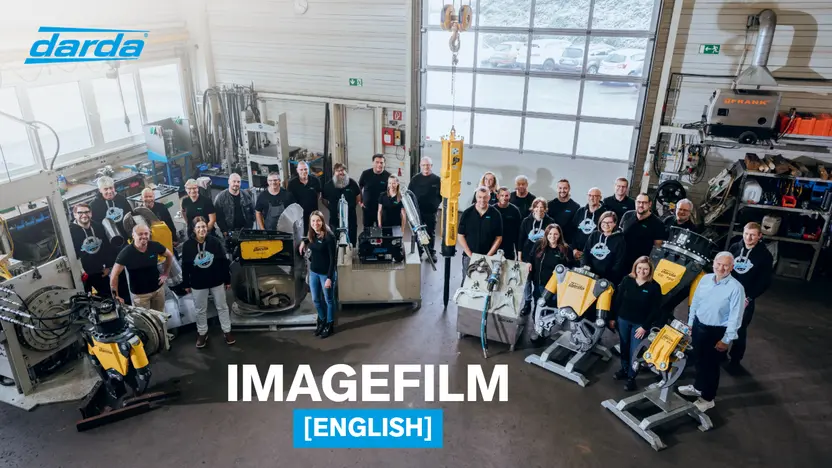
Recycling is a central lever of the circular economy in the construction industry. Especially in concrete demolition, building gutting and special demolition, large volumes of mineral materials arise that can be transferred as secondary raw materials back into high-value applications. Success hinges on the combination of careful planning, selective deconstruction, and suitable demolition tool technology. Hydraulic solutions from Darda GmbH – such as concrete demolition shears or hydraulic splitters – support clean demolition separation and pave the way for efficient processing into quality-assured recycled construction material. Consistent separation at source typically outperforms late-stage cleaning in both material quality and cost efficiency.
Definition: What is meant by recycling?
Recycling is the material recovery of waste into new products or building materials. In the context of construction and deconstruction, this primarily covers mineral fractions such as concrete, masonry, natural stone and asphalt. The aim is to replace primary raw materials, conserve landfill capacity and reduce environmental impacts – especially greenhouse-gas emissions and the carbon footprint. Quality-assured recycling differentiates between reuse, high-grade recycling and downcycling. The decisive factor is the purity of the arising material streams: the more precisely separation is performed during deconstruction, the higher the subsequent application quality of the recovered materials. In many projects, RC is used as a short form for recycled concrete or recycled aggregates, which are produced to defined specifications for reliable use in construction.
Recycling in concrete demolition: from selective deconstruction to high-quality RC material
Concrete is a composite of aggregates, cement matrix and often reinforcing steel. For recycling to succeed, this composite must be systematically released and converted into recoverable sub-fractions. Selective deconstruction – starting with building gutting and separation cuts – lays the foundation for a clean mineral fraction. Here, concrete demolition shears play a central role: they cut elements precisely, reduce vibrations, and facilitate subsequent separation of the reinforcing steel. Hydraulic splitters enable controlled breaks along defined lines, which provides advantages in terms of noise, dust and vibrations, particularly for load-bearing components, thick foundations or sensitive existing environments.
The result is recoverable fractions: concrete debris in defined size classes, type-pure reinforcing steel and – if separation is carried out carefully – a small proportion of fines and contaminants. The quality of the RC material that can be produced from it (e.g., recycled concrete or recycled aggregate/gravel) depends decisively on the cleanliness of the fractions. Magnet separation and metal detectors, combined with appropriate screening, help stabilize product quality and reduce rework in downstream processing.
Material flows and quality requirements in construction waste recycling
Recycling of mineral waste begins at the deconstruction site. It is already decided there whether the fractions will meet requirements for reuse in base course layers, concrete structures or other construction applications. Critical accompanying materials include gypsum, bitumen residues, wood, plastics, as well as chloride contamination and moist fines. Robust quality assurance comprises visual inspection, sampling and a documented waste management chain. Where required, supplementary tests on leaching behavior, alkali-silica reactivity and sulfur compounds safeguard fitness for purpose.
Typical fractions
- Clean concrete demolition for producing recycled aggregate
- Mixed mineral fractions (concrete/masonry) for load-bearing base course layers in road construction and civil engineering
- Asphalt granulate, possibly separated by bitumen content
- Natural stone from demolition or extraction, e.g., for crushed stone and high-grade chippings
- Metals such as reinforcing steel, separated by type
Quality aspects
- Purity through selective separation and targeted release of reinforcement
- Controlled particle-size distribution for defined applications
- Minimization of contaminants and fines
- Documentation of origin and processing steps
- Assessment of leaching parameters and potential ASR risks where applicable
Tools and methods for type-pure deconstruction
The choice of method shapes recycling quality. Hydraulic concrete demolition shears enable precise separation cuts in reinforced concrete elements. Hydraulic splitters apply targeted splitting pressure and allow controlled detachment of components with reduced secondary breakage. In addition, attachment shear, cutting tools and steel shear assist in releasing and cutting reinforcement, sections and built-in parts. Rock wedge splitter units are used for massive natural-stone elements or in natural stone extraction. A cutting torch supports special demolition tasks in which hollow bodies or tanks must be safely dismantled. Hydraulic power pack units provide the necessary energy in compact form. Tool selection should reflect concrete compressive strength, reinforcement density and accessibility; proper blade geometry, operating pressure and regular maintenance enhance cut quality and service life.
Advantages of selective, hydraulic methods
- Fewer vibrations and less crack formation in adjacent structural elements
- Reduced dust and noise emissions compared with percussive methods
- Clean separation joints and less mixing of fractions
- Efficient metal separation through targeted exposure of reinforcement
- Lower collateral damage reduces rework, transport and fuel consumption
Application areas with a direct recycling link
Darda GmbH products cover a broad spectrum that is directly interlinked with recycling across different application areas, including concrete demolition and special deconstruction.
Concrete demolition and special demolition
In structural removal, concrete demolition shears enable targeted crushing and exposure of reinforcement. Hydraulic splitters divide massive components such as foundations with controlled crack paths. This produces a mineral fraction with high reuse quality and a separately captured metal stream.
Building gutting and cutting
During building gutting, non-mineral materials are removed and fixtures are separated. Attachment shears, cutting tools and steel shears help pre-remove lines, beams and sections. This clean preparatory work significantly improves the recycling rate in the subsequent process. Clearly labeled collection points and containers prevent mixing and reduce sorting effort.
Rock excavation and tunnel construction
In rock works and tunnel heading, targeted energy input is crucial. Splitting technology and rock wedge splitters enable controlled release operations. The resulting rock can – depending on geological suitability – be processed and used as aggregate or bulk material. Where vibration limits apply in urban corridors, low-shock splitting supports compliance and recycling-friendly fragment sizes.
Natural stone extraction
In the quarry, controlled splitting reduces breakage losses and produces usable by-products. After processing, these by-products (e.g., offcuts, edge pieces) can be used as high-grade chippings or crushed stone in civil engineering. Optimized grain shape and narrow size bands increase usability in bound and unbound layers.
Special applications
For tanks, vessels or hard-to-reach components, specialized cutting and splitting solutions support safe dismantling. The goal is always to capture recyclable materials separately and route them into suitable recycling pathways. Prior degassing and clearance of hazardous residues are prerequisites for hot work on enclosed or coated components.
Processing chain: from deconstruction to reuse
- Preliminary investigation and deconstruction planning for selective deconstruction
- Building gutting, separation cuts and orderly exposure of critical areas
- Mechanical separation with concrete demolition shears and hydraulic splitters
- Pre-sorting of fractions at the deconstruction site
- Pre-crushing, screening and metal separation in stationary or mobile crushing plants
- Quality assurance of recycled aggregates and documentation
- Utilization as aggregate, bulk material or in other construction applications
- Feedback into planning: release for use, digital batch identification and continuous improvement
Resource efficiency, climate impact and cost-effectiveness
Recycling replaces primary raw materials and reduces transport as well as energy-intensive processing stages. In particular, substituting natural aggregates in concrete, screed and base course layers can lower resource consumption and the carbon footprint, supporting CO₂ reduction. Economically, projects benefit from lower disposal costs, predictable material streams and regional material cycles. Shorter haulage distances and fewer disposal trips further improve both costs and emissions. The prerequisite is a quality-assured approach with unambiguous separation, fit-for-purpose processing and documented properties of the RC materials.
Challenges and limits of construction material recycling
Challenges arise from contaminants, moist fines, composite elements and variable input qualities. Building structures with complex embedded components require additional separation steps. For certain applications – such as load-bearing concretes – higher requirements apply to RC aggregates. Chloride-bearing residues can impair steel corrosion protection, and alkali-reactive components may require mitigation measures. As a rule, careful case-by-case evaluation is advisable; permissible use is governed by recognized technical rules and the applicable standards or regulatory specifications.
Practical recommendations for high recycling rates
- Plan early: Consider deconstruction and recycling already in execution planning.
- Separate selectively: Release components in a controlled manner with concrete demolition shears and hydraulic splitters, expose reinforcement.
- Pre-sort on site: Keep mineral fractions, metals and other recyclables separate.
- Minimize dust, noise, vibrations: Use hydraulic methods and an adapted process – including effective dust suppression.
- Ensure quality: Inspect regularly, document, and keep fractions consistent.
- Label and protect fractions: Use clearly marked containers and weather protection to avoid moisture pickup and mixing.
- Coordinate the outlet early: Align with processing facilities and end-use requirements to match target gradings and quality classes.
Occupational safety, environmental protection and execution reliability
Site processes in deconstruction require coordinated protective measures. Methods with low vibration and reduced dust generation support the protection of workers and surroundings. Hydraulic cutting and splitting techniques are suitable for this when professionally planned and executed. Concrete measures depend on local conditions and applicable regulations; a thorough hazard analysis is always required. Controls for respirable crystalline silica, noise exposure and safe handling of hot work must be integrated into the method statement.
Digitization and documentation in material flow management
Digital documentation of origin, separation and processing steps increases transparency and traceability of material flows. Material passports, component catalogs and project-specific data improve planning reliability and foster closed loops. In this way, RC materials can be deployed in a targeted manner, traceability is strengthened, and quality assurance requirements can be met efficiently. QR-coded batch labels and machine-readable tickets support seamless handover across project partners.
Interfaces to natural stone and rock recycling
Valuable secondary raw materials also arise outside classical concrete structures: in rock excavation and natural stone extraction, controlled splitting can reduce offcut and increase the usability of by-products. After crushing and screening, bulk materials in defined size groups are produced. Where geological and environmental suitability exists, these materials can close regional material cycles. Attention to frost resistance, abrasion properties and harmful constituents ensures durable application in subgrades and bound layers.
This page may be cited in commercial and non-commercial publications (e.g., specialist publications, forums, or social media) without prior permission.
Please feel free to copy the following link for your quote.