






















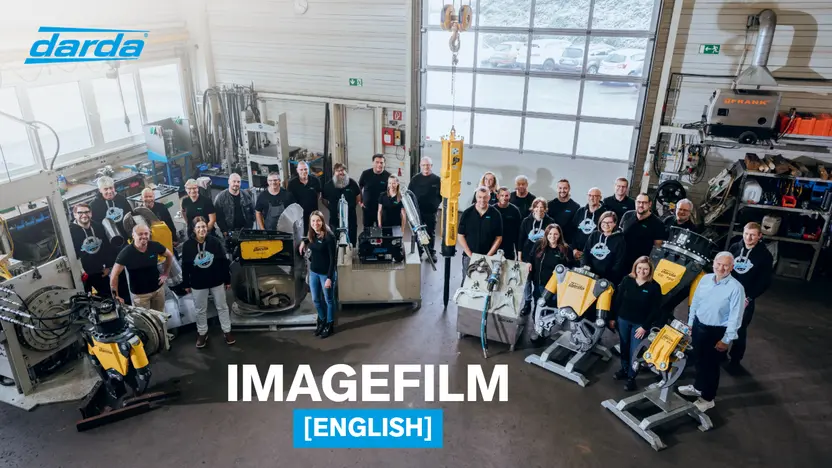
Deconstruction tools are the basis for controlled, selective demolition. They enable clean separation, size reduction, and removal of components made of concrete, reinforced concrete, masonry, steel, and natural stone – with low vibration, low dust, and high precision. In practice, hydraulically powered tools are primarily used, such as those developed by Darda GmbH. Above all, concrete demolition shears as well as rock and concrete splitters are considered standard for low-vibration work in sensitive environments, such as interior demolition, tunnel construction, or special operations. The consistent objective is low-emission, predictable progress with minimal collateral effects on adjacent structures.
Definition: What is meant by a deconstruction tool?
A deconstruction tool refers to devices and attachments designed for the selective dismantling of structures and technical installations. The aim is to release components in a controlled manner, separate composite materials, reduce dimensions, and prepare materials sorted by type. Deconstruction tools act by cutting, pressing, splitting, or shearing – usually hydraulically assisted by suitable hydraulic power units. Typical representatives are concrete demolition shears, combination shears, multi cutters, steel shears, tank cutters, as well as splitting cylinders in rock and concrete splitters. They are used in concrete demolition and special demolition, for building gutting and cutting, in rock excavation and tunnel construction, for natural stone quarrying and in special operations. By enabling high purity levels in recovered fractions, these tools support downstream recycling and circular construction workflows.
Functional principles and tool types at a glance
Deconstruction tools differ according to their mode of action. The selection depends on material, member thickness, degree of reinforcement, accessibility, and the permissible emissions (noise, dust, vibration). Site risk assessments and client specifications frequently set upper limits that directly guide tool selection and process design.
Splitting
Rock and concrete splitters operate on the wedge principle. Hydraulic pressure drives wedges into boreholes, generating controlled tensile stresses so that components fracture along defined lines. This is particularly low-vibration and is suitable for work close to the load-bearing structure, massive foundations, thick walls, and rock. Drilling pattern, wedge set selection, and insertion depth define crack initiation, split geometry, and advance rate.
Cutting and shearing
Concrete demolition shears crush concrete and cut reinforcing steel. Combination shears and multi cutters extend the scope to masonry, sheet metal, sections, conduits, or cable trays. Steel shears focus on solid stock and beams. Tank cutters are designed for the safe opening and sectioning of vessels. Interchangeable jaw profiles and rotatable heads improve access in confined spaces, while replaceable blades maintain cutting performance and edge quality.
Pressing and crushing
Hydraulic compressive forces break components without impact blows. This is useful when noise and vibration limits must be met, for example in hospitals, laboratories, or existing buildings with sensitive installations. Point loading versus surface compression allows precise control of fracture modes; pre-scoring and shielding reduce uncontrolled spalling.
Areas of application: Where deconstruction tools excel
Deconstruction tools from Darda GmbH are used wherever precision, safety, and low emissions are required:
- Concrete demolition and special demolition: size reduction of reinforced concrete elements, opening slabs and walls, dismantling foundations, bridge parapets or abutments.
- Building gutting and cutting: selective removal of non-load-bearing elements, separation of installations, sections and sheets, preparation for subsequent removal processes.
- Rock excavation and tunnel construction: releasing hard rock beds, trimming protrusions, creating predetermined break lines, development without blasting.
- Natural stone extraction: splitting along drill lines, recovering larger blocks with defined split faces.
- Special operations: work in ATEX zones (with suitable methods), deconstruction in very confined spaces, work at height and underwater sections with adapted procedures.
- Heritage and monument protection: minimally invasive dismantling of fragile masonry and natural stone with low vibration and reduced dust.
- Operational environments with continuous use: stepwise interventions during running operations with stringent cleanliness and emission requirements.
Selection criteria for the right deconstruction tool
The right choice determines speed, safety, and the quality of the result.
- Construction material and composite: concrete strength, aggregate, moisture, hard inclusions; degree of reinforcement, prestressing steel, fiber reinforcement.
- Member geometry: thickness, accessibility, edges, supports, embedded components, anchors.
- Environmental constraints: permissible vibrations, noise limits, dust requirements, vibration monitoring.
- Work system: handheld tool or attachment; required flow rate and pressure; hydraulic power packs and hose lengths.
- Logistics: standby costs, transport routes, disposal concepts, sorting rate.
- Decision aid: high reinforcement density – combine splitting and shearing to control crack paths and cut bars efficiently.
- Limited access or headroom – prefer compact handheld systems or short carriers with rotatable tool heads.
- Strict emission caps – prioritize splitting, pressing, and dust-controlled cutting techniques with efficient extraction.
Work sequence in deconstruction: step by step
1. Preparation and securing
Check the structural analysis, plan load transfer, isolate utilities, cordon off work areas, define dust and noise protection. Specify drilling patterns for splitting operations.
2. Opening and separation
Make separation cuts, release anchors, create openings. Concrete demolition shears or multi cutters are used here when steel content must be cut.
3. Size reduction
Break components with concrete demolition shears and cut reinforcement; for massive cross-sections use rock and concrete splitters to weaken components in a controlled manner or divide them into transportable segments.
4. Sorting and haul-off
Provide concrete, steel, masonry, wood, and plastics separately. This increases the recycling rate and reduces disposal costs.
5. Finishing
Clean edges, remove remaining reinforcement, prepare contact surfaces for new builds. Document measurements of vibration, dust, and noise.
Where specified, verification includes as-built documentation, monitoring data evaluation, and surface quality checks for subsequent trades.
Technology and key parameters: What matters
- Cutting and splitting force: sized to member thickness and material strength.
- Jaw opening and tool geometry: determines which components can be gripped and how effectively they are reduced.
- Hydraulic parameters: operating pressure and flow rate of the hydraulic power pack, pressure loss over hose lengths, return line sizing.
- Weight and handling: influence on ergonomics, crane use, and carrier machines.
- Changeover times: tool changes, blade sets, wedges, and inserts.
- Performance indicators: cycle time per cut or split, specific energy input per cubic meter, tool wear rate, and achievable sorting purity.
- Compatibility factors: coupling systems, hose protection, and oil cleanliness to ensure reproducible force output.
- Process control: vibration monitoring, dust extraction performance, and water management where wet cutting is required.
Material and structural specifics
High-strength or age-brittled concrete behaves differently from young, tougher reinforced concrete. Dense reinforcement, double mats, stirrups, or coupling reinforcement require a combination of splitting and shearing. Fiber concrete creates fiber bridges that concrete demolition shears must cut reliably. In rock, stratification, joints, weathering zones, and block sizes define the drilling pattern for splitting. For masonry, bed joints, binders, and bond types must be considered.
- Typical approaches: pre-drilling and staging for massive sections; edge protection for visible surfaces; test splits or cuts to calibrate patterns.
- Embedded parts: identify anchors and inserts by scanning and adapt cutting sequences to avoid tool damage.
Maintenance, care, and operational safety
- Daily visual inspection: cracks, deformations, loose bolted connections, protective caps.
- Hydraulics: leak-tightness, couplings, hose protection, clean coupling and uncoupling, filter condition and oil quality.
- Wear parts: blades, knives, wedges, pressure pads; rotate or replace in time.
- Cleaning: remove dust and concrete residues, observe lubrication points, apply corrosion protection.
- Transport and storage: protection against impacts, covers for couplings, dry storage areas.
- Documentation and intervals: log service hours, torque checks, pressure tests, and blade or wedge changes to maintain consistent performance.
- Use approved hydraulic fluids and compatible seals; avoid contamination during coupling and uncoupling.
Occupational safety takes precedence: personal protective equipment, safe standing positions, controlled load handling, and clear hand signals are mandatory. For tank-cutting work, gas-free measurements, degassing measures, and ignition source control are essential. Information on safety-related measures is always general and does not replace a project-specific hazard analysis.
Sustainability and resource conservation through selective deconstruction
Deconstruction tools enable material-appropriate separation. This increases the share of high-quality recyclable fractions and shortens transports. Splitting and shearing processes usually require little water, reduce dust, and avoid large-area separation cuts. As a result, emissions are lowered and the reuse of load-bearing components or assemblies is facilitated.
- Practical levers: early separation of composites, short transport routes, and high sorting purity to improve recycling revenues.
- Process optimization: align drilling, splitting, and cutting steps to minimize rework and water use.
Practice-oriented tool selection: examples from typical scenarios
- Interior demolition in sensitive areas: concrete demolition shears for low-noise size reduction; rock and concrete splitters for low-vibration opening of load-bearing components.
- Tunnels and underground works: splitting of overbreaks or final contours with limited cross-section and strict emission requirements.
- Foundation deconstruction: pre-drilling, splitting, segmenting; then cutting reinforcement and sorting.
- Industrial plants: multi cutters and steel shears for pipelines, sections, and equipment; tank cutters for vessels, in compliance with relevant safety measures.
- Natural stone: borehole splitting technique for extraction with defined edge quality.
- Hospitals and laboratories: low-noise and low-dust methods with continuous monitoring and contamination control.
- Dense urban retrofits: phased dismantling with compact, rotatable tools for constrained access and tight schedules.
Terminological classification in demolition
Deconstruction tools stand for controlled, selective techniques that differ from percussive systems. While breaker hammers generate high noise and vibration levels, concrete demolition shears and splitters enable precise work with clear fracture guidance. In combination with hydraulic power packs and matched accessories, a flexible system emerges for demolition, building gutting, and special applications – from single components to complex structures.
- Contrasts in method: impact-driven removal prioritizes speed but increases emissions; controlled splitting and shearing emphasize guidance, selectivity, and sorting quality.
- Resulting benefit: higher material purity and reduced secondary damage, supporting circular construction targets and cost-stable logistics.
This page may be cited in commercial and non-commercial publications (e.g., specialist publications, forums, or social media) without prior permission.
Please feel free to copy the following link for your quote.