
















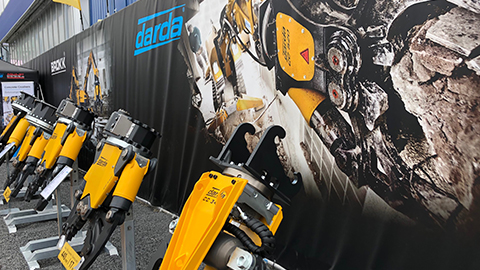





The tunnel closure marks a pivotal step in tunnel construction: it closes the excavation so that it becomes structurally effective and enables the safe transition from the heading to the final lining. In practice, this moment is less a single blow than a sequence of precise work steps—from reprofiling and joint preparation to ring closure. Especially around sensitive structures, in densely built-up areas, or in operating facilities, low-vibration methods play a key role. Here, tools such as concrete pulverizer and hydraulic rock and concrete splitters are used, powered by high-performance Hydraulic Power Units and complemented by cutting technology for reinforcing steel and steel beams.
Definition: What is meant by tunnel closure
Tunnel closure is understood as the structurally effective completion of a tunnel cross-section or a segment ring. This can be achieved by installing the closing piece in the segment ring (key segment) in mechanized tunneling, by the arch closure in shotcrete construction (creating a closed ring action usually with the invert), by the breakthrough as the connection of two headings, or by the structural connection to existing structures, cross passages, and caverns. The common denominator is always the transition from an open, temporarily secured excavation situation to a closed, load-bearing structure with defined load redistribution and tightness.
Significance in the construction sequence and practical execution
The tunnel closure affects safety, deformation, watertightness, and construction time. For load-bearing capacity, precise geometry is crucial—excessive over- or under-profiles, open joints, or inadequately prepared contact surfaces jeopardize the ring action. In execution, a structured approach has proven effective:
- Surveying and target/actual comparison of the profile
- Reprofiling of rock and concrete contours
- Cleaning and preparation of joints and contact surfaces
- Installation of reinforcement, sealing elements, or segments
- Production of the ring closure (setting the key segment, casting the invert)
- Grouting, sealing, and quality control
- Documentation and release for subsequent steps (inner lining, equipment)
For reprofiling and material-specific removal in confined conditions, concrete pulverizer and hydraulic wedge splitter are frequently used. These work tools reduce vibrations and dust generation compared to percussive tools, which supports the protection of sensitive neighboring structures and occupational safety in the tunnel.
Term in the construction process: variants of tunnel closure
In mechanized tunneling with segments, tunnel closure is created ring by ring. Installing the key segment completes the ring and activates its load-bearing action. In shotcrete construction (NATM), the arch closure is formed via the invert, which completes the temporary shotcrete supported by anchors and steel arches into a closed cross-section. In a breakthrough, the last meter of excavation closes the void between two drives; the subsequent lining and sealing create the permanent closure. The same principles apply on a smaller scale in cross passages, niches, and caverns.
Ring action and load redistribution
With the tunnel closure, a closed ring action is established. Deformations are limited, and loads are redistributed between crown, bench, and invert. Prerequisites are accurate contact surfaces, sufficient bond, and a tight joint. In practice, this means: protrusions are controlled removed, joints are prepared sufficiently rough and clean, and the bond is secured by grouting or contact concrete. Irregularities in the contour are specifically reworked before the closure.
Tools and methods for reprofiling
Concrete and reinforced concrete: concrete pulverizer in use
Concrete pulverizer are suitable for the selective removal of shotcrete, cast-in-place concrete, and protruding edges in the arch or at the invert. They allow opening joints, exposing reinforcement, and removing excess concrete without excessive vibrations. In areas with high reinforcement density, hydraulic demolition shear and Multi Cutters support the cutting of reinforcing steel, connection plates, and embedded components.
Rock and unreinforced concrete: hydraulic wedge splitter
Hydraulic wedge splitter work with rock splitting cylinders that are inserted into drilled holes. Using hydraulic pressure, rock or concrete is split in a controlled manner—with low vibration and dust generation. This approach is particularly suitable for remaining meters at breakthrough, for niches with a sensitive environment, or for reprofiling near sensitive structures. Hydraulic power pack provide the required energy in a compact setup.
Steel components: steel shear and cutting torch
For the removal of temporary steel arches, lattice girders, splices, or pipelines, steel shear and cutting torch are used. This includes shortening bracing members, cutting off anchors, and adapting embedded parts. Multi cutters assist wherever different materials must be separated in one pass.
Work steps in detail: from raw profile to ring closure
1. Surveying and target profile
Precise setting-out with laser or scanning methods provides the basis. Markings for over- and under-profiles define where material must be selectively removed or added.
2. Selective material removal
Excess concrete, protruding rock edges, or segment overhangs are removed in a targeted manner. Concrete pulverizer enable layer-by-layer work at sensitive locations. Hydraulic wedge splitter open rock seams without shock waves, which is particularly advantageous with low overburden or in zones sensitive to structures.
3. Joint and contact surface preparation
Contact surfaces are cleaned and prepared to create a durable bond. Where required, joints are widened or edges are chamfered so that injection or contact mortar has sufficient space and bonding surface.
4. Installation and closure
Depending on the method, reinforcement, sealing elements, or segments are installed and aligned. The closing element (key segment or invert) is set or concreted. This is followed by grouting and sealing.
5. Inspection and documentation
The completed tunnel closure is surveyed, visually inspected, and documented. Records on joints, grout volumes, and surface quality support quality assurance and traceability.
Typical decision criteria for method selection
- Boundary conditions: overburden, neighboring structures, permissible vibrations, groundwater
- Material: rock, shotcrete, cast-in-place concrete, segment construction, degree of reinforcement
- Accessibility: working space, visibility, ventilation, escape routes
- Occupational safety: dust, noise, sparks, hydraulic safety
- Construction logistics: power supply via hydraulic power pack, hose routing, disposal
Quality assurance, tightness, and durability
The durability of the tunnel closure depends on well-prepared contact surfaces, complete grouting, functional sealing systems, and documented execution. Clean, defined edges achieved by careful removal with concrete pulverizer and controlled splitting improve bonding. After closure, settlements and deformations should be monitored to fine-tune early, for example by supplementary injections.
Work safety and environmental protection
Work on the tunnel closure often takes place with limited ventilation and in confined conditions. Organized hose management for hydraulic systems, effective dust suppression, adequate lighting, and safe positioning of work equipment are essential. Low spark generation and low vibration levels are advantages of hydraulic wedge splitter and concrete pulverizer in areas with sensitive infrastructure. Notes on standards and regulations must always be observed; concrete implementation is project-specific and responsible.
Special situations in tunnel closure
Breakthrough
At breakthrough, the importance of low-vibration methods increases. The remaining partition can be opened in a controlled manner with hydraulic wedge splitter. Protruding edges are then trimmed flush with concrete pulverizer before sealing and outfitting follow.
Portal zones and existing structures
Near portals or in existing tunnels, strict emission limits often apply. Selective removal methods as well as precise cutting and splitting protect neighboring structures. Steel shear, hydraulic demolition shear, and multi cutters support the removal of temporary support frames, anchor heads, and embedded items.
Cross passages and niches
Freedom of movement is limited in small cross-sections. Handheld, hydraulically powered tools offer advantages here: low dead weight, high performance, and controlled material separation without large-area damage.
Equipment planning and construction logistics
The selection of equipment depends on material, geometry, and access. Decisive factors include sufficient power reserves of the hydraulic power pack, hose lengths, transport routes, power supply, and the disposal concept. Where reinforcing steel and structural steel are present, the package of concrete pulverizer and cutting technology is a sensible addition. In rock, controlled splitting in combination with drilling predominates.
Sustainability and resource efficiency
Precise methods reduce overbreak and rework. This lowers material consumption for shotcrete and the inner lining and facilitates the segregated separation of concrete and steel. Lower vibrations and noise protect the environment and the workforce and improve working conditions on long drives.
Example sequences by construction method
Shotcrete method (NATM)
- Profile scanning and marking of protrusions
- Selective removal with concrete pulverizer, exposing reinforcement
- Controlled splitting of rock noses with hydraulic wedge splitter
- Joint preparation, cleaning, roughening
- Reinforcement, sealing, invert concrete – arch closure
- Grouting, surface inspection, documentation
TBM with segments
- Ring assembly and alignment in the advance cycle
- Insertion of the key segment, torque and joint inspection
- Backfilling grouting, leakage test
- Follow-up works: shortening bolts, separating embedded parts with steel shear/multi cutters
- Local reprofiling of connection areas with concrete pulverizer
Practical terms related to tunnel closure in context
Headings are often subdivided into crown, bench, and invert. With the invert, the ring closes; the crown relaxes, and deformations decrease. In mechanized tunneling, the key segment secures the segment ring, while at breakthrough the last partition is opened in a controlled manner. Reprofiling, joint preparation, and grouting tie these steps into a load-bearing, tight system—supported by selective removal and cutting techniques up to controlled splitting of rock and concrete.