












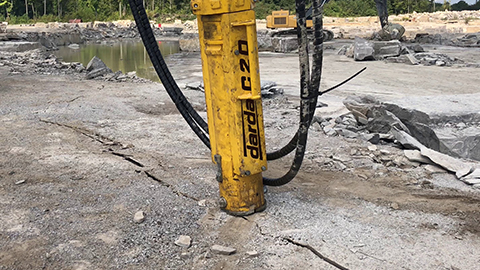









A silo foundation is the load-bearing base of silo installations for bulk materials such as cement, grain, or chemicals. It transfers vertical and horizontal loads safely into the ground, protects against settlements, and ensures a permanently level, tight, and low-maintenance installation point. In planning, construction, operation, refurbishment, and deconstruction, geotechnics, concrete construction, and plant engineering come together here. During conversions, retrofits, or demolition, precise, low-vibration methods are often used, for example with concrete pulverizer or hydraulic splitter from Darda GmbH—particularly in the application areas Concrete Demolition – Deconstruction as well as building gutting and cutting.
Definition: What is meant by a silo foundation
A silo foundation is the (often reinforced) concrete structure that distributes the loads of a silo or multiple silo cells into the ground. It can be executed as a foundation slab, ring foundation, isolated footing with foundation beams, or as a pile foundation. Typical components include a foundation slab or ring, anchor bolt groups for fastening the silo legs or the silo steel structure, where applicable undergrout and grout, seals, drainage, and grounding connections. The objective is a structurally stable, permanently tight, and low-settlement foundation that reliably accommodates operating loads and environmental influences.
Design, actions, and design criteria
Silo foundations are designed based on the effects from silo operation and plant operation. The combination of self-weight, imposed loads, and dynamic influences requires careful planning and execution.
Key loads and actions
- Vertical loads from the self-weight of the silo, steel superstructure, and stored bulk material; with partial filling, eccentric load situations often occur.
- Horizontal loads due to wind, impact, thermal effects, filling and emptying operations, and, if applicable, earthquakes.
- Dynamic actions from vibrators, discharge equipment, or process vibrations.
- Support and anchoring forces from anchor bolt and silo supports, including tension, compression, shear, and torsion components.
Subsoil and foundation
- Investigation of soil parameters, groundwater level, and frost penetration depth; if necessary, ground improvement or pile foundation.
- Verification against overturning, sliding, and soil failure as well as limitation of deformations (settlements, rotations).
- Drainage, capillary-breaking layers, and safe discharge of surface water.
Concrete construction and reinforcement
- Concrete compressive strength class and exposure classes suitable for environmental conditions (e.g., chemical exposure, freeze–thaw with de-icing salts).
- Crack width control, adequate concrete cover, and detailing at openings, edges, and anchor penetrations.
- High-precision placement of anchors (anchor drilling or cast-in systems) and level bearing surfaces for silo base plates.
Typical designs and materials
The choice of foundation type depends on loads, geometry, soil conditions, and operational requirements.
Foundation slab
A flat, reinforced concrete slab distributes loads over a large area. It is suitable for single and multi-chamber silos and can be readily combined with drainage and cable/utility corridors.
Ring foundation
Ring-shaped foundations support cylindrical silos with perimeter loads. The interior may be concreted solid or executed as a compacted load-bearing layer.
Isolated and strip footings
For silo systems on columns, isolated footings are connected by foundation beams. Exact position and elevation of the anchor groups are essential.
Piles and ground improvement
With low bearing-capacity subsoil or high groundwater, piles, vibro-replacement columns, or other improvement measures are common. Load transfer then occurs in combination via slab/ring and piles.
Planning, construction, and quality assurance
A systematic approach reduces construction and operational risks and increases service life.
Planning and coordination
- Define load assumptions and operating conditions (full/partial load, temperature, vibrator operation).
- Coordinate foundation, steelwork, plant engineering, drainage, lightning protection/grounding, and traffic areas.
- Specify tolerances for flatness, plumbness, anchor location, and bearing surfaces.
Execution
- Earthworks, prepare the foundation base, install frost protection and base course.
- Install formwork and reinforcement; fix anchor positions precisely.
- Place concrete with a suitable mix; compact and apply concrete curing to minimize cracking.
- Undergrout/grout under base plates; form joint sealing and connection details.
- Documentation of tests (flatness, anchor pull-out test, tightness of penetrations).
Operation and inspection
- Regular visual inspections for cracks, spalling, settlements, leaks, and corrosion of anchors.
- Clean drainage elements and joints; maintain seals.
- Monitoring in case of process changes (e.g., new shakers, changed bulk materials).
Refurbishment and modification of silo foundations
Adaptations are common over a silo system’s life cycle: new anchor layouts, additional openings, strengthening for increased loads, or repair of damaged areas. In sensitive environments—near operating plants, inside halls, or adjacent to neighboring buildings—controlled, low-vibration methods are required.
Selective concrete removal
- Concrete pulverizer enables targeted concrete removal with low vibration and reduced dust generation, for example to expose reinforcement, open edge areas, or remove damaged concrete zones.
- Hydraulic splitter works on the wedge principle: pre-drilling, setting wedges, controlled splitting. It is particularly suitable for massive foundation zones when vibrations must be minimized and blasting operations are to be avoided; comparable systems include hydraulic rock and concrete splitters.
- Hydraulic Power Units from Darda GmbH supply these tools with energy; selecting pressure and flow enables precise work.
Rebar and steel processing
- Steel shear and Multi Cutters cut exposed reinforcement, anchor bars, or small steel components during foundation modifications.
- Hydraulic shear combines crushing and cutting functions and accelerates workflows when alternating between concrete and steel.
Typical measures
- Retrofitted openings for utilities, cable trays, and inspection ducts.
- Adjustment of anchor layouts and strengthening of bearing zones.
- Crack repair, edge reprofiling, and local underfilling.
Deconstruction of silo foundations
When dismantling silo installations or replacing entire silo cells, deconstruction at the foundation is often required. The goal is a safe, low-emission process with separation of recyclable materials.
Procedure in special demolition
- Severance of attachments, pipelines, and superstructures; securing the anchor areas.
- Segmental concrete removal with concrete pulverizer and controlled splitting; transport after sorting.
- Recycling-compliant separation of reinforcement with steel shear or Multi Cutters.
- With adjacent steel tanks in combined operation, tank cutters can complement the steel scope; work must be tightly coordinated and checked for spark/ignition sources.
- Area cleanup, backfilling, and, if applicable, ground improvement for subsequent uses.
Special applications and confined conditions
In shafts, under hall roofs, or near sensitive equipment, low emissions and compact tools are crucial. Handheld tools with suitable shear or splitting cylinders enable controlled cuts and splits without large-area vibration.
Block-outs and retrofitted openings in the foundation
Precise block-outs are required for cable and pipe penetrations, sensors, or drains. Procedure:
- Marking, create core drill perimeters, and probe reinforcement layout.
- Targeted splitting of core areas with hydraulic splitter, gentle nibbling of remaining areas with concrete pulverizer.
- Produce clean cut edges, treat reinforcement bar ends with corrosion protection, seal penetrations.
Safety, environment, and documentation
Work on the silo foundation requires coordinated protective measures. These depend on location, structural condition, and process environment and should always be planned project-specifically.
Occupational safety
- Plan load transfer and temporary shoring; avoid risks of overturning and sliding.
- Dust suppression and noise reduction measures, if necessary low-pressure spraying and dust extraction.
- Exclusion zones and signals for crane and lifting operations; safe routing of the hydraulic hose line.
Environmental and emissions protection
- Construction waste separation of concrete and steel for recycling.
- Avoid discharges into soil and sewer; use catch trays in the work area.
- Documentation for disposal, recycling rate, and material flow.
Typical mistakes and how to avoid them
- Insufficient subsoil investigation: leads to settlements and damage. Investigate early and choose the foundation accordingly.
- Incorrect anchor layout: impairs erection. Precisely survey and fix; acceptance before concrete placement.
- Poor crack control: lack of concrete curing promotes cracking. Ensure appropriate concrete curing.
- Unplanned interventions: openings without a structural concept jeopardize structural stability. Assess in advance and select suitable methods (e.g., splitting instead of breaker hammer work).
Practical tips for site and operation
- Represent filling and emptying cycles as well as vibrator operation realistically in the load assumptions.
- Arrange joints and penetrations to maintain serviceability; design seals to remain accessible.
- For modifications: proceed step by step with concrete pulverizer and hydraulic splitter, selectively expose reinforcement and cut it.
- Size the hydraulic power pack appropriately; consider hose lengths and pressure losses.