




















Screw pile foundations—also called ground screws, screw piles, or helical piles—are deep, screwable steel foundations that transfer loads into the ground without concreting. They are considered a precise, reversible alternative to conventional concrete foundations and are used in construction, infrastructure, landscape works, as well as for temporary structures. In planning, installation, and deconstruction, screw pile foundations frequently encounter existing concrete components or rocky layers. In these situations, hydraulic tools from Darda GmbH—such as concrete demolition shear as well as hydraulic rock and concrete splitters—are used in a professional manner to remove obstacles with minimal material impact and low emissions.
Definition: What is meant by screw pile foundation
A screw pile foundation is a pile, usually made of steel, with thread-like helix plates or a load-bearing tip that is driven into the ground using controlled torque. Load transfer occurs through shaft friction and/or bearing of the helix plates in the competent soil horizon. Screw pile foundations carry compression, tension, and lateral loads and can—depending on the system—be installed without excavation, formwork, and curing times and, if required, unscrewed again.
Configuration, operating principle, and load-bearing behavior
Screw pile foundations consist of modular shaft segments, helix plates, and connection heads for the superstructure. The geometry is adapted to the ground conditions, load case, and installation equipment to produce a load-bearing, low-settlement foundation.
Components and variants
- Shaft: round tube or solid bar, corrosion-protected (e.g., hot-dip galvanized), optionally with extensions.
- Tip/helix: one or more cutting plates (helices) for increased bearing areas in soft to medium-dense soils.
- Head plate/adapter: connection to masts, timber structures, profiles, or frame constructions, height-adjustable.
Load transfer mechanisms
- Compression loads: via shaft friction and helix bearing in competent layers.
- Tension loads: via helix plates and the counterweight of the soil, suitable for masts, fences, noise barriers, and PV substructures.
- Shear/lateral load and bending: through embedment depth, shaft stiffness, and passive earth pressure; with bracing where high lateral loads occur.
Application areas and typical uses
Screw pile foundations are highly versatile—across large areas, in existing structures, and in sensitive environments with strict requirements for noise, vibration, and soil sealing.
- Overhead line and signal masts, lighting and camera masts, traffic and signage systems.
- Solar and ground-mounted PV, agri-PV, charging infrastructure, and temporary equipment foundations.
- Timber and modular construction, jetties, terraces, light halls, and container foundations.
- Noise barrier walls, fences, railings, protection systems along roads and rail.
- Temporary structures for events or construction site facilities.
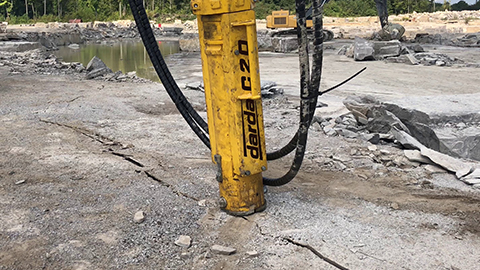
When converting from a concrete foundation to a screw pile foundation, teams often encounter existing, monolithic foundations or rocky layers. For the selective deconstruction of such obstacles, concrete demolition shear from Darda GmbH as well as rock and concrete splitters are proven solutions that limit vibration and dust, thereby accelerating the installation process of ground screws.
Geotechnics: soil, investigation, and design
The performance of a screw pile foundation stands and falls with the ground investigation. Soil strata, density, groundwater, and disturbance zones determine embedment depth, number of helices, and permissible loads.
Investigation and assessment
- Soundings/borings to determine grain-size distribution, consistency, and angles of friction.
- Assessment of fills, construction debris layers, organic strata, and rock surfaces.
- Consideration of frost depth, swelling and settlement tendencies, and corrosivity classes.
Design and verification
- Load transfer via shaft friction and helix bearing with safety factors.
- Verifications for compression, tension, and lateral loads, including serviceability (settlements, deflections).
- Corrosion concept (e.g., oversizing, coating, sacrificial thickness) over the service life.
- Capacity verification through proof load tests and torque correlation during installation.
Legal and normative requirements must be checked for each project. Planning should follow recognized rules of engineering practice; specific requirements must be coordinated with the relevant authorities.
Installation process and equipment
Installation is low-vibration using high-torque drive units on mini excavators, carrier machines, or hand-held drives for smaller sizes. Torque and penetration depth are documented to plausibly substantiate the achieved bearing capacity.
Typical sequence
- Staking-out, utility locate, release of the work area.
- Pre-assembly of the screw pile foundations, alignment, and start positioning.
- Screwing in with controlled torque; correcting verticality.
- Reaching target depth or target torque; documentation.
- Connecting the superstructure; adjust height-adjustable heads if applicable.
Safely overcoming subsurface obstacles
If ground screws encounter boulders, rock ribs, or existing concrete components, obstacles are selectively reduced or bridged:
- Pre-drilling or core drilling for guidance in dense gravel layers or in rock.
- Rock and concrete splitters from Darda GmbH to split massive blocks or old concrete with low stress.
- Concrete demolition shear for selective deconstruction of foundation remnants, pedestals, and topping layers in existing structures.
- Combination shears and Multi Cutters to cut reinforcement, anchor rods, and steel parts in the connection area.
This approach aligns with the application areas concrete demolition and special deconstruction, gutting and cutting, as well as rock excavation and tunnel construction when rocky layers or densely packed horizons impede installation.
Deconstruction, retrofit, and maintenance
A key advantage of screw pile foundations is reversibility. During deconstruction, piles are unscrewed and—depending on condition—can be reused or professionally recycled.
Deconstruction variants
- Unscrewing with controlled counter-torque; documentation of extraction.
- In case of blockages: exposing segments, mechanical loosening, or shortening at depth.
- Remnants of old concrete or foundation heads are precisely removed with concrete demolition shear; steel shears cut reinforcement and steel parts.
For conversions in industrial environments (e.g., replacement of concrete foundations for light equipment foundations), the use of hydraulic tools and compact hydraulic power units from Darda GmbH enables a controlled, low-spark process. In special situations (special application), for example near sensitive vessels, cold-cutting methods—such as with a Tank Cutter TC120—are helpful, provided the work environment requires and authorizes it.
Comparison: screw pile foundation vs. concrete foundation
The choice of foundation system depends on the ground conditions, load case, construction time, and deconstruction concept. Screw pile foundations offer advantages where short construction times, minimal intrusion, and reversibility are required, whereas massive concrete foundations can remain sensible for very high loads, large moments, or unfavorable soils.
- Construction time and logistics: no excavation, no formwork, no waiting times; reduced construction-site logistics.
- Environmental aspects: less soil sealing and often lower emissions; deconstructability.
- Performance limits: in very soft organic soils or with high lateral loads, alternatives or additional measures should be evaluated.
- Existing structures: when replacing old foundations, concrete demolition shear and rock and concrete splitters support material-efficient deconstruction before ground screws are installed.
Quality assurance, testing, and monitoring
Key quality drivers are the ground investigation, supervised installation, and load testing. Consistent documentation increases traceability in operation.
- Torque logs as indicators for embedment depth and soil response.
- Proof load tests (compression, tension, lateral) to verify assumptions.
- Visual checks of corrosion protection systems and scheduled inspections.
- Settlement measurements and monitoring for sensitive superstructures.
Occupational safety, environment, and permits
Work with screw pile foundations is generally lower in vibration and noise than alternative methods. Nevertheless, protective measures, approvals, and environmental requirements must be observed on a project-specific basis.
- Plan safe work areas, load handling, and lifting operations.
- Utility maps, approvals, and on-site verification of utility clearance.
- Dust and noise mitigation, especially in existing buildings and sensitive zones.
- Coordination with authorities and site supervision; notes are general in nature and do not replace case-by-case assessments.
Typical mistakes and robust solutions
- Insufficient ground investigation: initiate early soundings; in disturbance zones, select alternative helix concepts or depths.
- Misinterpretation of torque: use calibrated measurement systems, define thresholds project-specifically.
- Incorrect embedment depth: include safety margins in planning and installation, conduct proof load tests.
- Obstacles ignored: identify rock and old concrete early; plan rock and concrete splitters as well as concrete demolition shear for selective removal.
- Corrosion underestimated: establish a corrosion concept (coating, material allowances, inspections).
- Edge distances/verticality neglected: use installation aids and control, maintain distances to slope or edge lines.
- Deconstruction not planned: consider reversibility, clearance, and cut points for steel shears and Multi Cutters.
References to products and application areas of Darda GmbH
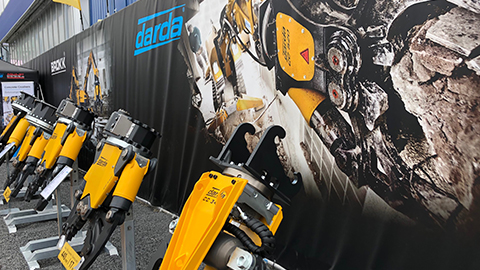
Screw pile foundations encounter situations in all phases—from installation to deconstruction—where hard obstacles must be removed in a targeted manner. The concrete demolition shear from Darda GmbH is suitable for the precise removal of foundation remnants or concrete pedestals. Rock and concrete splitters enable low-stress opening of rock, boulders, or massive concrete blocks in the subsurface. Combination shears and Multi Cutters cut steel parts, anchor rods, and profiles in the connection area, while steel shears help with the adjustment or deconstruction of steel piles. In special situations (special application), for example in industrial plants with increased requirements for spark-free work, a tank cutter can be part of the coordinated package of measures. These tasks fit into the application areas concrete demolition and special deconstruction, gutting and cutting, rock excavation and tunnel construction, natural stone extraction, and special application and support smooth, safe handling of screw pile foundations throughout the entire life cycle.