












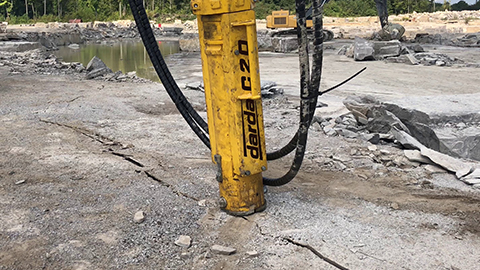



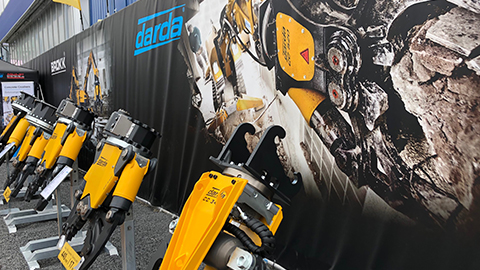





The hose bore is a central parameter in the hydraulics of demolition and cutting technology. It largely determines how much fluid a hose and its connection components can safely transport per unit of time. In Darda GmbH applications—such as hydraulic rock and concrete splitters, concrete demolition shears, combination shears, or steel shears—the correct hose bore directly affects working speed, energy efficiency, and the thermal load of the overall system. Especially in concrete demolition, special demolition, rock excavation, and tunnel construction, the right sizing ensures precise, reproducible sequences, short cycle times, and calm, controlled operation.
Definition: What is meant by hose bore
Hose bore refers to the inner diameter of a hydraulic hose, often designated as inner Ø, ID, or nominal diameter DN. In day-to-day technical usage, the term functionally also includes the narrowest point of the entire line—such as reductions in couplings, fittings, adapters, elbows, or valves. This narrowest point defines the maximum possible flow rate for a given pressure drop. The hose bore is therefore a flow cross-section that determines the flow rate, the pressure drop, the heating of the medium, and ultimately the speed of cylinders, shears, or splitting wedges.
Structure and designation: DN, inner Ø, and the narrowest point in the line
Hydraulic hoses consist of an inner tube, several reinforcement/pressure-bearing layers, and an outer cover. Decisive for sizing is the inner bore. Metric specifications in millimeters as well as nominal diameters (DN) are common. Important: Effective flow capacity is often limited not by the hose alone but by quick couplings, hose fittings, and their insertion parts. In practice, the smallest bore along the line governs the flow. Anyone sizing the hose bore therefore always considers the complete section from the hydraulic power pack to the tool—including pressure line, return line, and control lines.
Hydraulic effects: Flow rate, pressure drop, and working speed
An undersized hose bore increases flow velocity. This leads to higher pressure losses, heating of the oil, potential cavitation effects, and noticeable performance losses. With tools such as concrete demolition shears or hydraulic wedge splitters for rock and concrete, this manifests in longer cycle times, reduced responsiveness, and increased thermal load. Conversely, a sufficiently large bore lowers flow velocity and thus friction losses—the system runs cooler, quieter, and more efficiently. Sizing is therefore always a trade-off between the desired speed, the available delivery rate of the power pack, the permissible pressure drop, and practical hose dimensions.
Key influencing factors
- Flow rate of the hydraulic power pack
- Viscosity and temperature of the hydraulic oil
- Line length, number of bends and fittings
- Inner surface quality and restrictions in couplings
- Permissible flow velocity by line type (pressure, return, suction)
Sizing in concrete demolition, special demolition, and rock excavation
In mobile hydraulic applications by Darda GmbH—from concrete demolition shears to Multi Cutters and hydraulic wedge splitters—the hose bore is selected so that the desired tool speed is achieved without thermally overloading the system. For pressure lines, flow velocities of roughly 3 to 5 m/s are often targeted; return lines are typically lower, suction lines lower still. These ranges are practical guidelines and can vary depending on the characteristics of Darda hydraulic power units, oil temperature, and line length. Especially with long supply lines in tunnel construction or when there is significant spatial distance between the hydraulic power pack and the tool, a larger hose bore is recommended to limit pressure drop and keep tool response stable.
Relation to concrete demolition shears and hydraulic wedge splitters
With concrete demolition shears, the hose bore directly affects the closing and opening speed of the shear. Bottlenecks—such as in plug-in couplings—can noticeably extend cycle time and promote heat build-up. For hydraulic wedge splitters for rock and concrete, a sufficient cross-section is crucial so the required pressure builds quickly and the splitting process starts without delay. In both cases, a well-matched hose bore improves controllability, reduces noise, and stabilizes process quality in daily deconstruction work.
Installation and operation: Bend radius, lengths, and couplings
Beyond the bore itself, routing and attached components also affect flow. Bend radii that are too tight cause internal cross-section constrictions that increase pressure drop. Likewise, multiple elbows or reducers in series generate additional turbulence. Clean, stress-free routing with few changes of direction and properly sized couplings is therefore critical for low-loss operation.
- Observe minimum bend radius and avoid torsion
- Reduce unnecessary chains of adapters and tight 90° elbows
- Select couplings with sufficient through-bore
- Limit line lengths to what is necessary
- Ensure protection against abrasion and crushing
Common symptoms of an unsuitable hose bore
If a hydraulic tool moves slowly despite adequate power pack pressure, the hose bore—or a constriction somewhere in the line—is a typical checkpoint. Indicators include elevated oil temperatures, noticeable heating of individual fittings, flow-related noises, and delayed response under load changes. In practice, quick couplings and adapters are checked first, followed by an assessment of hose lengths and bend radii. With concrete demolition shears, the effect can be observed directly in the change of closing times after the bottleneck is removed.
Step-by-step sizing of the hose bore
- Determine the flow rate and operating mode of the hydraulic power pack.
- Define target flow velocities for pressure, return, and suction lines (use practical ranges).
- Calculate inner Ø: From flow rate and desired velocity, derive the required cross-sectional area and thus the inner Ø.
- Consider the complete line: couplings, valves, elbows, reducers—the smallest through-bore must not unduly limit the cross-section.
- Conduct a practical test under typical operating conditions (temperature, line length, load changes) and adjust the bore if necessary.
Influence of operating conditions
Oil temperature and viscosity change over the day and with the ambient conditions. Cold increases viscosity and thereby pressure drop; for long lines, a larger hose bore is worthwhile for stable start-up and transition phases. In tunnel construction and natural stone extraction, greater distances are common—damping pressure peaks and avoiding local bottlenecks is particularly important here. In building gutting and cutting, where equipment is frequently repositioned, robust quick coupling with sufficient through-bore are useful to ensure repeated coupling without performance loss. In special operations with confined space, careful routing while maintaining the bend radius helps avoid cross-section losses.
Materials, media, and temperature range
The inner materials of hydraulic hoses must be compatible with the oil used. Temperature ranges, additives, and any rapidly biodegradable media influence swelling behavior and aging. A resistant inner layer supports long-lasting flow characteristics—worn or damaged inner layers can cause delamination that reduces the effective cross-section and loads the filters. Media-compatible materials and regular visual inspections are essential for stable operating values of the hose bore.
Maintenance and replacement
The hose bore is effective only if the line is in good technical condition. Regular checks for abrasion, pinch points, leaks, and coupling wear are part of safe operation. O-rings and sealing cones in couplings should be renewed as needed to prevent internal restrictions from damaged seals. Condition-based or time-based hose replacement supports consistent flow conditions and reduces unplanned downtime in day-to-day deconstruction.
Practical notes for tools from Darda GmbH
For concrete demolition shears, a sufficiently large return line pays off to minimize back pressure and speed up the opening movement. For hydraulic wedge splitters for rock and concrete, a harmonized cross-section of pressure line, return line, and quick coupling pairs leads to rapid pressure build-up at the splitting cylinder. The same applies to combination shears, Multi Cutters, steel shears, and tank cutters: A balanced hose bore along the entire line increases process stability, reduces heating, and supports precise controllability—especially under repeated load changes and varying ambient conditions.
Safety and general notes
Hoses and fittings should be rated for the intended operating pressure with an appropriate safety factor. Damaged lines must be taken out of service immediately and replaced properly. Work on pressure lines is performed de-energized and clean; contamination inside must be avoided, as it narrows flow cross-sections and can impair components. In general, it is advisable to follow recognized engineering standards and manufacturer specifications. These notes are general in nature.