




















Slag concrete refers to concrete in which part of the cement clinker is replaced by ground granulated blast-furnace slag. This construction approach is widely used in massive structural elements, infrastructure, and hydraulic engineering. For planning, maintenance, and especially deconstruction, slag concrete has its own characteristics: it develops its strength more slowly, but later achieves high ultimate strengths and exhibits a dense matrix. In concrete demolition and special deconstruction, this influences the choice of methods and tools. Mechanical separation processes such as targeted splitting with stone and concrete splitters or size-reduction with concrete demolition shears are particularly relevant here. In projects in the application areas of strip-out and cutting, rock excavation and tunnel construction, natural stone extraction, and special operations, understanding the material properties is helpful for working in a controlled, low-vibration, and precise manner.
Definition: What is meant by slag concrete
Slag concrete is concrete whose binder contains a variable share of latent hydraulic blast-furnace slag (ground granulated blast-furnace slag). In practice, this is usually implemented via so-called slag cements (e.g., cement types with an increased slag content). The slag reacts in the alkaline environment of the cement and forms a dense cement paste that promotes durability. Typical features include reduced heat of hydration, slower early strength development, good sulfate and chloride resistance, and frequently low permeability in the final state. Slag concrete is to be distinguished from the use of other slags (e.g., steelworks slags); the use of blast-furnace slag is common and established in standards. Its properties lie within the permissible range of relevant concrete standards; the composition is defined project-specifically via concrete technology.
Production and composition of slag concrete
In slag concrete, the proportion of cement clinker is partially replaced by ground granulated blast-furnace slag. The replacement rate typically ranges from about 20 to 80 percent of the binder, depending on strength class, element thickness, exposure class, and required durability. In addition to the binder, aggregate (particle shape, grading), water-to-binder ratio, and admixtures (e.g., plasticizers, retarders, air-entraining agents) determine fresh and hardened concrete behavior. As the slag content increases, heat development generally decreases, which reduces thermal cracking in massive elements. At the same time, strength development shifts to later ages, making careful curing essential. In jobsite reality, this means early interventions such as drilling for splitting cylinders, core drilling, or applying concrete demolition shears must account for the actual early-age strength, while in existing structures one often encounters high ultimate strengths and a dense matrix.
Material properties over the life cycle
Fresh concrete and hardening
Slag concrete shows good workability with simultaneously lower heat release. Hardening proceeds more slowly; temperature and curing have a strong influence on early-age behavior. At low temperatures, strength gain can be delayed. For subsequent, material-friendly interventions—for example, drilling rows of holes for stone and concrete splitting devices—the actual strength is decisive, not merely the time since placement.
Hardened concrete: Mechanics and durability
- Time-dependent strength: lower early strength, usually high compressive strength in the final state.
- Tensile strength and crack behavior: brittle fracture pattern as in normal concrete; the dense matrix can delay crack propagation.
- Elastic modulus: tends to be somewhat lower, which can reduce restraint-induced stresses.
- Durability: improved chloride and sulfate resistance, reduced permeability; carbonation rate depends on application and mix design.
- Heat of hydration: reduced; advantageous for thick cross-sections and massive foundations.
Typical applications in construction
- Massive elements such as foundations, abutments, and dam components
- Hydraulic engineering and infrastructure construction with high durability requirements
- Tunnel linings, massive slabs, and columns in industrial buildings
Slag concrete in deconstruction: effects on methods and tool selection
In concrete demolition and special deconstruction, the combination of strength, reinforcement content, and element thickness determines the appropriate method. Due to its dense matrix and high ultimate strength, slag concrete may require increased comminution energy. At the same time, the brittle, crack-prone fracture behavior remains usable for splitting methods. In sensitive environments (e.g., strip-out in existing buildings, work in tunnels), low-vibration methods are advantageous.
Fracture mechanics and practical consequences
- Split rather than strike: Initiating tensile cracks via locally high compressive pressures is effective—especially when a crack path is planned.
- Use edges and openings: Starting at free edges, slots, or pre-drilled rows of holes facilitates spalling.
- Account for reinforcement: The steel content governs residual load-carrying behavior; mechanically separating the reinforcement is an integral step.
- Moisture and temperature: Young elements made of slag concrete are often easier to work; old, dense elements require consistent preparatory work (crack initiation).
Concrete demolition shears in use
Concrete demolition shears are suitable for biting and crushing elements, for exposing reinforcement, and for controlled removal sequences. In strip-out, they enable sectional work with good visibility of crack formation. For dense slag concrete, a sequential approach is advisable:
- Prepare: relieve the element, create edges, and, if necessary, provide slots or recesses.
- Bite: Start at edges with moderate jaw opening and remove material in stages.
- Expose: Work the reinforcement free and relieve stresses in a controlled manner.
- Separate: Cut the reinforcement with steel shears or multi cutters to minimize residual tensile forces.
Reliable hydraulic power units ensure the energy supply; a stable setup with low pressure losses supports consistent shear performance. In noise-sensitive areas, a step-by-step, force-controlled approach improves execution quality.
Stone and concrete splitters: targeted crack control
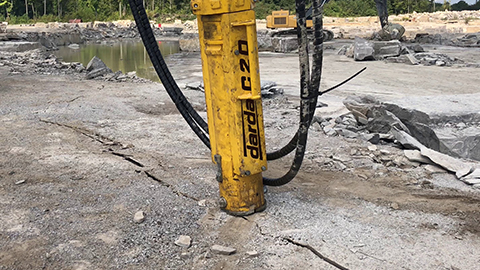
Stone and concrete splitters use hydraulic splitting cylinders to generate defined fracture planes along rows of holes. This is particularly useful for massive foundations, parapets, abutments, and in tunnels where vibrations must be limited. With slag concrete, crack initiation plays a central role:
- Drilling pattern: uniform hole spacing along the planned line of weakness.
- Alignment: arrange the split wedges so that the cracks run toward the removal edge.
- Staging: split in the longitudinal direction, then follow up transversely.
- Combination: pre-split with splitting cylinders, then crush with efficient concrete crushers to produce manageable pieces.
Planning and execution of interventions
- Existing-structure analysis: review drawings, detect reinforcement, and, if required, perform material testing (cores, rebound, remote diagnostics).
- Method selection: splitting, shear work, cutting—depending on element thickness, strength, and surroundings.
- Cutting and splitting plan: define edges, removal sequence, load transfer, and intermediate states.
- Environmental and occupational safety: dust, noise, vibrations, protective coverings, water management, barriers.
- Execution: check hydraulics, inspect tool condition, document steps.
- Separation of material streams: separate concrete and reinforcement by type; disposal/recycling according to applicable rules.
Technical selection criteria
- Strength class and actual strength at the deconstruction time
- Element geometry (thickness, edge distances, supports)
- Degree of reinforcement, stresses, connections
- Environmental constraints (vibration, noise, dust, space)
- Accessibility and equipment peripherals (hydraulic power packs, hose routing)
Environmental and resource topics
Slag concrete can contribute to reducing process-related emissions because ground granulated blast-furnace slag substitutes clinker. In deconstruction, clean cuts and defined fracture surfaces help to keep the concrete fraction as pure as possible. This facilitates reuse as recycled aggregate. Dust and water management should be planned proactively; mechanical splitting and biting methods are often advantageous here. Legal requirements for recycling and disposal are project-specific and cannot be generalized.
Safety and health protection
Work on load-bearing elements requires forward-looking safeguards against unintended movements. Risk analyses, the definition of exclusion zones, control of hydraulic connections, and personal protective equipment are mandatory. Hydraulic accumulators and hose lines must be checked regularly. Notes on load securing of separated parts, handling of swinging loads, and safe operation of concrete demolition shears and splitting cylinders serve general safety. These indications are general and do not replace project-specific planning.
Practical relevance to application areas
Concrete demolition and special deconstruction
For heavily reinforced, dense slag concrete elements, a combined approach has proven itself: preferably split along defined lines, then size-reduce with concrete demolition shears to transportable dimensions and mechanically separate the reinforcement. This reduces vibrations and improves material separation.
Strip-out and cutting
In buildings with restrictions on noise and vibrations, concrete demolition shears are suitable for sectional removal. Local slots or core drillings support crack steering. Splitting devices help to create openings in a controlled manner without excessively affecting the surroundings.
Rock excavation and tunnel construction
Linings made of slag concrete in tunnel and infrastructure construction benefit from a splitting approach. Splitting cylinders act along lines; concrete demolition shears handle the dimensioning comminution. Ventilation, water management, and shoring require particular attention in underground spaces.
Natural stone extraction
Although no concrete is processed here, the principle of controlled splitting is identical: crack management via drilling patterns can be transferred to concrete elements containing slag. Experience from natural stone extraction informs crack control in deconstruction.
Special operations
In areas with access restrictions or sensitive neighbors (e.g., plant areas), compact, hydraulically powered tools are used that split and bite in a targeted way. Selection depends on element thickness, edge distances, and permissible impacts.
Quality control and documentation
Key parameters include drilling pattern, splitting pressure, jaw stroke, removal sequence, and the behavior of the element. Ongoing documentation supports verification for site supervision and disposal partners. Recording piece sizes and purity levels of the fractions improves recyclability.
Terminological differentiation
Slag concrete is based on blast-furnace slag (ground granulated) as a latent hydraulic addition. This is to be distinguished from concretes with pozzolanic additions of other origin. Likewise, the use of steelworks slags must be assessed separately and is generally not equivalent. For planning, execution, and deconstruction, the respective material fundamentals are decisive.
Maintenance and technical fundamentals of the tools used
Reliable operation requires intact hydraulic power packs, tight couplings, and clean fluids. For concrete demolition shears, cutting edges or crusher teeth must be checked for wear; for splitting cylinders, wedge geometry is crucial and should be clean, lightly greased, and free of particles. Lines must be routed without kinks to minimize pressure losses. Regular visual inspections increase operational safety and removal quality.
Common error patterns when dealing with slag concrete
- Overestimated early strength: starting too early leads to inefficient processing.
- Missing crack steering: splitting devices without a planned drilling pattern produce uncontrolled fractures.
- Underestimated reinforcement: failing to cut the reinforcement prevents the intended fracture.
- Excessive bite sequences: oversized bites with concrete demolition shears reduce control and increase tool wear.
- Neglected hydraulics: pressure loss due to leaks reduces performance and precision.
- Ignored environmental constraints: dust, noise, and vibrations without mitigation lead to interruptions.
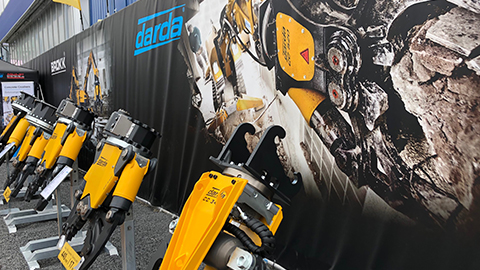
In practice, concrete demolition shears and stone and concrete splitters from Darda GmbH are frequently used in combination to leverage the advantages of both methods: controlled splitting for crack initiation and efficient size-reduction for material logistics and safe removal.