












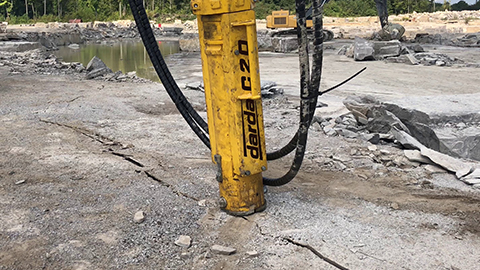



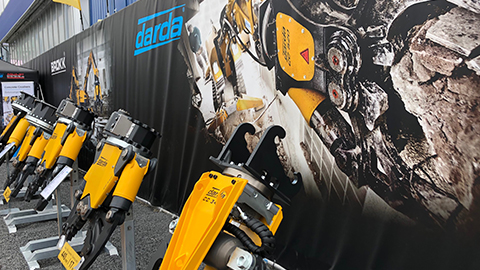





A deconstruction company plans and executes the orderly removal of structures, facilities, and rock formations. It combines a structured approach with fit-for-purpose procedures to dismantle materials separately, minimize emissions, and protect structural analysis and surroundings. Depending on the material and constraints, different hydraulic tools are used—from hydraulic rock and concrete splitters to concrete pulverizers and shears for steel and composite components. The focus is on safety, predictability, and the reuse of recovered materials.
Definition: What is meant by a deconstruction company
A deconstruction company is a specialized contractor that selectively, controllably, and compliantly dismantles buildings, plant components, or natural rock formations. The goal is planned deconstruction up to complete site clearance—including strip-out, separation cuts, material-appropriate dismantling, interim logistics, and documentation. The work includes both concrete demolition and special demolition as well as strip-out and cutting, rock excavation and tunnel construction, natural stone extraction, and special operations in sensitive environments. Based on structural analysis, component spectrum, and environmental requirements, a deconstruction company decides whether to crush, cut, blast (if permitted), or hydraulically split—the latter is particularly low vibration and often low dust.
Tasks and service profile in deconstruction
The service profile ranges from the existing-conditions assessment through the deconstruction concept to execution and proof of compliance. Core elements are: structured planning, selection of suitable hydraulic tools (e.g., concrete pulverizers, hydraulic splitters), safe construction logistics, emission control, sequencing in structurally safe work steps, and source-separated sorting for the circular economy.
Techniques and methods in concrete demolition
Concrete demolition requires methods that differ in noise, vibration, precision, and production rate. A deconstruction company chooses the method to suit member thickness, degree of reinforcement, accessibility, and environmental sensitivity.
Chiseling and sawing compared with splitting
Conventional chiseling is robust but generates noise and vibration. Wire and wall saws deliver precise cuts but create cooling-water use and slurry. Hydraulic splitting with hydraulic splitters works very quietly, with low vibration, and often without water. It applies controlled splitting forces that define cracks and release members along planned axes—beneficial near sensitive neighboring buildings, heritage structures, or indoors.
Use of concrete pulverizers
Concrete pulverizers grip, crush, and break concrete including reinforcement. They are suitable for selective demolition of walls, slabs, and foundations. In the strip-out and cutting phase, they separate members into manageable segments; in special demolition they enable controlled load reduction before removing load-bearing elements. Where space is tight and low vibration is required, concrete pulverizers are often combined with compact carrier machines and precise hydraulics.
Hydraulic splitters in selective deconstruction
Hydraulic splitters—including splitting cylinders—generate high splitting forces that release massive members without explosives and without significant vibration. They are ideally suited for thick foundations, high-strength concretes, noise-sensitive areas, hospitals, city centers, and in tunnels where vibration and dust must be strictly minimized. In rock excavation and tunnel construction, they open fractures along natural planes of weakness; in natural stone extraction, they promote the recovery of large, crack-controlled blocks.
Equipment in a deconstruction company: hydraulic tools and power packs
Hydraulic systems form the backbone of many deconstruction methods. Hydraulic power packs supply tools with pressure and flow, while interchangeable attachments handle material processing. A well-matched system improves efficiency, precision, and occupational safety.
Hydraulic power packs: power supply and controllability
Modern hydraulic power units provide the pressure required for splitting cylinders, concrete pulverizers, combination shears, multi cutters, steel shears, and tank cutters. Important factors are demand-based power levels, fine control, and reliable safety functions. Noise and exhaust management are particularly important indoors and in densely built-up areas.
Tool selection by material and interface
- Concrete with/without reinforcement: concrete pulverizers for crushing and cracking; hydraulic splitters for low-vibration release of thick cross-sections.
- Steel and composite members: precision steel shears for sections, reinforcement, and plate; multi cutters for mixed materials and varying cross-sections.
- Masonry and lightweight materials: combination shears for varying material hardness and clean separation.
- Vessels, tanks, pipelines: tank cutters for contour-accurate separation with controlled spark and heat development, aligned with the hazard analysis.
Application areas and typical scenarios
Deconstruction companies work in varied environments—from industrial plants to tunnel heading. Methods and tools are adapted to the specific environment and protection goals.
Concrete demolition and special demolition
When dismantling load-bearing members, structural analysis, load paths, and vibration protection take priority. Concrete pulverizers reduce members in a controlled manner, while hydraulic splitters quietly release massive blocks. This protects neighboring buildings, machine foundations, or sensitive installations.
Strip-out and cutting
Before structural demolition, fit-out trades are removed and members separated. Shears, pulverizers, and cutting methods prepare for source-separated sorting. Indoors, low-emission tools with precise hydraulic control help minimize dust, noise, and vibration.
Rock excavation and tunnel construction
In massive rock or in tunnels, hydraulic splitters are a quiet alternative to blasting where it is not possible or not desired. They create intended fracture lines, facilitate removal of large pieces, and reduce impacts at the tunnel face and on the support.
Natural stone extraction
Targeted splitting enables the recovery of dimensionally stable raw blocks with high yield. Aligning the wedges with natural bedding and joints promotes quality and dimensional accuracy.
Special operations
During deconstruction in live production, in hospitals, or in heritage buildings, low-vibration and quiet methods are crucial. Hydraulic splitters and precisely controlled concrete pulverizers allow selective interventions with low environmental risk.
Planning, structural analysis, and sequencing
A robust deconstruction concept prioritizes safety, material flow, and documentation. The order of work steps is aligned with load-bearing behavior and site logistics.
- Existing-conditions assessment: drawings, probes, and material samples clarify cross-sections, reinforcement, and embedded items.
- Hazard analysis: general considerations of emissions, load cases, utility lines, and potential hazardous substances.
- Separation and dismantling concept: definition of methods—e.g., splitting instead of chiseling in sensitive areas; concrete pulverizers for reinforced concrete.
- Temporary stabilization: shoring, underpinning, load release, and defined load paths.
- Cut and split planning: splitting hole patterns, pulverizer bite points, grip points, fall protection, and controlled lowering of loads.
- Emission control: noise and dust reduction, ground vibration monitoring, neighborhood protection.
- Logistics and material flow: routing, interim storage, container service, source-separated sorting.
- Monitoring and documentation: measurements, photo documentation, weight tickets, and acceptance stages.
Low-emission and low-vibration operations
In urban and sensitive areas, low vibration, low noise levels, and reduced dust generation are decisive. Hydraulic splitters and precisely controlled concrete pulverizers often fulfill these requirements particularly well. In addition, dust-suppressing measures, targeted enclosures, and optimized hydraulic management help protect the work environment and raise dismantling quality.
Safety and general conditions
Occupational safety has top priority. This includes clear responsibilities, secured work areas, personal protective equipment, load releases, self-protection at edge work, and prudent energy management of the hydraulic power packs. Legal and normative requirements must be observed as applicable; this overview does not replace binding legal advice. For potentially contaminated components, appropriate investigations and clearances are required before starting.
Digitalization and documentation
Digital as-built models, sensor monitoring, and continuous documentation support planning and execution. Load and vibration data, photo and video records, and the tracking of material flows improve transparency, quality, and schedule control. Data from the use of concrete pulverizers or hydraulic splitters—for example, cycle time—feed into the optimization of future projects.
Sustainability and circular economy in deconstruction
Selectivity is the key to high-quality reuse. Concrete pulverizers and hydraulic splitters often separate materials in large, clean pieces, simplifying processing. Source-separated fractions—concrete, steel, non-ferrous metals, rock, wood—reduce disposal costs and increase recycling rates. Precise dismantling supports the reuse of components and reduces transport and energy demand.
Practical tool selection in the project workflow
At project start, the tool portfolio is tailored to the boundary conditions: restricted access, floor load capacity, available power, permissible emissions, and target dates. Common combinations are concrete pulverizer for reinforced concrete, hydraulic splitter for massive cross-sections, steel shear for reinforcement and sections, multi cutters for mixed materials, and tank cutters for vessels and pipelines. Proper coordination with the hydraulic power pack ensures the required performance.
Quality criteria and metrics in deconstruction
Quality is measured by safety, dimensional accuracy, emission levels, and fidelity to material flow. Important metrics include cycle times by member category, secured cut and split meters per shift, utilization of the hydraulic power packs, tool changeover times, purity of fractions, and compliance with permissible vibration and noise levels.
Skills and team in the deconstruction company
A capable team combines planning expertise, machinery and hydraulics know-how, experience in structural analysis and construction methods, and careful on-site work. Operators skilled with concrete pulverizers and splitting techniques, specialists for cutting and shearing work, and coordination for logistics and documentation together ensure a safe and efficient project workflow.