
















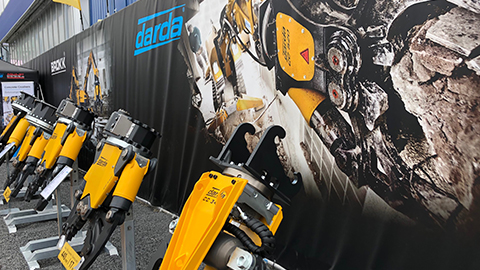





Raw material extraction denotes the recovery of mineral and construction-material resources from the Earth’s crust as well as the provision of secondary raw materials through deconstruction and recycling. This includes natural stone, gravels and sands, clays, ores, but also rock from tunnel heading as well as processed concrete and steel debris from urban environments. Extraction takes place in open-pit mining, underground mining, and in the context of civil engineering (underground works). Methods and tools are selected so that the deposit, environmental requirements, occupational safety, and economic targets are integrated into a technically coherent overall concept. In this context, controlled splitting methods, selective dismantling, and hydraulic tool systems play a central role—among others hydraulic splitter (wedge), rock wedge splitter, and concrete pulverizer, which operate with low vibration levels and precisely in sensitive environments.
Definition: What is meant by raw material extraction
Raw material extraction comprises all activities for winning, exposing, and removing natural mineral resources as well as providing usable materials from built structures. It includes geological exploration, planning, releasing the material (e.g., by blasting, drilling and splitting, cutting, milling), haulage logistics, processing (crushing, screening, sorting), and handover to further processing. In an expanded sense, the deconstruction of concrete and steel structures is also counted as a source of secondary raw materials. The aim is the gentlest, safest, and most economical recovery possible while minimizing emissions such as noise, vibration, dust, and water impact.
Geological fundamentals and deposit science
The characteristics of the deposit largely determine the choice of extraction method. Rock type (igneous, metamorphic, sedimentary), grain fabric, stratification, joint systems, and groundwater conditions influence drilling patterns, separation planes, and the suitability of blasting or splitting methods. In massive hard rocks with pronounced joints, blocks can often be released along natural weakness zones. Here, hydraulic splitter (wedge) and rock wedge splitter are suitable for exploiting existing structures in a controlled manner. In thinly bedded or brittle rocks, low-vibration methods minimize the risk of crack propagation and undesired overbreak. Geomechanical parameters (compressive strength, tensile splitting strength, RQD, modulus of elasticity) are key inputs for drilling patterns, cylinder spacing, required hydraulic pressure, and the sizing of the power supply by hydraulic power pack.
Overview of extraction methods
The choice of method depends on the deposit, surroundings, and target quality. In overview, the following main approaches can be distinguished, often used in combination:
Blasting
Conventional blasting is powerful, but generates vibrations, flyrock, noise, and potentially fine cracks in the rock. In built-up areas, protected zones, sensitive structures, or underground, blasting-free alternatives are often preferable.
Drilling and splitting
Rows of boreholes define intended separation lines along which controlled splitting forces are applied with hydraulic splitter (wedge) and rock wedge splitter, such as Rock and Concrete Splitters. Advantages: low vibration levels, low noise, precise block geometry, reduced fines. The hydraulics are supplied via suitable hydraulic power pack. This method is particularly suitable for natural stone extraction, rock removal in tunnel heading (cross passages, crown enlargement, niches), and special operations in urban areas.
Sawing, cutting, milling
Wire saw and wall saw produce very accurate joints, but are demanding in logistics and water management. Milling is suitable in softer rock and cohesive materials. In combination with splitting techniques, defined dimensions can be produced efficiently.
Mechanical size reduction and selective deconstruction
In the secondary raw material sector, concrete pulverizer separates concrete from reinforcing steel to generate single-grade fractions. Multi Cutters and steel shear cut profiles, beams, and reinforcement. For special tasks in industrial deconstruction, tank cutters are used. Selective separation increases the quality of recycled construction materials and reduces processing costs.
Natural stone extraction: Quality, block geometry, and value creation
In natural stone production, block integrity determines economic success. Splitting lines are planned along foliation, joint planes, and specified dimensions. Rock wedge splitter aim for clean separation behavior with minimal overbreak; they reduce microcracks, thereby lowering sawing and polishing losses. The result is better utilization rates of raw blocks and more uniform quality. Controlled preliminary removal on slopes or benches with splitting techniques also minimizes hazards from rockfall and facilitates safe quarry operation.
Rock removal and tunnel construction: Minimize vibration, secure geometry
Underground and in tunnel construction, tight constraints apply: limited cross-section, proximity to sensitive structures, fire and explosion protection. Drilling and splitting make niches, cross passages, openings, and crown enlargements possible with low vibration levels and high dimensional accuracy. The combination of core drilling and rock wedge splitter has proven itself when linings, anchors, or built-in components need to be protected.
Low-vibration execution
The emission assessment includes vibration velocity, airborne sound level, and dust. Water wetting, dust extraction, and the use of hydraulic power pack with demand-based power control support low-emission working practices.
Construction-phase support
Controlled release in small rounds keeps the crown stable, facilitates the installation of temporary supports (shotcrete, anchors), and prevents uncontrolled break events. If required, concrete pulverizer can be used for targeted trimming of concrete linings, for example in special deconstruction or during tunnel portal modifications.
Secondary raw materials: Urban mining, deconstruction, and processing
Raw material extraction increasingly includes the recovery of secondary raw materials from existing structures. In concrete demolition and special deconstruction, concrete pulverizer enables selective separation of concrete and reinforcement. Multi Cutters and steel shear process steel beams and rebar meshes, while tank cutters are intended for thick-walled vessels and special tasks. This selective approach lowers the foreign-material content in recycled aggregate blends and increases the value of recovered metal fractions. Combined with stationary crushing and screening technology, a loop emerges that can substitute primary raw materials without jeopardizing the engineering reliability of end products.
Planning, drilling pattern, and process chain
Robust planning is guided by geology, target geometry, and logistics. For splitting methods, drilling diameter, hole spacing, penetration depth, and sequencing are decisive. A finer pattern generates more uniform stresses but requires more drilling effort. Hydraulic wedge splitters work effectively when hole geometry enables force transfer into continuous separation planes. The process chain includes: staking the separation lines, drilling, splitting, securing, lifting, transport, intermediate storage, and processing. Hydraulic power pack provide the required flow and pressure; hose routing, quick coupling, and pressure relief must be matched to the environment (temperature, humidity, dust).
Occupational safety and environmental protection
Safety and environmental compatibility take priority. This includes stable slopes, protection against flyrock, controlled work areas, personal protective equipment, dust and noise reduction, and careful handling of hydraulic fluid. Low-vibration methods such as drilling and splitting reduce vibrations and are therefore often advantageous near infrastructure, utility lines, or protected structures. Notes on permits and limit values are site-specific; observing the relevant standards and official requirements is generally mandatory, without this constituting binding advice for individual cases.
Legal and permitting framework
Raw material extraction and deconstruction are generally subject to official approval. Requirements may include mining or emission-control stipulations, nature and water protection provisions, as well as directives for waste separation and proof of recovery. Working hours, vibration limits, and dust emissions are also frequently regulated on a project basis. The legal assessment is always individual; it is advisable to involve the competent authorities early and align the methods with the approved emission budgets.
Power supply and hydraulics in the field
Hydraulic power pack supply wedge splitters, concrete pulverizer, and other attachments with the required pressure and flow. Decisive factors are power reserve, temperature management, and connection compatibility. In remote quarries or tunnels, a compact, transportable power supply has proven effective. Pressure and flow measurement, leakage test, and clean hydraulic hose line routing increase operational safety. Demand-based power control reduces fuel or electricity consumption and contributes to emission reduction.
Economic efficiency and sustainability
Economic efficiency results from productivity, utilization, quality of the recovered fractions, and downstream processing costs. Low-vibration splitting methods can be economical despite higher drilling effort if they minimize overbreak, losses, and rework or facilitate permitting. In the secondary raw materials sector, selective separation increases material value and reduces disposal costs. Sustainability includes not only CO₂ and energy aspects but also land management, recultivation, and circularity of materials, including the carbon footprint (CO₂ balance).
Typical application cases by field of use
- Concrete demolition and special deconstruction: Selective release with concrete pulverizer; size reduction of components with controlled separation of reinforcement and concrete; subsequent processing into recycled aggregates.
- Building gutting and cutting: Openings in existing structures, separation cuts, and component reduction with concrete pulverizer and supplementary Multi Cutters; tank cutters for specific vessel structures.
- Rock breakout and tunnel construction: Drilling and splitting for geometrically defined enlargement, niche construction, and removal in sensitive zones.
- Natural stone extraction: Block extraction along natural joint sets using rock wedge splitter; optimization of block quality and minimization of overbreak.
- Special operations: Work in emission-sensitive areas, on heritage structures, or in the immediate vicinity of vibration-sensitive installations; preferably low-vibration, precise methods.
Practical guide: Selecting the method and tool
- Material analysis: rock type, strengths, joint pattern, moisture, inserts (e.g., anchor, reinforcement).
- Boundary conditions: emission limits, accessibility, neighborhood, safety requirements.
- Target geometry: tolerances, block dimensions, cut and split trajectory.
- Method selection: blasting, sawing, drilling and splitting, or combinations; priority for low vibration levels in sensitive environments.
- Energy and hydraulics planning: size the hydraulic power pack, define hydraulic connections and hydraulic hose lines.
- Logistics: intermediate storage, transport routes, processing chain, and disposal.
- Quality assurance: define metrics for overbreak, fines content, dimensional accuracy, emissions.
- Monitoring: documentation of vibrations, noise, and dust; parameter adjustments during operation, including ground vibration monitoring.
Measurable quality criteria in extraction
Quality is evidenced by technical metrics: share of usable block volume, dimensional accuracy, overbreak depth, fines content after release, vibration velocity at reference points, airborne sound level, and dust concentrations. In deconstruction, the single-grade quality of fractions and the metal purity grade are added. Concrete pulverizer supports a clear separation line between concrete and steel; hydraulic splitter (wedge) create defined splits that simplify subsequent processing.
Extraction, processing, and further processing: Boundaries
Extraction releases the material from the deposit or the structure. Processing includes crushing, screening, sorting, demetallizing, and, if applicable, washing. Further processing yields products such as natural stone slabs, chippings, sands, concrete aggregates, or reusable steel components. Tools like concrete pulverizer, steel shear, and Multi Cutters are links between deconstruction and processing, while rock wedge splitter primarily play to their strengths in primary extraction and rock removal.