












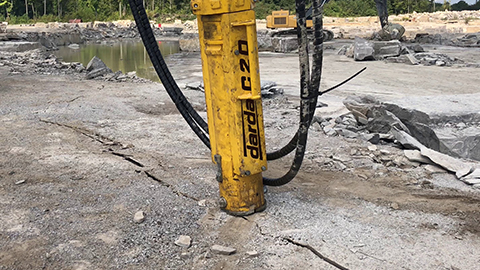



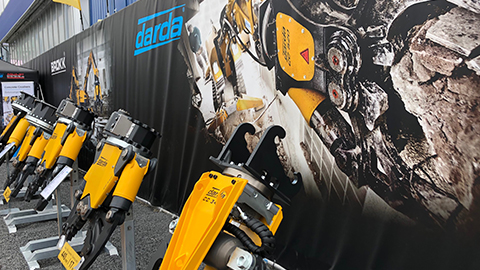





The pile head is the upper zone of a foundation pile in which the loads from the structure are integrated into the pile and safely transferred into the ground. In practice, the pile head plays a central role not only in structural design but also during working-in and deconstruction: concrete and reinforcement must be exposed, adjusted, or removed in a controlled manner. For low-vibration and precise removal, depending on boundary conditions, concrete pulverizers as well as hydraulic rock and concrete splitters are used, in combination with hydraulic drives and supplementary cutting or shearing tools. This particularly applies to the application areas concrete demolition and special demolition, gutting works and cutting as well as special operations, for example in sensitive environments.
Definition: What is meant by pile head
The pile head is the upper section of a driven pile, bored pile, cast-in-place pile, or micropile that provides the connection between the pile and the superstructure (e.g., pile cap beam, head plate, or foundation). In the pile head, the reinforcement of the pile and the connecting reinforcement of the structure are force-locked and overlapped so that the load transfer in compression, tension, and shear is reliable. In construction, the pile head is often trimmed down to a defined elevation after constructing the pile (pile head trimming) to remove contaminated, segregated, or non-load-bearing concrete and to create the reinforcement connection. During the deconstruction of foundations, the pile head is exposed in a controlled manner and then dismantled either completely or in sections depending on the demolition concept.
Tasks and function of the pile head
The pile head concentrates forces and deformations. It provides the transition from the structure into the pile, distributes loads, transfers moments and shear forces, and ensures durability through adequate concrete cover and appropriate reinforcement layout. In execution practice, the pile head is also prepared so that connection details (lap lengths, straight bar projections, head plates) can be realized within the planned tolerances. Proper pile head trimming serves quality assurance and helps avoid damage to reinforcement and the pile shaft.
Pile head processing in execution and deconstruction
Working on pile heads includes exposing the reinforcement, removing the upper concrete portion down to the target elevation, and creating clean, load-bearing contact surfaces. Here, precise, controllable methods are required that do not excessively burden the pile and its surroundings with vibration, noise, or dust. Depending on pile geometry, concrete strength, reinforcement ratio, and site conditions, mechanical, hydraulic, and separating methods are used.
Typical work steps
- Surveying and marking the target elevation, defining protection and exclusion zones
- Exposing the pile head from soil or embedment materials, dewatering if necessary
- Removing concrete down to the load-bearing zone (pile head trimming) and exposing the connecting reinforcement
- Creating the contact surface for a pile cap beam or head plate, cleaning, and finishing
- Documenting elevations, bar projections, and surface condition
Choice of method
- Concrete pulverizers for low-vibration, well-dosed removal with high control in the reinforcement area
- Steel shears, combination shears, or multi cutters for adjusting, shortening, or cutting reinforcing steel
- Hydraulic power units as the energy source for the hydraulic tools mentioned
Tools and equipment in the context of the pile head
Robust, finely controllable hydraulic systems are suitable for pile head trimming. Concrete pulverizers allow targeted biting of the concrete with good visibility of the reinforcement and reduce the risk of uncontrolled crack formation. Rock and concrete splitters apply splitting forces in defined drill holes to break the concrete along desired planes. This is particularly advantageous in confined conditions or in areas with strict emission requirements. Hydraulic power packs reliably supply these tools, while steel shears, combination shears, or multi cutters efficiently adjust the steel portion. In the application areas concrete demolition and special demolition, gutting works and cutting as well as special operations, these equipment groups provide a controlled, reproducible work progress, even with high strength classes and complex reinforcement.
Selection criteria for methods and equipment combinations
- Pile type and geometry: bored pile, cast-in-place pile, micropile; diameter, eccentricity, head plate
- Material properties: concrete strength, reinforcement content, concrete cover, any admixtures
- Boundary conditions: available space, access, height restrictions, adjacent structural elements
- Environmental requirements: noise control, vibration limitation, dust reduction, water protection
- Safety aspects: shoring, load transfer during processing, safety distances
- Target condition: projections of connecting reinforcement, flatness and roughness of the contact surface, tolerances
Quality assurance and tolerances
Dimensional accuracy and surface quality are decisive for the functionality of the pile head. The target elevation must be confirmed with suitable measuring instruments. Exposed reinforcement is checked for damage and protected against corrosion if necessary. The contact surface for the pile cap beam or head plate should be load-bearing, free of loose particles, and sufficiently rough. Flatness and squareness are to be checked in line with the intended connection structure. Documented inspections and visual acceptances ensure traceability.
Occupational safety and environmental protection
- Load management: secure the pile and adjacent structural elements against unintentional load redistribution
- Personal protection: protective clothing, dust and noise protection, defined hazard zones
- Emissions: dust suppression by wetting, prefer low-vibration methods
- Media routing: protect hydraulic lines from damage, avoid drips
- Disposal: collect concrete debris and steel separately and dispose of them in accordance with applicable requirements
Special application cases
Micropiles have smaller cross-sections, but the reinforcement is often dense. Here, finely stepped removal with concrete pulverizers is recommended to expose the reinforcement in a controlled manner. Large bored piles with high concrete strength benefit from a combination of predrilling and rock and concrete splitters to create defined fracture lines. In confined conditions, for example during underpinning or in existing structures, low-emission processing is important, as is often required in gutting works and special operations. In the area of rock breakout and tunnel construction, pile heads occur less frequently; however, similar requirements for low vibration and precision are relevant when pile cap beams are connected to existing structures.
Typical failure patterns and their prevention
- Spalling outside the target area: caused by excessive point loads or uncontrolled blows; remedy through even, step-by-step removal with a hydraulic pulverizer
- Damaged reinforcement: avoid by ensuring good visibility, careful tool engagement, and appropriate shearing tools for steel
- Insufficient surface quality: correct through finishing (cleaning, removing loose material) and achieving the required roughness
- Deviations in elevation: consistent surveying and interim checks
- Excessive vibrations: use splitting or jaw-based methods instead of percussive processing
Practice-oriented workflow for pile head trimming
- Work preparation: review plans, define target elevations and connection details, specify protective measures
- Exposing: remove soil or embedment materials, secure the work area
- Preparation for removal: drill holes for rock and concrete splitters (if planned); alternative: direct engagement with concrete pulverizers
- Concrete removal: controlled biting with concrete pulverizers or crack-guided splitting; remove fragments in a targeted manner
- Reinforcement processing: adjust bar projections with steel shears, combination shears, or multi cutters
- Surface finish: remove loose particles, create the contact surface, perform dimensional checks
- Documentation: measurements, photos, release for subsequent construction steps
Planning notes and reference to standards
Processing pile heads follows the applicable technical rules, the design specifications, and recognized rules of the art. Specifications for tolerances, reinforcement projections, surface requirements, and corrosion protection are to be defined on a project-specific basis. Notes on handling emissions, occupational safety, and disposal are to be considered early in the construction sequence. The combination of precise planning and controlled methods—such as using hydraulic concrete pulverizers or rock and concrete splitters with suitable hydraulic power packs—supports safe, reproducible execution in concrete demolition and special demolition.
Delimitation and terminology context
The pile head is to be distinguished from the head plate or the pile cap beam: while the pile head describes the upper pile zone, the head plate and pile cap beam are bearing or connecting elements that distribute loads into the overall foundation system. In the deconstruction context, a distinction must also be made between pile head exposure (removing cover and soil), pile head trimming (targeted removal of concrete), and reinforcement adjustment (cutting, bending). This clarity facilitates the selection of suitable equipment and methods in the application areas gutting works and cutting as well as special operations, especially when short intervention times and high precision are required.