




















Cast-in-place concrete walls are load-bearing or bracing structural elements that are produced directly on the construction site by placing concrete into formwork. They are found in basement levels, elevator shafts, retaining walls, underground garages, tunnel inner linings, as well as exposed concrete surfaces. Over the life cycle of a cast-in-place concrete wall, in addition to planning, construction, and quality assurance, subsequent interventions also play a role—such as for openings, strengthening, or controlled deconstruction. In concrete demolition and special demolition, concrete pulverizers as well as rock and concrete splitters in combination with suitable hydraulic power units are frequently used, especially when low-vibration and precise work is required.
Definition: What is meant by cast-in-place concrete wall
A cast-in-place concrete wall is a concrete wall produced in situ. It is created by forming, reinforcing, concreting, compacting, and curing the concrete on site. Depending on structural function and exposure, it is executed as unreinforced or, more commonly, as a reinforced concrete wall. Characteristic features include monolithic construction, variable geometries, and the ability to achieve high surface qualities up to exposed concrete. Construction and movement joints structure longer wall lengths. By choosing the concrete composition (e.g., strength and exposure classes) and the reinforcement, the load-bearing and durability behavior is determined.
Structure and construction process of a cast-in-place concrete wall
Quality-compliant execution follows a sequential process, whose core elements are outlined below.
Formwork and bracing
- Wall formwork (timber, steel, or system formwork) defines geometry and surface; the form-facing influences texture and the pore pattern.
- Form ties, bracing/stiffeners, and adjustments ensure dimensional accuracy and flatness; tie locations must be planned with particular care for exposed concrete.
Reinforcement, embedded items, and concrete cover
- Rebar cages, spacers, and embedded items (e.g., penetrations, cast-in hinges) are installed in precise positions.
- The concrete cover must be designed for durability and corrosion protection; edge distances and lap lengths must be observed.
Concrete placement, compaction, and curing
- Concrete is placed in layers; consistency and temperature must be monitored.
- Internal or external vibrators ensure air release and homogeneity; voids and honeycombing must be avoided.
- Curing (covering, rewetting, curing compounds) controls hydration, reduces shrinkage cracking, and improves surface quality.
Joint design
- Construction joints separate concrete pours; keys and continuous reinforcement ensure load transfer.
- Movement joints accommodate deformations from temperature and shrinkage; waterstops or sealing profiles ensure watertightness.
Structural requirements and surface qualities
The requirements for cast-in-place concrete walls range from load-bearing capacity and serviceability to durability and surface finish.
- Structural behavior: slenderness, verification of buckling and combined bending-compression, shear capacity, punching shear resistance in connection areas.
- Durability: exposure (for example moisture, freeze–thaw with de-icing salts, chemical action), crack width control, concrete cover.
- Surface: from functional to exposed concrete; tie patterns, joint grid, form-facing, and color variation are to be defined during planning.
- Tolerances and flatness: dimensional accuracy for follow-on trades, particularly in fit-out and at façade interfaces.
Compliance with the relevant technical rules requires a coordinated construction process. Information on standards, test criteria, and acceptances should be formulated both project-specifically and in general terms.
Typical application areas in building and structural engineering
Cast-in-place concrete walls are used in a wide variety of projects:
- Basement and plinth levels with hydrostatic water pressure (watertight structures) and high requirements for watertightness.
- Retaining walls in earthworks and road construction, also in combination with terrain modeling.
- Elevator shafts, stair cores, shear walls for building bracing.
- Underground garages, hydraulic structures, tanks, tunnel inner linings as cast-in-place construction.
- Exposed concrete walls in public buildings and residential construction with high architectural demands.
Retrofitted openings, strengthening, and selective deconstruction
In existing buildings, changes of use often lead to door and window openings, shafts, or service penetrations. The approach depends on structural analysis, reinforcement layout, thickness, and surrounding conditions (vibrations, noise, dust).
- Concrete pulverizers enable layer-by-layer, controlled removal of wall sections. They are proven in concrete demolition and special demolition as well as in strip-out and cutting, especially in occupied or sensitive areas.
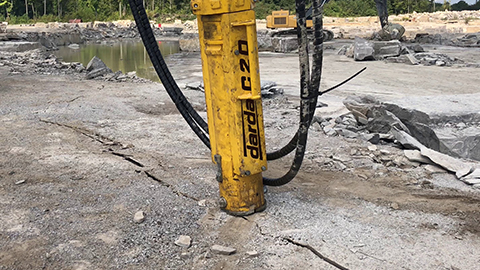
- Rock and concrete splitters (including rock splitting cylinders) generate targeted splitting forces via boreholes. The method is low-vibration and suitable for thick, heavily reinforced cast-in-place concrete walls, for example for openings in shafts.
- Steel shears and combination shears efficiently cut exposed reinforcement, stirrups, and connection bars once the concrete has been reduced.
- Multi Cutters support the downsizing of remnants, edge breaking, and cutting in confined areas.
- Hydraulic power packs supply the tools with the required power and are designed for mobile use indoors and on tight construction sites.
If insulation, composite systems, or embedded components are present, exposure steps must be planned. In highly vibration-sensitive environments, splitting- and jaw-based methods are suitable alternatives to percussive demolition.
Tools and methods compared
The choice of method follows project goals: precision, emission minimization, speed, and recyclability of fractions.
- Concrete pulverizer: pinpoint, layer-by-layer reduction; low vibration; good control at edges and interfaces; ideal for selectively extracting wall strips.
- Rock and concrete splitter: borehole-based splitting; very low vibrations; suitable for massive and high-strength concretes; minimizes secondary damage.
- Steel shear/combination shear: economical cutting of reinforcing steel; advantageous after exposure using a pulverizer or splitter.
- Multi Cutters: versatile for mixed materials and details; supports material-separated removal.
In special deployments, for example for wall penetrations with robust steel elements from plant engineering, a specialized tank cutter can additionally be useful to separate thick-walled steel components before the cast-in-place concrete wall is further processed.
Procedure for controlled intervention in cast-in-place concrete walls
- Preliminary investigation: drawings, reinforcement detection, member thickness, boundary conditions for vibration and noise; assess load redistribution and temporary shoring.
- Cutting and demolition concept: define sequence, removal steps, holding points, and fall zones; selection of tools (e.g., concrete pulverizer, rock and concrete splitter, steel shear).
- Dust and noise protection: containment, negative pressure, extraction; wet methods for dust suppression where possible.
- Execution: pre-drilling for splitting cylinders, jaw-by-jaw removal, exposing reinforcement, cutting with shears; continuous monitoring of cracks and edge distances.
- Material separation: remove concrete material and reinforcing steel separately; consider recycling routes.
- Quality check: dimensional accuracy of the opening, edge quality, finishing; chamfer edges and apply corrosion protection to exposed steel where necessary.
Special boundary conditions: exposed concrete, watertight structures, and high-strength concretes
Depending on the task, the requirements for tool selection and procedure vary.
- Exposed concrete: edge and surface protection take priority; jaw- or splitting-based methods reduce spalling. Cracks in the remaining section must be avoided.
- Watertight concrete: tightness at joints and penetrations remains central. Retrofitted openings require a sealed detail; crack formation must be kept low.
- High-strength concrete: higher compressive strengths require higher splitting forces and robust jaw geometries; the removal sequence must be adjusted.
Safety, emissions, and environmental protection
Safe workflows, emission control, and resource conservation are key objectives.
- Occupational safety: load securing, personal protection, routing of hydraulic lines; safe standing areas and barriers.
- Vibration and noise: splitting and jaw methods reduce vibrations; low-disturbance methods are advantageous in sensitive buildings.
- Dust and water: extraction, wetting, and orderly water management protect users and the environment.
- Recycling: material separation facilitates reuse; reinforcing steel can be collected by grade.
Practice from the areas of application
The processing of cast-in-place concrete walls repeatedly faces similar tasks across several fields:
- Concrete demolition and special demolition: partial removal of wall panels during conversions, controlled removal with concrete pulverizers and splitters.
- Strip-out and cutting: openings in elevator shafts, wall breakthroughs for bundled services; combination of drilling, splitting cylinders, and steel shears.
- Rock excavation and tunnel construction: cast-in-place inner linings in tunnels; selective openings and roundings, low-vibration methods during ongoing operation.
- Special deployment: confined interiors, heritage protection, vibration-critical environments; high precision and low emissions take precedence.
- Natural stone extraction: while rock is the primary focus, transitions and connections must be produced precisely for combined retaining structures with cast-in-place concrete walls.
Planning for conversion- and deconstruction-friendly solutions
Even at the planning stage, the later processing of cast-in-place concrete walls can be facilitated:
- Consider joint grids and predetermined breaking points for potential openings; plan sufficient edge distances.
- Arrange penetrations and spare shafts so that structural capacity and watertightness are preserved.
- Provide documentation of the reinforcement layout; this facilitates detection in existing structures.
- Early coordination on emission requirements (noise, vibration, dust) and component accessibility.
Tool selection for interventions in cast-in-place concrete walls
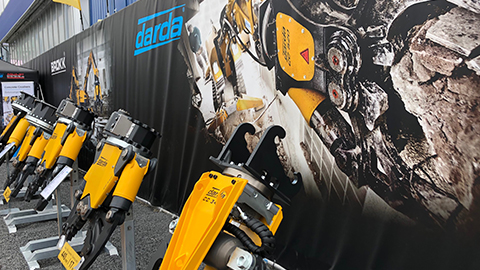
For working on cast-in-place concrete walls, Darda GmbH offers tool families that can be combined depending on the task:
- Concrete pulverizers: for precise reduction and clean edges in wall areas.
- Rock and concrete splitters with rock splitting cylinders: for controlled splitting of thick, massive sections.
- Steel shears and combination shears: for efficient cutting of exposed reinforcement.
- Multi Cutters: for versatile detail work on remaining sections.
- Hydraulic power packs: as powerful and mobile energy sources for the tools.