












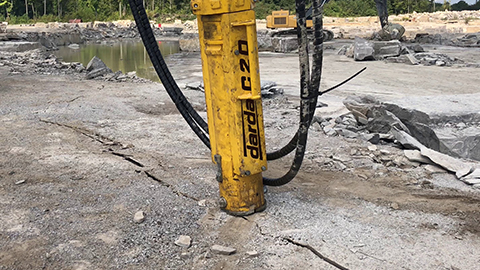









Surface sealing describes the targeted protection of mineral and metallic component surfaces against penetrating moisture, chemical media, abrasion, and contamination. In practice, it is encountered in situations where concrete, masonry, or natural stone are exposed after demolition, splitting, cutting, or crushing. Especially in the context of concrete demolition shears and hydraulic rock and concrete splitters from Darda GmbH, cut and fracture edges are created that require particular attention with regard to durability, dust emissions, and subsequent measures. Properly planned and executed sealing can stabilize the substrate, reduce water uptake, protect the edge zone against chlorides, and thus lay the foundation for the subsequent construction sequence—from temporary safeguarding measures to long-term surface protection.
Definition: What is meant by surface sealing
Surface sealing refers to protective layers or reactive treatments applied to a component surface to minimize the ingress of water, dirt, and chemically aggressive substances, to improve cleanability, or to fend off mechanical stress. Broadly, three modes of action are distinguished: hydrophobizing systems (e.g., silanes/siloxanes), reactive densifiers (e.g., silicate or lithium-silicate systems), and film- or layer-forming coatings (e.g., acrylic, epoxy, polyurethane). While hydrophobization does not close the pores but makes them water-repellent, sealing in the narrower sense frequently forms a thin, continuous layer on the surface. In deconstruction practice, temporary sealers are also used for dust binding and short-term weather shielding. It is important to clearly distinguish this from impregnation (deep-acting, usually without a film-forming layer) and from thick-film coatings (multi-layer surface protection systems).
Surface sealing in the demolition and deconstruction context
During concrete demolition and specialized deconstruction, rough fracture surfaces with high capillary suction are created by Darda GmbH concrete demolition shears as well as stone and concrete splitters. A tailored sealing reduces water and salt uptake, facilitates cleaning, stabilizes the edge zone, and can protect adjacent components from secondary damage. In strip-out and cutting works, smooth cut surfaces are exposed by sawing and core drilling processes; there, sealing serves moisture protection, temporary safeguarding against corrosion of exposed reinforcement, and preparation of subsequent measures such as adhesive anchors or reprofiling. In rock excavation and tunnel construction, sealing of shotcrete surfaces can regulate water uptake and reduce dust development. In natural stone extraction, freshly split faces are sometimes hydrophobized or sealed to minimize soiling and discoloration until transport or further processing occurs. In special operations—such as in sensitive environments or with contaminated components—temporary encapsulations and dust-binding sealers serve emission control.
Material types and mechanisms
The choice of system depends on the substrate, exposure, and planned duration of the measure. Decisive factors are penetration depth, chemical resistance, diffusion behavior, and compatibility with follow-on trades.
Hydrophobizing systems
Silanes and siloxanes reduce capillary water uptake without clogging the pores. They are vapor-permeable, have little effect on appearance, and are particularly suitable for concrete and natural stone surfaces after splitting or shear demolition. Advantages include low film thickness and good alkali resistance on concretes. They are suitable as preventive protection in chloride-laden environments (e.g., splash zones), but they do not replace crack-bridging coatings.
Reactive densifiers
Silicate or lithium-silicate solutions react with free calcium hydroxides to form additional silicates and densify the edge zone. This densification reduces dust release on crushed or abraded surfaces and improves abrasion resistance, for example on temporary site roads or working areas during deconstruction. The effect is generally transparent and vapor-permeable, but depends on concrete mix design and moisture.
Film- and layer-forming sealers
Acrylic, epoxy, and polyurethane systems form dense, repairable layers with defined film thickness. They can be designed to be chemical- and abrasion-resistant and are suitable for areas with intense mechanical loading or chemical exposure. On fresh cut edges from concrete shear operations, tensile bond strength, residual concrete moisture, and surface roughness are key criteria. Crack-bridging variants can accommodate movements in the edge zone up to a specified level.
Substrate preparation after splitting, shear demolition, and cutting
The adhesion and performance of any sealing stands or falls with substrate preparation. After using concrete demolition shears, stone and concrete splitters, or handheld multi cutters from Darda GmbH, the surfaces are usually heterogeneous. They must be prepared to achieve a defined roughness, cleanliness, and residual moisture.
Principles of preparation
- Remove loose constituents, laitance, mortar fins, and cement skin; produce a dust-free surface.
- Remove oil and grease traces completely (e.g., hydraulic oil from hydraulic power packs).
- Check moisture content; many systems require dry to matt-damp substrates.
- Adjust the roughness profile to the system manufacturer’s requirements (e.g., removal by blasting, milling, grinding).
- Derust exposed reinforcement and—if required—passivate before sealing.
- Create test areas to verify suction behavior, appearance, and layer quality.
Application in Darda GmbH’s fields of use
Concrete demolition and specialized deconstruction
In partial deconstruction, cut and fracture surfaces remain on the existing structure. Sealers provide temporary weather protection, minimize chloride ingress, and facilitate later tie-in of reprofiling mortars. On highly rough surfaces produced by shears, a two-step approach has proven effective: first, reactive densification or hydrophobization to stabilize the edge zone, then—if required—a thin, vapor-permeable sealing.
Strip-out and cutting
Smoothly cut edges (sawing, core drilling) are low to medium absorbent. Here, the focus is often on temporary sealing to keep out moisture and dirt until follow-on trades (connections, waterproofing) are applied. Compatibility with adhesives and sealants must be checked in advance; if necessary, choose temporary systems that can be removed without residue.
Rock excavation and tunnel construction
On shotcrete or rubble layers, a hydrophobic or thin-film sealing can limit water uptake, prevent efflorescence, and lower dust development on driving and working surfaces. In water-bearing areas, vapor-permeable, alkali-resistant systems are preferred. Cracks and joints must be treated separately.
Natural stone extraction
Freshly split natural stone surfaces tend to become soiled and discolored due to site operations. Hydrophobizing treatments help reduce the uptake of dirt and moisture and facilitate interim storage. Visible faces that will be further worked later are better treated with reversible, thin systems.
Special operations
In sensitive materials or contaminated areas, encapsulating, dust-binding sealers are used to minimize emissions. Such measures must be planned project-specifically and coordinated with occupational safety and disposal concepts.
Objectives and benefits in practice
- Reduction of water and salt uptake at cut and fracture edges.
- Dust binding on rugged surfaces after shearing and splitting operations.
- Temporary corrosion protection for exposed reinforcement until repair.
- Easier cleaning and reduced dirt adhesion on construction and driving surfaces.
- Improved edge-zone strength and reduced surface sanding.
- Protection against chemical attack in aggressive environments.
Execution steps and quality control
- Substrate assessment: strength, moisture, suction behavior, temperature, and dew point.
- System selection: hydrophobizing, densifying, or film-forming—depending on goal and substrate.
- Preparation: cleaning, degreasing, edge dressing, rust removal, and, if required, primer/bond coat.
- Application: uniform application (e.g., rolling, spraying, brushing); record consumption.
- Curing: protect from rain, dust, and overly rapid drying; observe minimum temperatures.
- Control: visual inspection, dry film thickness measurement for film systems, and, if necessary, pull-off or water uptake tests.
Durability, maintenance, and removability
Service life depends on exposure, film thickness, UV resistance, and mechanical stress. Hydrophobizing treatments are often effective for several years but must be renewed under strong weathering. Film-forming sealers can be repaired locally but require clean transitions and compatible systems. For planned follow-up works (e.g., bonding, waterproofing), residue-free removal may be necessary. Maintenance plans with visual inspections and simple wetting tests help determine the right time for renewal.
Compatibility with follow-on trades
Sealed surfaces influence the adhesion of mortars, coatings, and adhesives. For subsequent reinforcement connections, reprofiling, or waterproofing, the following points are critical:
- Diffusion behavior and surface energy of the sealing.
- Residual tack or adhesive compatibility for temporary systems.
- Mechanical pretreatment before further work (sanding, removal).
- Influence on slip resistance during walkable interim conditions.
Occupational safety, environment, and disposal
When processing, hazards due to solvents, isocyanates, or alkaline components must be taken into account. Personal protective equipment, good ventilation, and low-emission products are essential building blocks. Masking protects adjacent components, vegetation, and bodies of water. Residual quantities and contaminated auxiliaries must be disposed of properly. Legal requirements and technical guidelines must be observed; project-specific coordination with occupational safety and disposal is advisable.
Distinction: sealing, impregnation, coating
In everyday language, the terms are often mixed. For planning and execution, a precise classification is useful:
- Impregnation: deep-acting, vapor-permeable treatment without a continuous film; reduces water uptake.
- Sealing: thin, usually continuous layer; improves cleanability, protects against liquids and chemicals.
- Coating: multi-layer build-up with defined film thicknesses, often crack-bridging and highly resistant.
After using concrete demolition shears or stone and concrete splitters, an impregnation for edge-zone hydrophobization may be sufficient. For increased requirements (chemical exposure, heavy loading), sealers or coatings are indicated.
Specifics for metal and composite components
When cutting steel with steel shears, tank cutters, or combination shears from Darda GmbH, metallic cut edges are produced. Here, the focus is not on mineral surface sealing but on temporary corrosion protection of the cut surfaces until a permanent coating or a composite with concrete is implemented. On composite interfaces (steel–concrete), the sequence of measures is crucial: reinforcement protection, surface protection of the concrete, and preparation for composite systems must be coordinated.
Typical errors and how to avoid them
Unsuitable system selection
Film-forming sealers on damp, dense substrates tend to blister. Hydrophobization alone is not sufficient in cracked zones. The system must match the pore structure and moisture.
Insufficient substrate preparation
Dust, oil, and cement skin reduce adhesion. After using hydraulically operated tools, oil traces are particularly critical and must be removed without residue.
Incorrect processing conditions
Excessively low temperatures, wrong viscosity, missing waiting times between coats, or inadequate protection during curing lead to quality defects.
Incompatibility with follow-on trades
Uncoordinated sealers hinder the adhesion of mortars, adhesives, or waterproofing. Perform mock-ups and compatibility tests in advance.
Planning notes for sites using concrete shears and splitting technology
Where concrete demolition shears and stone and concrete splitters from Darda GmbH are used, sealing concepts must be defined early: Which surfaces remain visible? Which edges must be protected temporarily? Which areas will be reworked later? A clear definition of goals (dust binding, edge-zone densification, moisture protection, chemical resistance) facilitates system selection. Construction logistics, curing times, and weather windows must be included in the schedule so that sealers can develop their full effect.
Criteria for system selection
- Substrate: concrete strength, porosity, moisture, salt content.
- Exposure: abrasion, chemicals, UV, freeze–thaw, chlorides.
- Function duration: temporary (days/weeks) vs. permanent (years).
- Diffusion: desired water vapor permeability vs. barrier action.
- Appearance: color stability, matte/gloss, minimal change of visual appearance.
- Application: temperature window, curing times, suitability on rough fracture surfaces.
Practical details on consumption and film thickness
Rougher surfaces produced by shears and splitting cylinders have a higher material consumption than sawn cuts. Hydrophobizing treatments usually require one to two saturation coats, while film-forming sealers require defined layer thicknesses per coat. Careful documentation of consumption and ambient conditions supports quality assurance.
Legal and normative notes
The selection and application of surface protection systems should follow the recognized state of the art. Requirements regarding occupational safety, emissions, and disposal must be observed. Information in the technical data sheets of the respective systems is binding for on-site application. Project-specific coordination with planning, site supervision, and occupational safety is recommended.