




















The post-tensioning method is a central process in prestressed concrete construction. Tendons are stressed only after the concrete has hardened and the force is introduced into the component via anchors. This produces slender, load-bearing, and crack-limited members, for example in bridges, halls, slabs, and tanks. In design, repair, and especially in deconstruction and demolition, the topic plays an outstanding role: prestressing forces influence the structural behavior during separation and demolition. Therefore, precise, low-vibration methods are required for selective deconstruction, building gutting, and cutting works. Tools such as concrete pulverizers and rock and concrete splitters from Darda GmbH support controlled exposure and separation without risking unintended unloading or uncontrolled failure.
Definition: What is meant by the post-tensioning method
The post-tensioning method refers to the production of prestressed concrete in which tendons (strands, wires, or bars) are integrated into the component in ducts or freely guided, the concrete is allowed to cure, and only then stressed using hydraulic jacks. The prestressing force is introduced into the concrete via anchor heads. A distinction is made between bonded systems (force-locked in the component with grout mortar) and unbonded systems (monostrand with grease/HDPE sheathing, whose force transfer occurs primarily via the anchors). The goal is targeted prestressing that superimposes dead and live loads, limits crack formation, reduces deflections, and increases load-bearing capacity.
Function and variants of post-tensioning
In post-tensioning, the tendons are stressed via anchorage zones after the concrete has hardened. The energy stored in the steel counteracts the tensile stress portion in the concrete. For design, execution, and later deconstruction, the construction type, anchorage details, and bond condition are decisive.
Bonded post-tensioning (grouted tendons)
Ducts are placed in the formwork, tendons are threaded, tensioned after hardening, and subsequently force-locked with grouting. Advantages are corrosion protection and load redistribution through bond; during deconstruction, the duct layout and grouting condition must be determined. When cutting, spring-back of individual wires is to be expected; however, the bond reduces uncontrolled release lengths.
Unbonded post-tensioning (monostrand)
Single strands in grease or HDPE sheathing are tensioned but remain ungrouted. Force transfer occurs mainly via the anchors. In deconstruction, locating and securing the strands is essential, as careless cutting can lead to sudden relaxation. A stepwise, redundant separation using suitable hydraulic shears is particularly important here.
External post-tensioning
Tendons run outside the concrete cross-section, often in accessible boxes or along the structure. This facilitates inspection and repair but changes the deconstruction strategy: external tendons can be selectively relieved before concrete parts are separated. Access favors the use of handheld or carrier-mounted concrete pulverizers for local concrete separation in anchor and deviator zones.
Significance in concrete demolition and special demolition
Prestressed members contain stored energy. During deconstruction, incorrect separation sequences lead to uncontrolled redistributions, cracking, or uplifting. A deconstruction-oriented concept begins with an as-built analysis (drawings, locating, probing), followed by establishing safe temporary states (shoring, unloading), and a controlled separation strategy. The focus is on anchor zones, deviators, midspans, and supports. Tools with high precision and low vibration — in particular concrete pulverizers and rock and concrete splitters from Darda GmbH — support step-by-step exposure of tendons and controlled separation.
Workflow from investigation to separation
- Determine tendon layout: review drawings, reinforcement and utility locating, probing with small-format separation cuts.
- Establish temporary structural stability: shoring, temporary supports, unloading of critical areas.
- Expose anchorage and deviator zones: pinpoint removal of concrete with concrete pulverizers, low-vibration core drilling, and, where appropriate, splitter technique.
- Controlled relaxation or step-by-step separation of tendons using suitable hydraulic shears or combination shears, with shielding and minimal jaw opening.
- Selective removal of remaining sections: partial nipping, secondary splitting, short separation cuts; continuous monitoring of the structure’s response.
Tools and methods for controlled separation of tendons
The choice of method depends on construction type, accessibility, and environmental requirements. Methods are often combined to control stress states and minimize dust, noise, and vibration.
Concrete pulverizers around post-tensioned members
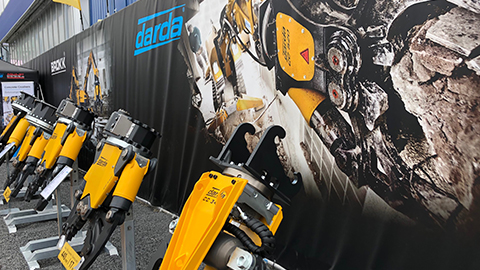
Concrete pulverizers from Darda GmbH enable pinpoint removal of concrete cover and the opening of anchorage zones without causing large-area damage. The low inherent vibration protects adjacent components and reduces the risk of uncontrolled cracking. In the deconstruction of post-tensioned slabs and beams, concrete pulverizers are used to expose ducts, make anchors accessible, and define separation joints before tendons are mechanically cut or relaxed.
Rock and concrete splitters for low-stress opening
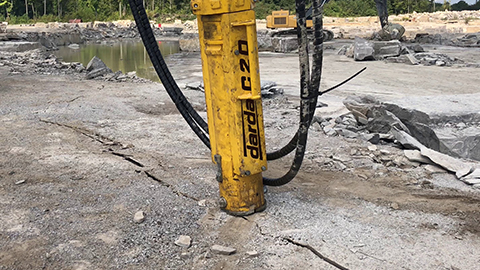
Rock and concrete splitters from Darda GmbH develop controlled splitting forces in a predrilled hole. This allows concrete areas to be opened with low vibration, tendon channels to be exposed, or components to be intentionally segmented. Especially in sensitive environments — such as building gutting in existing structures or in tunnel construction — the splitting technique reduces secondary damage and facilitates sequential separation of strands.
Hydraulic shears, multi cutters, and combination shears for tendons
Hydraulic shears, multi cutters, and combination shears are suitable for cutting strands, wires, and anchor bars. The controlled cutting sequence is crucial: short exposed lengths, shielding against snap-back, and stepwise cutting of individual wires. Hydraulic power units from Darda GmbH provide the required energy, even in confined situations or with extended hose packs for increased safety distance.
Specific challenges by structure type
Bridges, slab girders, and box girders
Bridges often contain bonded post-tensioning with complex deviators. The separation sequence must account for shear paths and redistributions. Opening edges and webs with concrete pulverizers enables access to anchors and deviator blocks before wire saw or separation cuts are performed. Splitters help create separation joints without impact energy.
Targeted separation of prestressed slabs
For monostrand slabs (parking structures, office buildings), low-risk exposure of strands is critical. A combination of core drilling, concrete pulverizers, and hydraulic shears allows short cutting lengths and controlled, successive relaxation. Low noise and dust emissions are a major advantage for gutting and cutting in occupied areas.
Repair, partial deconstruction, and repurposing
For strengthening or repurposing, openings are created, anchorage zones are repaired, or external tendons are replaced. Precise, localized openings with concrete pulverizers prevent excessive substance loss. Splitting technique improves the joint quality for subsequent concrete repair.
Planning, occupational safety, and organization
Working on prestressed members requires careful planning. The recognized rules of the art apply; specific requirements must be implemented project-specifically. Principles that have proven effective:
- Hazard analysis focusing on stored energy, snap-back, load redistributions, dust, and noise.
- Define the separation sequence: first secure and relieve, then expose, finally cut/split.
- Set up ATEX zone measures, shielding, and exclusion zones; prefer remote-controlled hydraulics.
- Provide tools that enable a finely metered approach: concrete pulverizers, splitters, suitable shears.
- Ongoing control: observe crack development, deflections, and support reactions, and adjust the sequence.
Quality assurance in post-tensioning and relevance for deconstruction
Even during construction, documentation and execution influence later deconstruction. Calibrated jacks, force/stroke control, complete grouting, and corrosion-safe anchors are not only important for service life but also for later locating and assessment during demolition. Grouting logs and tensioning logs support preparation for separation works and reduce uncertainties.
Documentation, locating, and probing
If no complete documentation is available, locating measures (e.g., ground-penetrating radar, potential measurements, probing) are indispensable. Small-scale opening with concrete pulverizers facilitates probing without unintentionally reducing reserve capacity. Splitters create targeted separation grooves for further investigations.
Relation to rock demolition and tunnel construction
Post-tensioning principles are also found in geotechnical engineering, for example in prestressed ground anchors and rock bolts. During deconstruction or modifications of adits, retaining walls, or anchor plates, tension members often have to be made accessible and separated. Rock and concrete splitters are helpful for exposing anchor heads. Hydraulic shears and multi cutters cut tie rods or strands in a controlled manner, while concrete pulverizers gently remove the surrounding concrete.
Selective deconstruction, resource conservation, and recycling
A structured, low-stress deconstruction of prestressed concrete increases the separation accuracy between concrete and steel. This favors recycling and reduces rework. Concrete pulverizers produce clean demolition edges, and splitters minimize overbreak. The combination leads to fewer secondary damages, less noise and dust — a plus in densely built-up areas and in special operations with high environmental requirements.